Thank you for visiting SNEWPapers!
Sign up free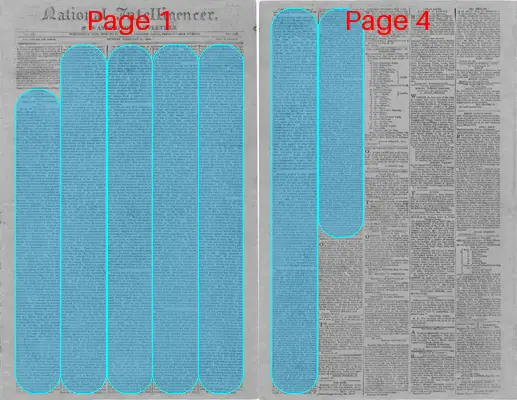
The National Intelligencer And Washington Advertiser
Washington, District Of Columbia
What is this article about?
On January 20, in the House of Representatives, Mr. G. W. Campbell responds to Mr. Quincy's accusations, defending the administration and majority against claims of deception in enacting the embargo and raising an army, accusing Quincy of malicious fabrications to aid British interests and influence elections in Massachusetts.
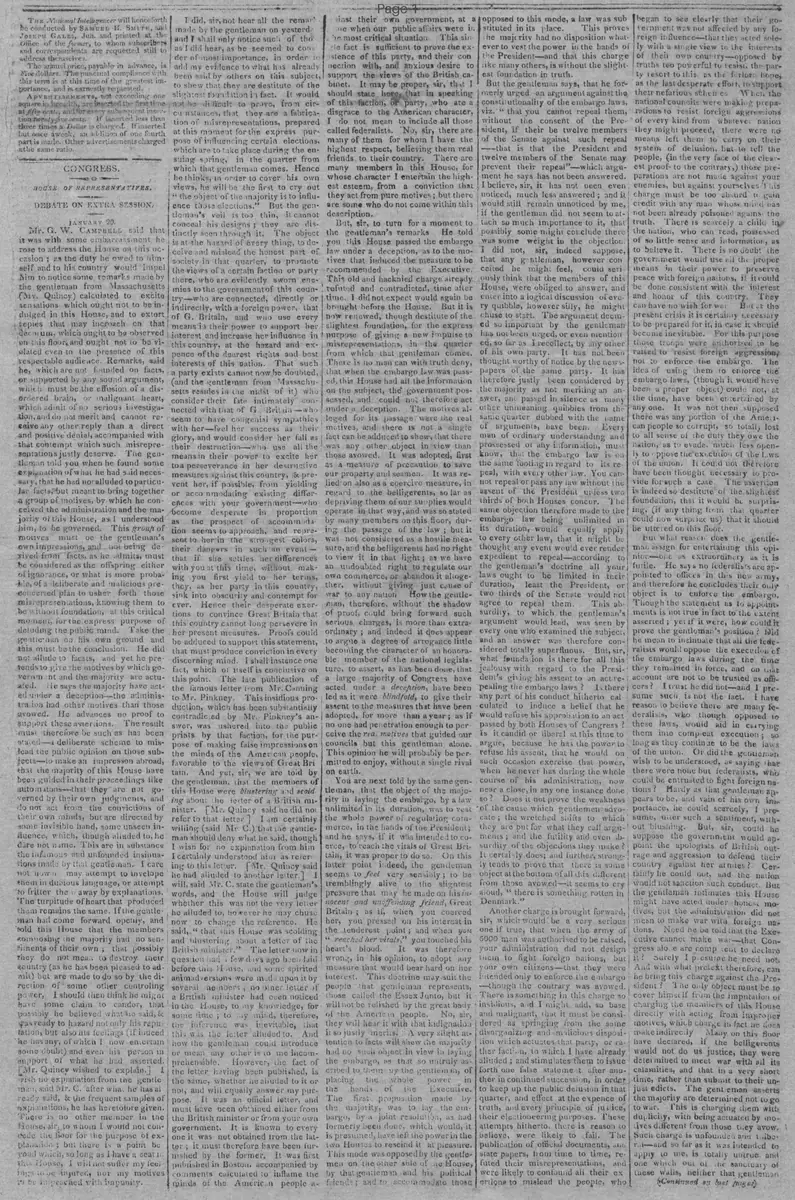
Merged-components note: This is the continuation of the January 20 congressional debate speech from page 1 to page 4, as indicated by 'Continued on last page' and '(Speech concluded from first page.)'.
Clippings
1 of 2
OCR Quality
Full Text
HOUSE OF REPRESENTATIVES.
DEBATE ON EXTRA SESSION.
JANUARY 20
Mr. G. W. Campbell said that it was with some embarrassment he rose to address the House on this occasion; as the duty he owed to himself and to his country would impel him to notice some remarks made by the gentleman from Massachusetts (Mr. Quincy) calculated to excite sensations which ought not to be indulged in this House, and to extort replies that may encroach on that decorum, which ought to be observed on this floor and ought not to be violated even in the presence of this respectable audience. Remarks, said he, which are not founded on facts, or supported by any sound argument, which must be the effusion of a disordered brain, or malignant heart, which admit of no serious investigation, and do not merit and cannot receive any other reply than a direct and positive denial, accompanied with that contempt which such misrepresentations justly deserve. The gentleman told you when he found some explanation of what he had said necessary, that he had not alluded to particular acts, but meant to bring together a group of motives, by which he conceived the administration and the majority of this House, as I understood him, to be governed. This group of motives must be the gentleman's own impressions, and not being derived from facts, as he admits, must be considered as the offspring either of ignorance, or what is more probable, of a deliberate and malicious preconcerted plan to usher forth those misrepresentations, knowing them to be without foundation, at this critical moment, for the express purpose of deluding the public mind. Take the gentleman on his own ground and this must be the conclusion. He did not allude to facts, and yet he pretends to give the motives by which government and the majority are actuated. He says the majority have acted under a deception—the administration had other motives than those avowed. He advances no proof to support these assertions. The result must therefore be such as has been stated—a deliberate scheme to mislead the public Opinion on those subjects—to make an impression abroad, that the majority of this House have been guided in their proceedings like automatons—that they are not governed by their own judgments, and do not act from the convictions of their own minds, but are directed by some invisible hand, some unseen influence, which, though alluded to, he dare not name. These are in substance the infamous and unfounded insinuations made by that gentleman. I care not how he may attempt to envelop them in dubious language, or attempt to fritter them away by explanations. The turpitude of heart that produced them remains the same. If the gentleman had come forward openly, and told this House that the members composing the majority had no sentiments of their own; that possibly they do not mean to destroy their country (as he has been pleased to admit) but are made to do so by the direction of some other controlling power, I should then think he might have some claim to candor, that possibly he believed what he said, & was ready to hazard not only his reputation, but also his feelings (if indeed he has any, of which I now entertain some doubt) and even his person in support of what he had asserted.
Mr. Quincy wished to explain.] I wish no explanation from the gentleman, said Mr. C. after what he has already said, & the frequent samples of explanations, he has heretofore given. There is no other member in the House, sir, to whom I would not concede the floor for the purpose of explanation; but there is a point beyond which, so long as I have a seat in that House, I will not suffer my feelings to be injured nor my motives to be impeached with impunity.
I did, sir, not hear all the remarks made by the gentleman on yesterday and I shall only notice such of those as I did hear, as he seemed to consider of most importance, in order to add my evidence to what has already been said by others on this subject, to shew that they are destitute of the slightest foundation in fact. It would not be difficult to prove, from circumstances, that they are a fabrication of misrepresentations, prepared at this moment for the express purpose of influencing certain elections, which are to take place during the ensuing spring, in the quarter from which that gentleman comes. Hence he thinks, in order to cover his own views, he will be the first to cry out 'the object of the majority is to influence those elections.' But the gentleman's veil is too thin, it cannot conceal his designs; they are distinctly seen through it. The object is at the hazard of every thing, to deceive and mislead the honest part of society in that quarter, to promote the views of a certain faction or party there, who are evidently sworn enemies to the government of this country—who are connected, directly or indirectly, with a foreign power, that of G. Britain, and who use every means in their power to support her interest and increase her influence in this country, at the hazard and expense of the dearest rights and best interests of this nation. That such a party exists cannot now be doubted, (and the gentleman from Massachusetts resides in the midst of it) who consider their fate intimately connected with that of G. Britain—who seem to have congenial sympathies with her—feel her success as their glory, and would consider her fall as their destruction—who use all the means in their power to excite her to a perseverance in her destructive measures against this country, & prevent her, if possible, from yielding or accommodating existing differences with your government—who become desperate in proportion as the prospect of accommodation seems to approach, and represent to her in the strongest colors, their dangers in such an event—that if she settles her differences with you at this time, without making you first yield to her terms, they, as her party in this country, sink into obscurity and contempt forever. Hence their desperate exertions to convince Great Britain that this country cannot long persevere in her present measures. Proofs could be adduced to support this statement, that must produce conviction in every discerning mind. I shall instance one fact, which of itself is conclusive on this point. The late publication of the famous letter from Mr. Canning to Mr. Pinkney. This insidious production, which has been substantially contradicted by Mr. Pinkney's answer, was ushered into the public prints by that faction, for the purpose of making false impressions on the minds of the American people, favorable to the views of Great Britain. And yet, sir, we are told by the gentleman, that the members of this House were blustering and scolding about the letter of a British minister. [Mr. Quincy said he did not refer to that letter] I am certainly willing (said Mr. C.) that the gentleman should deny what he said, though I wish for no explanation from him. I certainly understood him as referring to this letter. [Mr. Quincy said he had alluded to another letter.] I will, said Mr. C. state the gentleman's words, and the House will judge whether this was not the very letter he alluded to, however he may choose now to change the reference. He said, 'that this House was scolding and blustering about a letter of the British minister.' The letter now in question had a few days ago been laid before this House, and some spirited animadversions were made upon it by several members; no other letter of a British minister had been noticed in the House, to my knowledge, for some time; to my mind, therefore, the inference was inevitable, that this was the letter alluded to. And how the gentleman could introduce or mean any other is to me incomprehensible. However, the fact of the letter having been published, is the same, whether he alluded to it or not, and will equally answer my purpose. It was an official letter, and must have been obtained either from the British minister or from your own government. It is known to every one it was not obtained from the latter; it must therefore have been furnished by the former. It was first published in Boston, accompanied by comments calculated to inflame the minds of the American people against their own government, at a time when our public affairs were in the most critical situation. This single fact is sufficient to prove the existence of this party, and their connection with, and anxious desire to support the views of the British cabinet.
It may be proper, sir, that I should state here, that in speaking of this faction, or party, who are a disgrace to the American character, I do not mean to include all those called federalists. No, sir, there are many of them for whom I have the highest respect, believing them real friends to their country. There are many members in this House, for whose character I entertain the highest esteem, from a conviction that they act from pure motives; but there are some who do not come within this description.
But, sir, to turn for a moment to the gentleman's remarks. He told you this House passed the embargo law under a deception, as to the motives that induced the measure to be recommended by the Executive. This old and hackneyed charge already refuted and contradicted, time after time, I did not expect would again be brought before the House. But it is now renewed, though destitute of the slightest foundation, for the express purpose of giving a new impulse to misrepresentations, in the quarter from which that gentleman comes. There is no man can with truth deny, that when the embargo law was passed, this House had all the information on the subject, the government possessed, and could not therefore act under a deception. The motives alleged for its passage were the real motives, and there is not a single fact can be adduced to shew, that there was any other object in view than those avowed. It was adopted, first as a measure of precaution to save our property and seamen. It was relied on also as a coercive measure, in regard to the belligerents, so far as depriving them of our supplies would operate in that way, and was so stated by many members on this floor, during the passage of the law; but it was not considered as a hostile measure, and the belligerents had no right to view it in that light; as we have an undoubted right to regulate our own commerce, or abandon it altogether, without giving just cause of war to any nation. How the gentleman, therefore, without the shadow of proof, could bring forward such serious charges, is more than extraordinary; and indeed it does appear to argue a degree of arrogance little becoming the character of an honorable member of the national legislature, to assert, as has been done, that a large majority of Congress have acted under a deception, have been led as it were blindfold, to give their assent to the measures that have been adopted, for more than a year; as if no one had penetration enough to perceive the real motives that guided our councils but this gentleman alone. This opinion he will probably be permitted to enjoy, without a single rival on earth.
You are next told by the same gentleman, that the object of the majority in laying the embargo, by a law unlimited in its duration, was to vest the whole power of regulating commerce, in the hands of the President; and he says, if it was intended to coerce, to reach the vitals of Great Britain, it was proper to do so. On this latter point indeed, the gentleman seems to feel very sensibly; to be tremblingly alive to the slightest pressure that may be made on his innocent and unoffending friend, Great Britain; as if, when you coerced her, you pressed on his interest in the tenderest point; and when you 'reached her vitals,' you touched his heart's blood. It was therefore wrong, in his opinion, to adopt any measure that would bear hard on her interest. This doctrine may suit the people that gentleman represents, those called the Essex Junto, but it will not be relished by the great body of the American people. No, sir, they will hear it with that indignation it so justly merits. A very slight attention to facts will shew the majority had no such object in view in laying the embargo, as that so untruly ascribed to them by the gentleman, of placing the whole power in the hands of the Executive.
The first proposition made by the majority, was to lay the embargo, by a joint resolution, as had formerly been done, which would, it is presumed, have left the power in the two Houses to rescind it at pleasure. This mode was opposed by the gentlemen on the other side of the House, by that gentleman and his political friends; and to accommodate those opposed to this mode, a law was substituted in its place. This proves the majority had no disposition whatever to vest the power in the hands of the President—and that this charge like many others, is without the slightest foundation in truth.
But the gentleman says, that he formerly urged an argument against the constitutionality of the embargo laws, viz. 'that you cannot repeal them, without the consent of the President, if there be twelve members of the Senate against such repeal'—that is that the President and twelve members of the Senate may prevent their repeal'—which argument he says has not been answered. I believe, sir, it has not been even noticed, much less answered: and it would still remain unnoticed by me, if the gentleman did not seem to attach so much importance to it, that possibly some might conclude there was some weight in the objection. I did not, sir, indeed suppose, that any gentleman, however conceited he might feel, could seriously think that the members of this House, were obliged to answer, and enter into a logical discussion of every quibble, however silly, he might chuse to start. The argument deemed so important by the gentleman has not been urged, or even mentioned, so far as I recollect, by any other of his own party. It has not been thought worthy of notice by the newspapers of the same party. It has therefore justly been considered by the majority as not meriting an answer, and passed in silence as many other unmeaning quibbles from the same quarter dubbed with the name of arguments, have been. Every man of ordinary understanding and possessed of any information, must know, that the embargo law is on the same footing in regard to its repeal, with every other law. You cannot repeal or pass any law without the assent of the President unless two thirds of both Houses concur. The same objection therefore made to the embargo law being unlimited in its duration, would equally apply to every other law, that it might be thought any event would ever render expedient to repeal—according to the gentleman's doctrine all your laws ought to be limited in their duration, least the President, or twelve members of the Senate would not agree to repeal them. This absurdity, to which the gentleman's argument would lead, was seen by every one who examined the subject, and an answer was therefore considered totally superfluous. But, sir, what foundation is there for all this jealousy with regard to the President's giving his assent to an act repealing the embargo laws? Is there any part of his conduct hitherto calculated to induce a belief that he would refuse his approbation to an act passed by both Houses of Congress? Is it candid or liberal at this time to argue, because he has the power to refuse his assent, that he would on such occasion exercise that power, when he never has during the whole course of his administration, now near a close, in any one instance done so? Does it not prove the weakness of the cause which gentlemen advocate; the wretched shifts to which they are put for what they call arguments; and the futility and even absurdity of the objections they make? It certainly does; and further, strongly tends to prove that there is some object at the bottom of all this, different from those avowed—it seems to cry aloud, 'there is something rotten in Denmark.'
Another charge is brought forward, sir, which would be a very serious one if true, that when the army of 5000 men was authorised to be raised, your administration did not design them to fight foreign nations, but your own citizens—that they were intended only to enforce the embargo—though the contrary was avowed. There is something in this charge so insidious, and I might add, so base and malignant, that it must be considered as springing from the same disorganizing and malicious disposition which actuates that party, or rather faction, to which I have already alluded; and stimulates them to issue forth one false statement after another in continued succession, in order to keep up the public delusion in that quarter, and effect at the expense of truth, and every principle of justice, their electioneering purposes. These attempts hitherto, there is reason to believe, were likely to fail. The publication of official documents, and state papers, from time to time, refuted their misrepresentations, and were likely to confound all their exertions to mislead the people, who began to see clearly that their government was not affected by any foreign influence—that they acted solely with a single view to the interests of their own country—opposed by truths too powerful to resist, the party resort to this as the forlorn hope as the last desperate effort, to support their nefarious schemes. When the national councils were making preparations to resist foreign aggressions of every kind from whatever nation they might proceed, there were no means left them to carry on their system of delusion, but to tell the people, (in the very face of the clearest proof to the contrary,) those preparations are not made against your enemies, but against yourselves. This charge must be too absurd to gain credit with any man whose mind has not been already poisoned against the truth. There is scarcely a child in the nation, who can read, possessed of so little sense and information, as to believe it. There is no doubt the government would use all the proper means in their power to preserve peace with foreign nations, if it would be done consistent with the interest and honor of this country. They can have no wish for war. But of the present crisis it is certainly necessary to be prepared for it, in case it should become inevitable. For this purpose those troops were authorised to be raised to resist foreign aggression not to enforce the embargo. The idea of using them to enforce the embargo laws, (though it would have been a proper object) could not, at the time, have been entertained by any one. It was not then supposed there was any portion of the American people so corrupt, so totally lost to all sense of the duty they owe the nation, as to evade, much less openly oppose the execution of the laws of the union. It could not therefore have been thought necessary to provide for such a case. The assertion is indeed so destitute of the slightest foundation, that it would be surprising, (if any thing from that quarter could now surprise us) that it should be uttered on this floor.
But what reason does the gentleman assign for entertaining this opinion—one as extraordinary as it is futile. He says no federalists are appointed to offices in this new army, and therefore he concludes their only object is to enforce the embargo. Though the statement as to appointments is not true in fact to the extent asserted; yet if it were, how could it prove the gentleman's position? Did he mean to insinuate that all the federalists would oppose the execution of the embargo laws during the time they remained in force, and on that account are not to be trusted as officers? I trust he did not—and I presume such is not the fact. I have reason to believe there are many federalists, who though opposed to these laws, would aid in carrying them into complete execution; so long as they continue to be the laws of the union. Or did the gentleman wish to be understood, as saying that there were none but federalists, who could be entrusted to fight foreign nations? Hardly as that gentleman appears to be, and vain of his own importance, he could scarcely, I presume, utter such a sentiment, without blushing. But, sir, could he suppose the government would appoint the apologists of British outrage and aggression to defend their country against her armies? Certainly he could not, and the nation would not sanction such conduct. But the gentleman intimates this House might have acted under honest motives, but the administration did not mean to make war with foreign nations. Need he be told that the Executive cannot make war—that Congress alone are competent to declare it? Surely I presume he need not. And with what pretext therefore, can he bring this charge against the President? The only object must be to cover himself from the imputation of charging the members of this House directly with acting from improper motives, which charge in fact he does make indirectly. Many on this floor have declared, if the belligerents would not do us justice, they were determined to meet war with all its calamities, and that in a very short time, rather than submit to their unjust edicts. The gentleman asserts the majority are determined not to go to war. This is charging them with duplicity, with being actuated by motives different from those they avow. Such charge is unfounded and libelous—and so far as it was intended to apply to me, is totally untrue and one which out of the sanctuary of these walls, neither that gentleman (Continued on last page
(Speech concluded from first page.)
...for which its author, if rules of decorum were duly regarded, would justly merit and receive the decided and public censure of this House.
This course must & soon will be resorted to, and can alone prevent the necessity of resolving to remarks, which are disgusting in the highest degree to every one who hears them. It alone will prevent introducing on this floor, the language of Billingsgate, or the courtly style of the oyster bench, as has been done by the same gentleman. He observed, the language used by some gentlemen who answered him, resembled that of Billingsgate, and that he never sat down with fishermen or took degrees at an oyster bench. If he has not yet, sir, taken his degrees, I have no doubt, he soon will receive that honor, with universal consent for he certainly has been a very apt scholar. and must have made great proficiency in the acquisition of their sentiments. as well as their language. He has given proofs of it on this floor, exceeding any thing of the kind ever before produced in a respectable deliberative body. He said you could not kick the majority of this House into war! This language is too disgraceful to merit notice-in the manner it was applied, it is below the style of a common ale-house, and will fix a stain on the character of its author. which all the aspersions and hypocritical explanations to which he may resort cannot remove for years to come.
But, sir, we cannot help inquiring what has it this time produced all these unfounded charges? And we are impelled to conclude, they are the result of a preconcerted plan, as has been already noticed, to continue the delusion in the public opinion to the eastward, so as to influence the ensuing elections in that quarter. On their success in this effort rest all the hopes of the party. In the late elections, with the aid of intrigue and misrepresentations they succeeded beyond the general expectation, and far beyond their own. Since that time a number of the false statements which supported their cause have been completely refuted by the publication of official documents-they seem to consider their cause as likely to be desperate-they can no longer persuade the people, that the embargo was intended as a war measure-that your councils are guided by French influence- that you are willing to submit to all foreign aggressions, and that the embargo was to be permanent. All these absurd tales have had their round, and are now no longer believed by any man of sense. The last struggle, the forlorn hope now is, to persuade the people, you are not serious, you are not in earnest in your preparations to defend their rights and avenge their wrongs 'They hope by impressing on their minds this barefaced falsehood, to be able still to lead them in the paths of error-they tremble for the fate of their party—they perceive clearly that G.Britain is pressed severely by the embargo, and is likely to discover her error in giving credit to the false statements she received from them respecting the people of this country, and in all probability is on the very point of accommodating her differences with your government. In this they see a death blow to the existence of the party in this country, and they use every means in their power to prevent such event—Hence their unremitted exertions to excite domestic disturbances, insurrections and rebellion in the eastern states, with the hope thereby to commit the people decisively on their side of the question, and particularly to persuade G. Britain she has a strong party here on her side, and thereby induce her to persevere in her aggressions, and prevent her from doing justice to this country. With her they are willing to rise or fall, and they know should our differences, with foreign nations be adjusted without disgracing our country, they vanish forever as a party. Such means pursued to effect such objects will draw down on their authors the just indignation of the American people; charges so serious, and at the same time so groundless, made against the representatives of the nation at this important crisis, ought to be exposed and repelled by every member of the majority on this floor-and as one, I deem it my duty to pronounce them, in the face of this nation and of the world, so far as they were intended to apply to me, to be slanderous and malicious falsehoods.
What sub-type of article is it?
What themes does it cover?
What keywords are associated?
What entities or persons were involved?
Where did it happen?
Story Details
Key Persons
Location
House Of Representatives
Event Date
January 20
Story Details
Mr. G. W. Campbell delivers a speech defending the administration and congressional majority against Mr. Quincy's accusations of deception regarding the embargo law and army authorization, accusing Quincy of fabricating claims to influence elections and support British-aligned factions in Massachusetts.