Thank you for visiting SNEWPapers!
Sign up free
National Gazette
Philadelphia, Philadelphia County, Pennsylvania
What is this article about?
In a previously unpublished speech on April 30, Mr. Moore defends the excise law's execution in Virginia but urges amendments for equitable taxation, arguing it unfairly burdens domestic grain distillers compared to those using imported molasses, especially for western defense costs. (248 characters)
Clipping
OCR Quality
Full Text
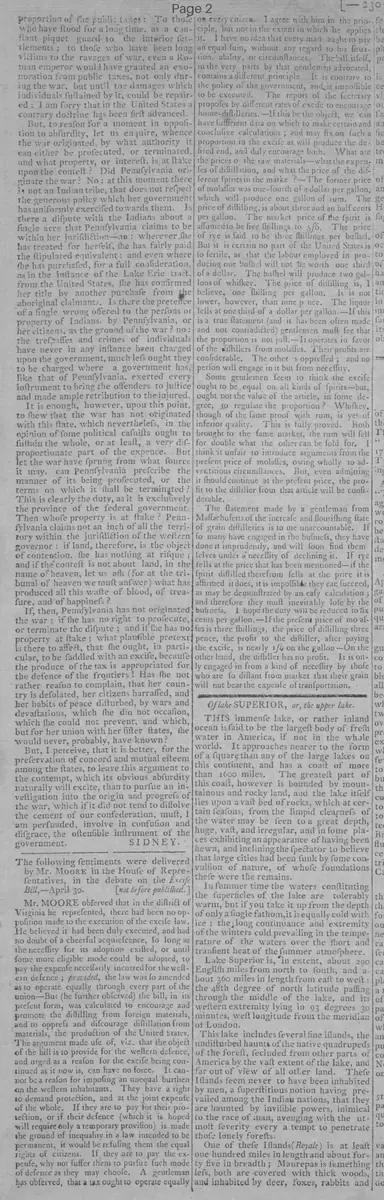
by Mr. Moore in the House of Representatives, in the debate on the Excise
Bill,—April 30.
[not before published.]
Mr. MOORE observed that in the district of
Virginia he represented, there had been no opposition made to the execution of the excise law.
He believed it had been duly executed, and had
no doubt of a cheerful acquiescence, so long as
the necessity for its adoption existed, or until
some more eligible mode could be adopted, to
pay the expense necessarily incurred for the western defence ; provided, the law was so amended
as to operate equally through every part of the
union—But (he further observed) the bill, in its
present form, was calculated to encourage and
promote the distilling from foreign materials,
and to oppress and discourage distillation from
materials, the production of the United States.
The argument made use of, viz. that the object
of the bill is to provide for the western defence,
and urged as a reason for the excise being continued as it now is, can have no force. It cannot
be a reason for imposing an unequal burthen
on the western inhabitants. They have a right
to demand protection, and at the joint expense
of the whole. If they are to pay for their protection, or if their defence (which it is hoped
will require only a temporary provision)is made
the ground of inequality in a law intended to be
permanent, it would be refusing them the equal
rights of citizens. If they are to pay the ex-
expense, why not suffer them to pursue such mode
of defence as they may choose. A gentleman
has observed, that a tax ought to operate equally
on every citizen. I agree with him in the principle, but not in the extent in which he applies
it. I have no idea that every man ought to pay
an equal sum, without any regard to his situation, ability, or circumstances. The bill itself,
in the very parts by that gentleman advocated,
contains a different principle It is contrary to
the policy of the government, and is impossible
to be executed. The report of the secretary
proposes by different rates of excise to encourage
home-distilleries. —If this be the object, we can
have sufficient data on which to make certain and
conclusive calculations ; and may fix on such a
proportion in the excise as will produce the desired end, and duly encourage both. What are
the prices of the raw materials—what the expenses of distillation, and what the price of the different spirits in the market ?—The former price
of molasses was one-fourth of a dollar per gallon,
which will produce one gallon of rum. The
price of distilling, is about three and an half cents
per gallon. The market price of the spirit is
assumed to be five shillings to 5s. 6d. The price
of rye is said to be three shillings per bushel.
But it is certain no part of the United States is
so fertile, as that the labour employed in producing one bushel will not be worth one third
of a dollar. The bushel will produce two gallons of whiskey. The price of distilling is, I
believe, one shilling per gallon. It is not
lower, however, than nine pence. The liquor
sells at one third of a dollar per gallon.—If this
is a true statement (and it has been often made
and not contradicted) gentlemen must see that
the proportion is not just.—It operates in favor
of the distillers from molasses. Their profits are
considerable. The others are oppressed ; and no
person will engage in it but from necessity.
Some gentlemen seem to think the excise
ought to be equal on all kinds of spirits—but,
ought not the value of the article, in some degree, to regulate the proportion ? Whiskey,
though of the same proof with rum, is yet of
inferior quality. This is fully proved. Both
brought to the same market, the rum will sell
for double what the other can be sold for. I
think it unfair to introduce arguments from the
present price of molasses, owing wholly to adventitious circumstances. But, even admitting
it should continue at the present price, the profit to the distiller from that article will be considerable.
The statement made by a gentleman from
Massachusetts of the increase and flourishing state
of grain distilleries is to me unaccountable. If
so many have engaged in the business, they have
done it imprudently, and will soon find themselves under a necessity of declining it. If rye
sells at the price that has been mentioned—if the
spirit distilled therefrom sells at the price it is
affirmed it does, it is impossible they can succeed,
as may be demonstrated by an easy calculation ;
and therefore they must inevitably lose by the
business. I hope the duty will be reduced to six
cents per gallon.—If the present price of molasses is three shillings, the price of distilling three
pence, the profit to the distiller, after paying
the excise, is nearly 1s. on the gallon—On the
other hand, the distiller has no profit. It is only engaged in from a kind of necessity by those
who are so distant from market that their grain
will not bear the expense of transportation.
What sub-type of article is it?
What themes does it cover?
What keywords are associated?
What entities or persons were involved?
Where did it happen?
Story Details
Key Persons
Location
House Of Representatives
Event Date
April 30
Story Details
Mr. Moore argues in the House that the excise law has been accepted in his Virginia district but needs amendment for equal operation across the union, criticizing the bill for favoring distillation from foreign molasses over domestic grains, which oppresses western inhabitants and contradicts fair taxation principles for national defense.