Thank you for visiting SNEWPapers!
Sign up free
Story
July 11, 1896
The Weekly Intelligencer
Lexington, Lafayette County, Missouri
What is this article about?
Historical account of Fast Day custom in New England, from Puritan origins for prayer and fasting to its modern decline into a secular holiday, with minimal observance; Massachusetts abolished it years ago.
Clipping
OCR Quality
98%
Excellent
Full Text
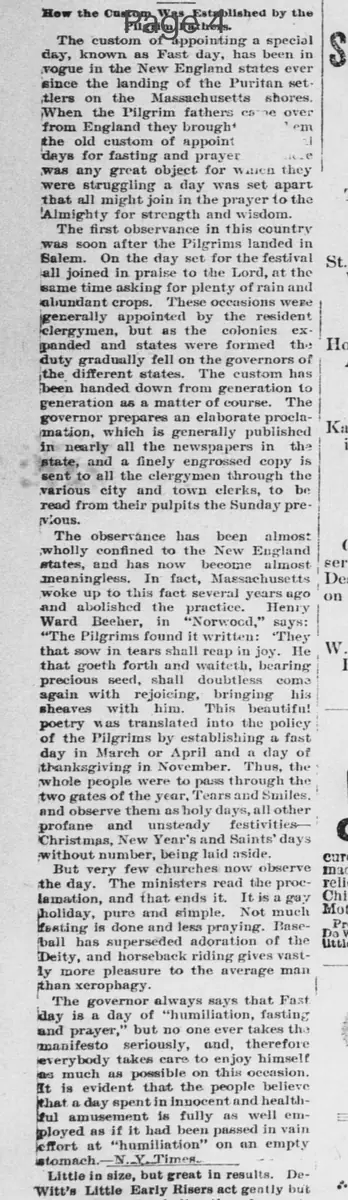
The custom of appointing a special day, known as Fast day, has been in vogue in the New England states ever since the landing of the Puritan settlers on the Massachusetts shores. When the Pilgrim fathers came over from England they brought with them the old custom of appointing days for fasting and prayer whenever there was any great object for which they were struggling a day was set apart that all might join in the prayer to the Almighty for strength and wisdom. The first observance in this country was soon after the Pilgrims landed in Salem. On the day set for the festival all joined in praise to the Lord, at the same time asking for plenty of rain and abundant crops. These occasions were generally appointed by the resident clergymen, but as the colonies expanded and states were formed the duty gradually fell on the governors of the different states. The custom has been handed down from generation to generation as a matter of course. The governor prepares an elaborate proclamation, which is generally published in nearly all the newspapers in the state, and a finely engrossed copy is sent to all the clergymen through the various city and town clerks, to be read from their pulpits the Sunday previous. The observance has been almost wholly confined to the New England states, and has now become almost meaningless. In fact, Massachusetts woke up to this fact several years ago and abolished the practice. Henry Ward Beecher, in "Norwood," says: "The Pilgrims found it written: They that sow in tears shall reap in joy. He that goeth forth and weepeth, bearing precious seed, shall doubtless come again with rejoicing, bringing his sheaves with him. This beautiful poetry was translated into the policy of the Pilgrims by establishing a fast day in March or April and a day of thanksgiving in November. Thus, the whole people were to pass through the two gates of the year. Tears and Smiles, and observe them as holy days, all other profane and unsteady festivities Christmas, New Year's and Saints' days without number, being laid aside. But very few churches now observe the day. The ministers read the proclamation, and that ends it. It is a gay holiday, pure and simple. Not much fasting is done and less praying. Base-ball has superseded adoration of the Deity, and horseback riding gives vastly more pleasure to the average man than xerophagy. The governor always says that Fast day is a day of "humiliation, fasting and prayer," but no one ever takes the manifesto seriously, and, therefore, everybody takes care to enjoy himself as much as possible on this occasion. It is evident that the people believe that a day spent in innocent and healthful amusement is fully as well employed as if it had been passed in vain effort at "humiliation" on an empty stomach.-N.Y. Times.
What sub-type of article is it?
Historical Event
Curiosity
What themes does it cover?
Providence Divine
Social Manners
What keywords are associated?
Fast Day
Puritan Custom
New England
Fasting Prayer
Religious Observance
Governor Proclamation
What entities or persons were involved?
Pilgrim Fathers
Henry Ward Beecher
Where did it happen?
New England States
Story Details
Key Persons
Pilgrim Fathers
Henry Ward Beecher
Location
New England States
Event Date
Ever Since The Landing Of The Puritan Settlers
Story Details
The custom of Fast Day originated with Puritan settlers in New England for fasting and prayer during struggles; first observed in Salem after landing; evolved to be proclaimed by governors but has become a secular holiday with little religious observance, abolished in Massachusetts.