Thank you for visiting SNEWPapers!
Sign up free
Editorial
February 9, 1813
The New Hampshire Gazette
Portsmouth, Rockingham County, New Hampshire
What is this article about?
An 1813 editorial in Portsmouth supports a Congressional bill prohibiting British seamen on US vessels, arguing it eliminates Britain's pretext for searching and impressing American ships' crews, and condemns pro-British advocates for opposing it.
Clipping
OCR Quality
95%
Excellent
Full Text
PORTSMOUTH
TUESDAY, FEBRUARY 9, 1813
For action or Quandary.
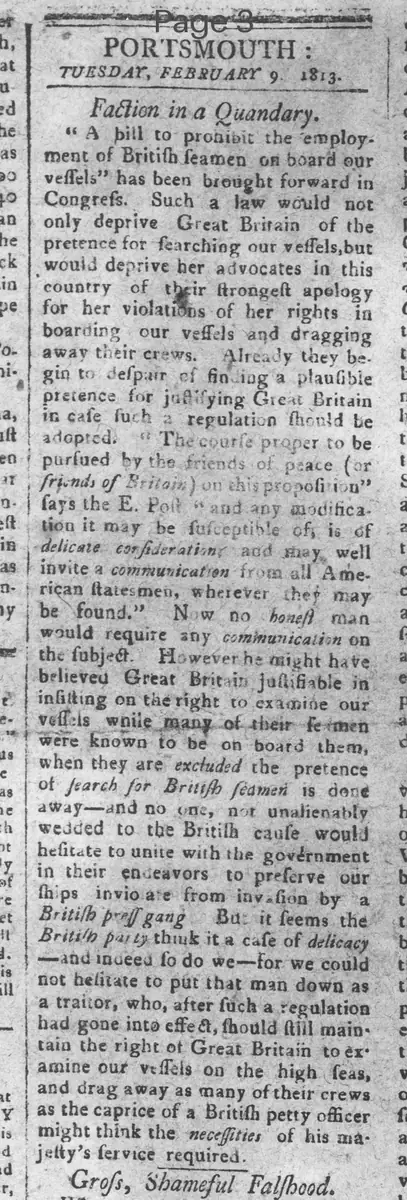
"A bill to prohibit the employment of British seamen on board our vessels" has been brought forward in Congress. Such a law would not only deprive Great Britain of the pretence for searching our vessels, but would deprive her advocates in this country of their strongest apology for her violations of our rights in boarding our vessels and dragging away their crews. Already they begin to despair of finding a plausible pretence for justifying Great Britain in case such a regulation should be adopted. "The course proper to be pursued by the friends of peace (or friends of Britain) on this proposition" says the E. Post "and any modification it may be susceptible of, is of delicate consideration; and may well invite a communication from all American statesmen, wherever they may be found." Now no honest man would require any communication on the subject. However he might have believed Great Britain justifiable in insisting on the right to examine our vessels while many of their seamen were known to be on board them, when they are excluded the pretence of search for British seamen is done away and no one, not unalienably wedded to the British cause would hesitate to unite with the government in their endeavors to preserve our ships inviolate from invasion by a British press gang. But it seems the British party think it a case of delicacy -and indeed so do we-for we could not hesitate to put that man down as a traitor, who, after such a regulation had gone into effect, should still maintain the right of Great Britain to examine our vessels on the high seas, and drag away as many of their crews as the caprice of a British petty officer might think the necessities of his majesty's service required.
TUESDAY, FEBRUARY 9, 1813
For action or Quandary.
"A bill to prohibit the employment of British seamen on board our vessels" has been brought forward in Congress. Such a law would not only deprive Great Britain of the pretence for searching our vessels, but would deprive her advocates in this country of their strongest apology for her violations of our rights in boarding our vessels and dragging away their crews. Already they begin to despair of finding a plausible pretence for justifying Great Britain in case such a regulation should be adopted. "The course proper to be pursued by the friends of peace (or friends of Britain) on this proposition" says the E. Post "and any modification it may be susceptible of, is of delicate consideration; and may well invite a communication from all American statesmen, wherever they may be found." Now no honest man would require any communication on the subject. However he might have believed Great Britain justifiable in insisting on the right to examine our vessels while many of their seamen were known to be on board them, when they are excluded the pretence of search for British seamen is done away and no one, not unalienably wedded to the British cause would hesitate to unite with the government in their endeavors to preserve our ships inviolate from invasion by a British press gang. But it seems the British party think it a case of delicacy -and indeed so do we-for we could not hesitate to put that man down as a traitor, who, after such a regulation had gone into effect, should still maintain the right of Great Britain to examine our vessels on the high seas, and drag away as many of their crews as the caprice of a British petty officer might think the necessities of his majesty's service required.
What sub-type of article is it?
Foreign Affairs
Partisan Politics
What keywords are associated?
British Seamen
Impressment
Congress Bill
Searching Vessels
British Advocates
What entities or persons were involved?
Congress
Great Britain
British Party
E. Post
Editorial Details
Primary Topic
Support For Bill Prohibiting British Seamen On Us Vessels
Stance / Tone
Strongly Supportive Of The Bill And Critical Of Pro British Advocates
Key Figures
Congress
Great Britain
British Party
E. Post
Key Arguments
Bill Deprives Great Britain Of Pretext For Searching Us Vessels
Removes Strongest Apology For Britain's Violations Of Us Rights
Pro British Advocates Despair Of Justifying Impressment
Honest Men Would Unite With Government To Protect Ships
Opposing The Bill After Passage Marks One As A Traitor