Thank you for visiting SNEWPapers!
Sign up free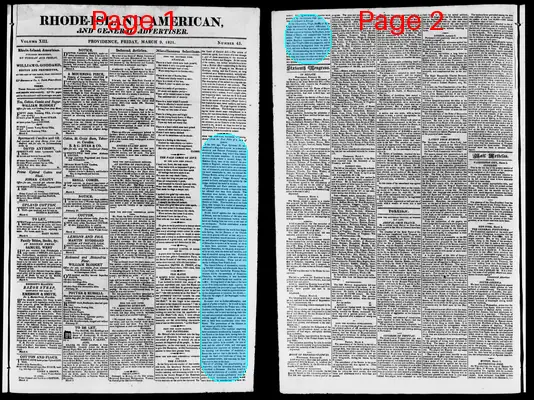
The Rhode Island American, And General Advertiser
Providence, Providence County, Rhode Island
What is this article about?
An extract from the Port Folio discussing historical superstitions and misconceptions, including witchcraft trials by Sir Matthew Hale, ancient views on souls in plants, parallels between Deucalion's flood and Noah's, the founding of Alexandria's library and Septuagint origin, ancient philosophers like Zoroaster, Enoch's pillars, and attributions of inventions like printing to Germans and Chinese.
Merged-components note: Continuation of historical and literary extracts from the Port Folio; relabel from filler to literary as it fits essays and miscellany.
Clippings
1 of 2
OCR Quality
Full Text
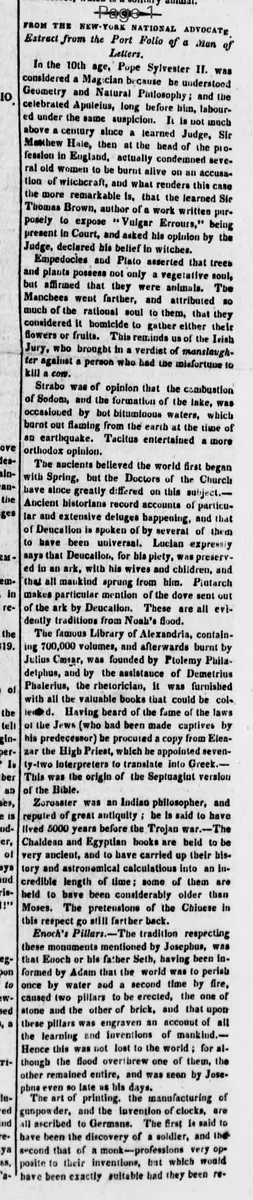
Extract from the Port Folio of a Man
of
Letters.
In the 10th age, Pope Sylvester II. was
considered a Magician because he understood
Geometry and Natural Philosophy; and the
celebrated Apuleius, long before him, laboured
under the same suspicion. It is not much
above a century since a learned Judge, Sir
Matthew Hale, then at the head of the profession
in England, actually condemned several
old women to be burnt alive on an accusation
of witchcraft, and what renders this case
the more remarkable is, that the learned Sir
Thomas Brown, author of a work written purposely
to expose "Vulgar Errours," being
present in Court, and asked his opinion by the
Judge, declared his belief in witches.
Empedocles and Plato asserted that trees
and plants possess not only a vegetative soul,
but affirmed that they were animals. The
Manchees went farther, and attributed so
much of their rational soul to them, that they
considered it homicide to gather either their
flowers or fruits. This reminds us of the Irish
Jury, who brought in a verdict of manslaughter
against a person who had the misfortune to
kill a corn.
Strabo was of opinion that the combustion
of Sodom, and the formation of the lake, was
occasioned by hot bituminous waters, which
burnt out flaming from the earth at the time of
an earthquake. Tacitus entertained a more
orthodox opinion.
The ancients believed the world first began
with Spring, but the Doctors of the Church
have since greatly differed on this subject.--
Ancient historians record accounts of particular
and extensive deluges happening, and that
of Deucalion is spoken of by several of them
to have been universal. Lucian expressly
says that Deucalion, for his piety, was preserved
in an ark, with his wife and children, and
that all mankind sprung from him. Plutarch
makes particular mention of the dove sent out
of the ark by Deucalion. These are all evidently
traditions from Noah's flood.
The famous Library of Alexandria, containing
700,000 volumes, and afterwards burnt by
Julius Caesar, was founded by Ptolemy Philadelphus,
and by the assistance of Demetrius
Phalerius, the rhetorician, it was furnished
with all the valuable books that could be collected.
Having heard of the fame of the laws
of the Jews (who had been made captives by
his predecessor) he procured a copy from Eleazar
the High Priest, which he appointed seventy-two
interpreters to translate into Greek.-
This was the origin of the Septuagint version
of the Bible.
Zoroaster was an Indian philosopher, and
reputed of great antiquity; he is said to have
lived 5000 years before the Trojan war.--The
Chaldean and Egyptian books are held to be
very ancient, and to have carried up their history
and astronomical calculations into an incredible
length of time; some of them are
held to have been considerably older than
Moses. The pretensions of the Chinese in
this respect go still farther back,
Enoch's Pillars.-The tradition respecting
these monuments mentioned by Josephus, was
that Enoch or his father Seth, having been informed
by Adam that the world was to perish
once by water and a second time by fire,
caused two pillars to be erected, the one of
stone and the other of brick, and that upon
these pillars was engraven an account of all
the learning and inventions of mankind.-
Hence this was not lost to the world: for although
the flood overthrew one of them, the
other remained entire, and was seen by Josephus
even so late as his days.
The art of printing, the manufacturing of
gunpowder, and the invention of clocks, are
all ascribed to Germans. The first is said to
have been the discovery of a soldier, and the
second that of a monk--professions very opposite
to their inventions, but which would
have been exactly suitable had they been reverse.
Printing and making gunpowder were practised by the Chinese 1500 years before they were known in Europe.
In the 7th century, Virgil, Bishop of Saltzburg, was involved in great difficulties, because he avowed his belief in the antipodes. He was treated as impious, by Boniface, Archbishop of Mentz, who censured him from the pulpit. Virgil complained to the Pope, on which Boniface represented him in such a light, that Virgil's faith was suspected, and he was ordered to be degraded from the priesthood, and sent to Rome to answer for his conduct. Notwithstanding the infallibility of the Pope, no one runs any risk in these days for believing that there are other men below us, or that there is another world, or another planetary system.
What sub-type of article is it?
What themes does it cover?
What keywords are associated?
Literary Details
Title
Extract From The Port Folio Of A Man Of Letters
Form / Style
Prose Reflections On Historical Misconceptions
Key Lines