Thank you for visiting SNEWPapers!
Sign up free
Letter to Editor
September 28, 1770
The New Hampshire Gazette And Historical Chronicle
Portsmouth, Greenland, Rockingham County, New Hampshire
What is this article about?
An observer in Cambridge reports the discovery of a comet on June 26, 1770, its rapid path across the northern hemisphere, calculated orbital elements including perihelion on August 8, and notable features: no tail and exceptional swiftness exceeding the 1472 comet.
Clipping
OCR Quality
95%
Excellent
Full Text
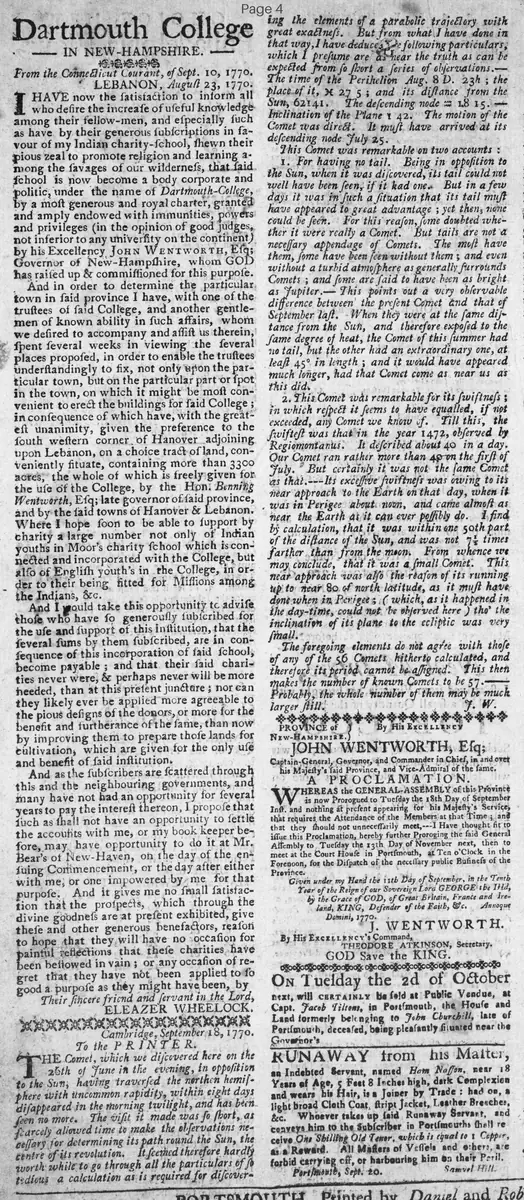
Cambridge, September 18, 1770.
To the PRINTER.
The Comet, which we discovered here on the
26th of June in the evening, in opposition
to the Sun, having traversed the northern hemisphere with uncommon rapidity, within eight days
disappeared in the morning twilight, and has been
seen no more. The visit it made was so short, as
scarcely allowed time to make the observations necessary for determining its path round the Sun, the
worth while to go through all the particulars of so
tedious a calculation as is required for discovering the elements of a parabolic trajectory with
great exactness. But from what I have done in
that way, I have deduced the following particulars,
which I presume are as near the truth as can be
expected from so short a series of observations.––
The time of the Perihelion Aug. 8 D. 23h ; the
place of it, ♈ 25° 5' ; and its distance from the
Sun, 0.2141. The descending node ♈ 18° 15'. –*
Inclination of the Plane 1° 42'. The motion of the
Comet was direct: It must have arrived at its
descending node July 25.
This Comet was remarkable on two accounts :
I. For having no tail. Being in opposition to
the Sun, when it was discovered, its tail could not
well have been seen. if it had one. But in a few
days it was in such a situation that its tail must
have appeared to great advantage ; yet then, none
could be seen. : For this reason. some doubted whether it were really a Comet. But tails are not a
necessary appendage of Comets. The most have
them, some have been seen without them ; and even
without a turbid atmosphere as generally surrounds
Comets ; and some are said to have been as bright
as Jupiter.–– This points out a very observable
difference between' the present Comet and that of
September last. -When they were at the same distance from the Sun, and therefore exposed to the
same degree of heat, the Comet of this summer had
no tail, but the other had an extraordinary one, at
least 45° in length ; and it would have appeared
much longer, had that Comet come as near us as
this did.
2. This Comet was remarkable for its swiftness :
in which respect it seems to have equalled. if not
exceeded, any Comet we know of. Till this. the
swiftest was that in the year 1472, observed by
Regiomontanus. It described about 40° in a day.
Our Comet ran rather more than 40° on the first of
July. But certainly it was not the same Comet
as that.---Its excessive swiftness was owing to its
near approach to the Earth on that day. when it
was in Perigee about noon, and came almost as
near the Earth as it can ever possibly do. I find
by calculation, that it was within one 20th part
of the distance of the Sun, and was not 11 times
farther than from the moon. From whence we
may conclude, that it was a small Comet. This
near approach was also the reason of its running
up to near 80° of north latitude, as it must have
done when in Perigee ; ( in which, as it happened in
the day-time, could not be observed here ) tho' the
inclination of its plane to the ecliptic was very
small.
The foregoing elements do not agree with those
of any of the 56 Comets hitherto calculated, and
therefore its period cannot be assigned. This then
makes the number of known Comets to be 57.–– :
Probably, the whole number of them may be much
larger still.
To the PRINTER.
The Comet, which we discovered here on the
26th of June in the evening, in opposition
to the Sun, having traversed the northern hemisphere with uncommon rapidity, within eight days
disappeared in the morning twilight, and has been
seen no more. The visit it made was so short, as
scarcely allowed time to make the observations necessary for determining its path round the Sun, the
worth while to go through all the particulars of so
tedious a calculation as is required for discovering the elements of a parabolic trajectory with
great exactness. But from what I have done in
that way, I have deduced the following particulars,
which I presume are as near the truth as can be
expected from so short a series of observations.––
The time of the Perihelion Aug. 8 D. 23h ; the
place of it, ♈ 25° 5' ; and its distance from the
Sun, 0.2141. The descending node ♈ 18° 15'. –*
Inclination of the Plane 1° 42'. The motion of the
Comet was direct: It must have arrived at its
descending node July 25.
This Comet was remarkable on two accounts :
I. For having no tail. Being in opposition to
the Sun, when it was discovered, its tail could not
well have been seen. if it had one. But in a few
days it was in such a situation that its tail must
have appeared to great advantage ; yet then, none
could be seen. : For this reason. some doubted whether it were really a Comet. But tails are not a
necessary appendage of Comets. The most have
them, some have been seen without them ; and even
without a turbid atmosphere as generally surrounds
Comets ; and some are said to have been as bright
as Jupiter.–– This points out a very observable
difference between' the present Comet and that of
September last. -When they were at the same distance from the Sun, and therefore exposed to the
same degree of heat, the Comet of this summer had
no tail, but the other had an extraordinary one, at
least 45° in length ; and it would have appeared
much longer, had that Comet come as near us as
this did.
2. This Comet was remarkable for its swiftness :
in which respect it seems to have equalled. if not
exceeded, any Comet we know of. Till this. the
swiftest was that in the year 1472, observed by
Regiomontanus. It described about 40° in a day.
Our Comet ran rather more than 40° on the first of
July. But certainly it was not the same Comet
as that.---Its excessive swiftness was owing to its
near approach to the Earth on that day. when it
was in Perigee about noon, and came almost as
near the Earth as it can ever possibly do. I find
by calculation, that it was within one 20th part
of the distance of the Sun, and was not 11 times
farther than from the moon. From whence we
may conclude, that it was a small Comet. This
near approach was also the reason of its running
up to near 80° of north latitude, as it must have
done when in Perigee ; ( in which, as it happened in
the day-time, could not be observed here ) tho' the
inclination of its plane to the ecliptic was very
small.
The foregoing elements do not agree with those
of any of the 56 Comets hitherto calculated, and
therefore its period cannot be assigned. This then
makes the number of known Comets to be 57.–– :
Probably, the whole number of them may be much
larger still.
What sub-type of article is it?
Informative
What themes does it cover?
Science Nature
What keywords are associated?
Comet Observation
Astronomy
Perihelion
Orbital Elements
Comet Swiftness
No Tail
Regiomontanus
Parabolic Trajectory
What entities or persons were involved?
To The Printer.
Letter to Editor Details
Recipient
To The Printer.
Main Argument
reports the observation and calculation of a comet's path discovered june 26, 1770, highlighting its short visibility, lack of tail, exceptional swiftness, and orbital elements, distinguishing it from prior comets.
Notable Details
Perihelion: Aug. 8 D. 23h, ♈ 25° 5', Distance 0.2141
Descending Node: ♈ 18° 15'
Inclination: 1° 42'
Direct Motion, Node Arrival July 25
No Tail Despite Favorable Conditions
Swiftness Exceeding 1472 Comet By Regiomontanus
Near Approach To Earth In Perigee July 1
Small Comet, 57th Known Comet