Thank you for visiting SNEWPapers!
Sign up free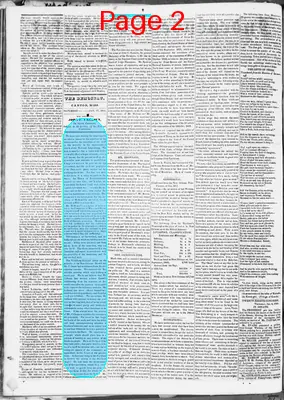
Editorial
January 27, 1844
Independent Democrat
Canton, Madison County, Mississippi
What is this article about?
Editorial discusses rejection of tariff reduction resolutions in Congress, argues for lower duties to increase revenue while aligning with Democratic principles, and defends John C. Calhoun against withdrawal rumors from presidential race, praising his advocacy for Southern interests and free trade.
Clipping
OCR Quality
98%
Excellent
Full Text
JOHN C. CALHOUN,
Of SOUTH CAROLINA.
Subject to the decision of the National Convention.
We have been waiting for some time to see what is meant by the rejection of the resolutions for the reduction of the tariff by the majority in the representative branch of the National Legislature.
We think it manifest that a lower rate of duties would afford a larger revenue, as it is well known that the present tariff on many articles now amounts to prohibition.
A large revenue can be provided for the government, and the professed principles of the Democratic party carried out by modifying the duties. Nor does it matter that there is a Whig majority in the Senate; the House of Representatives should do its own duty; and besides, we do not think the Senate could well refuse to pass a bill which would increase the revenue, and at the same time render the taxes less burdensome to the country. The excuse which the Globe gives for the rejection of McDowell's resolution, we do not think sufficient, it says this:
"Mr. McDowell's resolution of instruction to the Committee of Ways and Means to report a tariff bill discriminating with a view to revenue alone, was negatived, for the same reason that induced the majority to reject a similar resolution offered by Mr. Black of Georgia, yesterday. Many, who have full confidence that the committee will be guided by the principle couched in the instruction, were not inclined to give a vote which might be construed to imply a distrust which they did not indulge."
This reason is too far-fetched, and refined, and one on which we believe men never act. If they were sincerely and bona fide in favor of the reduction, why not vote for it? The Globe intimates that the Committee will report in accordance with the principles of the resolution, and for that we shall wait.
The Vicksburg Sentinel states on the authority of the New Orleans Herald that Mr. Calhoun had withdrawn from the presidential canvass.
We received the Herald this morning which says nothing on the subject. We do not believe that Mr. Calhoun has written a letter formally withdrawing from the canvass, as that would contradict the position he occupied in his letter to the Indiana Committee. Mr. Calhoun has never offered himself as a candidate for the presidency, and therefore could not withdraw. We are certain Mr. Calhoun will continue to occupy the position he has long held, that of being greatly superior in moral purity and intellectual endowments to any other statesman in the Union. It has always been the practice of Mr. Calhoun to sacrifice his interests to his principles. For years he has fought the battle of the south, and been the ablest and most uncompromising advocate of Southern interests; and so we expect him to continue whenever he is in a position to do service to the State. He entertains no principle which should place him in a position of hostility to any portion of the Southern people. He is at the head of the free trade party; that party which is in favor of a tariff for revenue only, and for allowing all classes of the community an equal share in the favors of the government. Is there anything in this for which he deserves the enmity of the Southern people? He has been the ablest champion of that institution which they sensitively wish to guard from invasion. Is there anything in this for which he deserves denunciation from the South? Mr. Calhoun should have been more pliant and compromising on this point if he wished to conciliate the other portions of the Union. His course on these two subjects should entitle him to the respect and confidence of this portion of the United States; and we are happy to say that such is the case, with the exception of a few, whose besotted idolatry for Mr. Clay, or native brainless idiocy will ever prevent them from doing justice to a high minded and honest adversary.
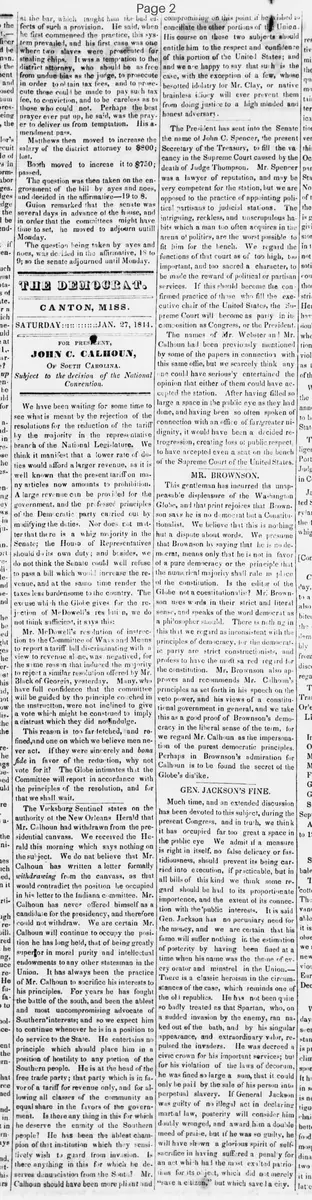
Of SOUTH CAROLINA.
Subject to the decision of the National Convention.
We have been waiting for some time to see what is meant by the rejection of the resolutions for the reduction of the tariff by the majority in the representative branch of the National Legislature.
We think it manifest that a lower rate of duties would afford a larger revenue, as it is well known that the present tariff on many articles now amounts to prohibition.
A large revenue can be provided for the government, and the professed principles of the Democratic party carried out by modifying the duties. Nor does it matter that there is a Whig majority in the Senate; the House of Representatives should do its own duty; and besides, we do not think the Senate could well refuse to pass a bill which would increase the revenue, and at the same time render the taxes less burdensome to the country. The excuse which the Globe gives for the rejection of McDowell's resolution, we do not think sufficient, it says this:
"Mr. McDowell's resolution of instruction to the Committee of Ways and Means to report a tariff bill discriminating with a view to revenue alone, was negatived, for the same reason that induced the majority to reject a similar resolution offered by Mr. Black of Georgia, yesterday. Many, who have full confidence that the committee will be guided by the principle couched in the instruction, were not inclined to give a vote which might be construed to imply a distrust which they did not indulge."
This reason is too far-fetched, and refined, and one on which we believe men never act. If they were sincerely and bona fide in favor of the reduction, why not vote for it? The Globe intimates that the Committee will report in accordance with the principles of the resolution, and for that we shall wait.
The Vicksburg Sentinel states on the authority of the New Orleans Herald that Mr. Calhoun had withdrawn from the presidential canvass.
We received the Herald this morning which says nothing on the subject. We do not believe that Mr. Calhoun has written a letter formally withdrawing from the canvass, as that would contradict the position he occupied in his letter to the Indiana Committee. Mr. Calhoun has never offered himself as a candidate for the presidency, and therefore could not withdraw. We are certain Mr. Calhoun will continue to occupy the position he has long held, that of being greatly superior in moral purity and intellectual endowments to any other statesman in the Union. It has always been the practice of Mr. Calhoun to sacrifice his interests to his principles. For years he has fought the battle of the south, and been the ablest and most uncompromising advocate of Southern interests; and so we expect him to continue whenever he is in a position to do service to the State. He entertains no principle which should place him in a position of hostility to any portion of the Southern people. He is at the head of the free trade party; that party which is in favor of a tariff for revenue only, and for allowing all classes of the community an equal share in the favors of the government. Is there anything in this for which he deserves the enmity of the Southern people? He has been the ablest champion of that institution which they sensitively wish to guard from invasion. Is there anything in this for which he deserves denunciation from the South? Mr. Calhoun should have been more pliant and compromising on this point if he wished to conciliate the other portions of the Union. His course on these two subjects should entitle him to the respect and confidence of this portion of the United States; and we are happy to say that such is the case, with the exception of a few, whose besotted idolatry for Mr. Clay, or native brainless idiocy will ever prevent them from doing justice to a high minded and honest adversary.
What sub-type of article is it?
Economic Policy
Partisan Politics
Taxation
What keywords are associated?
Tariff Reduction
John C. Calhoun
Presidential Canvass
Southern Interests
Free Trade
Democratic Principles
What entities or persons were involved?
John C. Calhoun
Democratic Party
Whig Majority
Mr. Mcdowell
Mr. Black
Globe
Vicksburg Sentinel
New Orleans Herald
Mr. Clay
Editorial Details
Primary Topic
Tariff Reduction And Defense Of John C. Calhoun
Stance / Tone
Supportive Of Tariff Reduction For Revenue And Strong Advocacy For Calhoun's Southern Principles
Key Figures
John C. Calhoun
Democratic Party
Whig Majority
Mr. Mcdowell
Mr. Black
Globe
Vicksburg Sentinel
New Orleans Herald
Mr. Clay
Key Arguments
Lower Tariff Rates Would Increase Government Revenue By Ending Prohibitive Duties
House Of Representatives Should Pass Tariff Reduction Regardless Of Senate's Whig Majority
Rejection Excuse From Globe Is Insufficient And Insincere
Calhoun Has Not Withdrawn From Presidential Canvass As He Was Never Formally A Candidate
Calhoun Prioritizes Principles Over Personal Interests And Champions Southern Rights
Calhoun Leads Free Trade Party Favoring Tariff For Revenue Only
Calhoun Defends Institution Sensitive To Southern People (Implying Slavery)