Thank you for visiting SNEWPapers!
Sign up free
Virginia Free Press
Charles Town, Jefferson County, West Virginia
What is this article about?
Editorial supporting Gen. William Henry Harrison's Whig nomination for president, quoting Col. R.M. Johnson's praise of his military and public service, republishing Harrison's principles for administration, and noting enthusiastic responses from newspapers, meetings, and regions against Van Buren.
Merged-components note: Sequential editorials on Gen. Harrison and political nominations, forming a single coherent political commentary piece.
Clipping
OCR Quality
Full Text
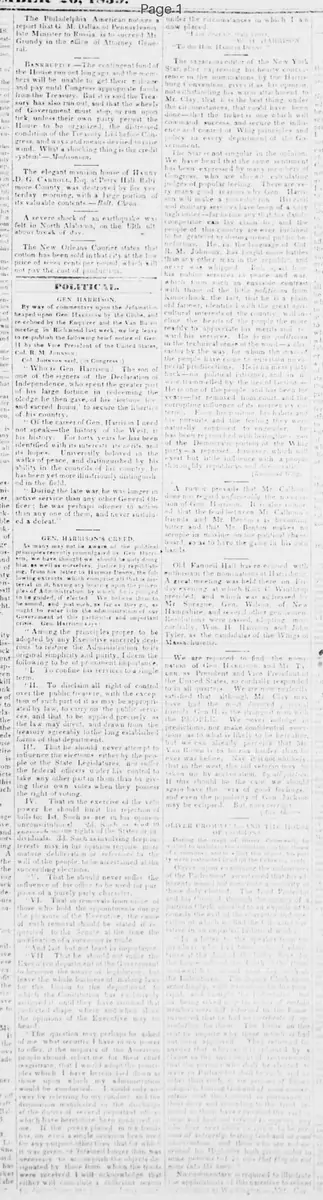
GEN. HARRISON.
By way of commentary upon the defamation heaped upon Gen. Harrison by the Globe, and re-echoed by the Enquirer and the Van Buren press, a meeting in Richmond last week, we beg leave to re-publish the following brief notice of Gen. H. by the Vice President of the United States, Col. R. M. Johnson.
Col. Johnson said, (in Congress)
"Who is Gen. Harrison? The son of one of the signers of the Declaration of Independence, who spent the greater part of his large fortune in redeeming the pledge he then gave, of his fortune and sacred honor,' to secure the liberty of his country.
"Of the career of Gen. Harrison I need not speak—the history of the West, is his history. For forty years he has been identified with its interests, as regards, and its hopes. Universally beloved in the walks of peace, and distinguished by his ability in the councils of his country. He has been yet more illustriously distinguished in the field.
"During the late war he was longer in active service than any other General Officer: he was perhaps oftener in action than any one of them, and never sustained a defeat."
GEN. HARRISON'S CREED.
As many may not be aware of the political principles recently promulgated by Gen. Harrison, we have thought we should be serving him, as well as ourselves, vastly in republishing, from his letter to Harmar Denny, the following extracts, which comprise pithy sentiments on the principles of Administration by which he pledges himself to be guided, if elected. We believe them to be sound, and just such, as far as they go, as ought to enter into the administration of our Government at this particular and important crisis. Gen. Harrison says:
"Among the principles proper to be adopted by any Executive sincerely desirous to restore the Administration to its original simplicity and purity, I deem the following to be of first importance.
I. To confine his services to a single term.
II. To disclaim all right of control over the public treasure, with the exception of such part of it as may be appropriated by law, to carry on the public service, and that to be applied precisely as the law may direct, and drawn from the treasury agreeably to the long established forms of that department.
III. That he should never attempt to influence the elections either by the people or the State Legislatures, nor suffer the federal officers under his control to take any other part in them than by giving their own suffrages when they possess the right of voting.
IV. That in the exercise of the veto power he should limit his objection of bills to: 1st Such as are in his opinion unconstitutional. 2nd Such as would in his opinion encroach on the rights of the States or individuals. 3d. Such as involving deep interests, may in his opinion require more mature deliberation or reference to the will of the people to be ascertained at the succeeding elections.
V. That he should never suffer the influence of the office to be used for purposes of a purely party character.
VI. That in removals from office of those who hold the appointments during the pleasure of the Executive the cause of each removal should be stated in the message to the Senate at the time the nomination of a successor in the office is made.
And it but not least in importance
VII. That little aid or comfort to the Executive department of the Government to become the source of influence hostile to the legislative, the whole business of making laws to the department of the House in which the Constitution has assigned it, until they have assumed the perfected shape, where and when all may see them.
The opinions of the Executive by
he and
The question may perhaps be asked of me what security I have in my power to offer it the majority of the American people should offer me for their chief magistrate that I would adopt the principles which I have herein indicated as those on which my administration would be conducted. I could only answer by referring to my conduct and the disposition manifested the discharge of the duties of various important offices which have heretofore been confided to me. If in the post placed in my hands he on even a single occasion been used or retained longer than was necessary to accomplish the object designated by those from whom the trust were received I will acknowledge that either will constitute a sufficient warning under the circumstances in which I am now placed.
To the In Harrison
The cautious editor of the New York Star, after expressing his hearty concurrence in the nominations by the Harrisburg convention, gives it as his opinion notwithstanding his warm attachment to Mr. Clay, that it is the best thing under the circumstances that could have been done—that the ticket is one which will command success and secure the triumph of Whig principles and policy in every department of the Government.
The Star is not singular in the opinion. We have heard that the same sentiment has been expressed by many members of Congress, who are shrewd calculators of popular feeling. There are very many good reasons why Gen. Harrison will make a toasted man: His military services have been of a set high order—far beyond any that his competitors can lay claim to—and the people of this country are ever inclined to be grateful to distinguished public benefactors. He in the language of Col. R. M. Johnson, has fought more battles than any other man in the republic and never whipped. In a word his past services in peace and war form such an enviable contrast with the of the present Executive and his party, that the fact that he is a plain old farmer, identified with the great agricultural interests of the country will incline the hearts of the people the more readily to appreciate his merits and to reward his services. He is no politician in the technical sense of the word—a character by the way for whom the mass of the people have conceived no especial predilections. He has no mercenary hack—no political intrigue, and in fine is untrammelled by the ties of faction.— He is one of the people and has been for years—far removed from court, and the corrupting influences of power. From his position, his habits and his pursuits and the feeling they were naturally supposed to engender, he has been reproached with being the choice of the democratic portion of the Whig party—a reproach, however which will exert but little influence with a people thoroughly republican and democratic.
A rumor prevails that Mr. Clay does not regard very favorably the form anion of Gen. Harrison. It is also reported that the feud between Mr. Calhoun friends and Mr. Benton's is becoming hitter and that Mr. Benton makes no scruple in moving on the political chess board so as to have the game in his own hand.
Old Faneuil Hall has received with enthusiasm the nominations at Harrisburg. A great meeting was held there on Tuesday evening at which Robt. C. Winthrop presided, and which was addressed by Mr. Sprague, Geo. Wilson of New Hampshire, and several other gentlemen. Resolutions were offered, approving most cordially Wm. H. Harrison and John Tyler, as the candidates of the Whigs of Massachusetts.
We are rejoiced to find the nominations of Gen. Harrison and Mr. Tyler as President and Vice President of the United States, so cordially responded to in all quarters. We are now refreshed that although, Mr. Clay may have lost the most devoted of his friends Gen. Harrison will gain in the disaffected all that he has lost.
The Philadelphia Inquirer says We never indulge in predictions, nor make confidential statements as to what is likely to be hereafter but we can safely retrieve that Mr. Van Buren is to run harder than he ever was before. No doubt on it—
In the West the old settler may be looked up by acclamation—by all.
H this should be the case, we shall again have the triumph of good feelings and even the popularity of Gen. Jackson may be eclipsed entirely, no cer'ase hthe.
What sub-type of article is it?
What keywords are associated?
What entities or persons were involved?
Editorial Details
Primary Topic
Support For Gen. Harrison's Whig Presidential Nomination
Stance / Tone
Strongly Pro Harrison And Whig Principles, Critical Of Van Buren Administration
Key Figures
Key Arguments