Thank you for visiting SNEWPapers!
Sign up free
Story
May 16, 1857
San Andreas Independent
San Andreas, Calaveras County, California
What is this article about?
Travel narrative from Murphy's to Calaveras Big Trees, describing ascent through forests, Capt. Hanford's sawmill and railroad, encounters with Native Diggers, scenic beauty, and the majestic trees including the stripped 'Mother of the Forest' that died in 1854.
Clipping
OCR Quality
98%
Excellent
Full Text
Notes of a Trip through the Mines to the Big Trees of Calaveras.
[Concluded.]
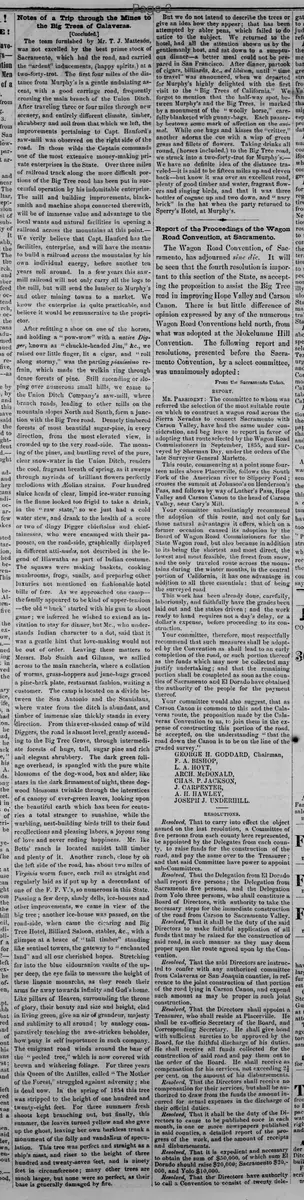
The team furnished by Mr. T. J. Matteson, was not excelled by the best prime stock of Sacramento, which had the road, and carried the "ardent" inducements. (happy spirits, at a two-forty-trot. The first four miles of the distance from Murphy's is a gentle undulating ascent, with a good carriage road, frequently crossing the main branch of the Union Ditch. After traveling three or four miles through new scenery, and entirely different climate, timber, shrubbery and soil from that which we left, the improvements pertaining to Capt. Hanford's saw-mill was observed on the right side of the road. In those wilds the Captain commands one of the most extensive money-making private enterprises in the State. Over three miles of railroad track along the more difficult portions of the Big Tree road has been put in successful operation by his indomitable enterprise. The mill and building improvements, blacksmith and machine shops connected therewith, will be of immense value and advantage to the local wants and natural facilities in opening a railroad across the mountains at this point. We verily believe that Capt. Hanford has the facilities, enterprise, and will have the means to build a railroad across the mountains by his own individual energy, before another ten years roll around. In a few years this saw-mill railroad will not only carry all the logs to the mill, but will send the lumber to Murphy's and other mining towns to a market. We know the enterprise is quite practicable, and believe it would be remunerative to the proprietor.
After refitting a shoe on one of the horses, and holding a "pow-wow" with a native Digger, known as "chuckle-headed Jim," &c., we raised our little finger, lit a cigar, and "roll along stormy," was the parting pianissimo refrain, which made the welkin ring through dense forests of pine. Still ascending or sloping over numerous small hills, we came to the Union Ditch Company's saw-mill, where branch roads, leading to other mills on the mountain slopes North and South, form a junction with the Big Tree road. Densely timbered forests of most beautiful sugar-pine, in every direction, from the most elevated view, is crowded up to the very road-side. The moaning of the pines, and bustling revel of the pure clear snow-water in the Union Ditch, renders the cool, fragrant breath of spring, as it sweeps through myriads of brilliant flowers perfectly melodious with Eolian strains. Four hundred sluice heads of clear, limpid ice-water running in the flume looked too frigid to take a drink, in the "raw state," so we just had a cold water stew, and drank to the health of a score or two of dingy Digger chieftains and chieftainesses, who were encamped with their papooses, on the road-side, graphically displayed in different attitudes, not described in the legend of Hiawatha as part of Indian costume. The squaws were making baskets, cooking mushrooms, frogs, snails, and preparing other luxuries not mentioned on fashionable hotel bills of fare. As we approached one camp— the family appeared to be kind of upper-tendom —the old "buck" started with his gun to shoot game; we inferred he wished to extend an invitation to stay for dinner, but Mc., who understands Indian character to a dot, said that it was a gentle hint that love-making would not be out of order. Leaving these matters to Messrs. Bob Smith and Gilman, we sallied across to the main rancheria, where a collation of worms, grass-hoppers and june-bugs graced a pine-bark plate, restaurant fashion, waiting a customer. The camp is located on a divide between the San Antonio and the Stanislaus, where water from the ditch is abundant, and timber of immense size thickly stands in every direction. From this ever-shaded camp of wild Diggers, the road is almost level, gently ascending to the Big Tree Grove, through intermediate forests of huge, tall, sugar pine and rich and elegant shrubbery. The dark green foliage overhead, is spangled with the pure white blossoms of the dog-wood, box and alder; like stars in the dark firmament of night, these dog-wood blossoms twinkle through the interstices of a canopy of ever-green leaves, looking upon the beautiful earth which has been for centuries a total stranger to sunshine, while the warbling, nest-building birds trill to their fond recollections and pleasing labors, a joyous song of love and never ending happiness. Mr. Ike Betts' ranch is located amidst tall timber and plenty of it. Another ranch, close by on the left side of the road, has about two miles of Virginia worm fence, each rail as straight and regularly laid as if put up by a descendant of one of the F. F. V.'s, so numerous in this State. Passing a few deep, shady dells, ice-houses and other improvements, we came in view of the big tree; another ice-house was passed, on the road-side, when came the clearing and Big Tree Hotel, Billiard Saloon, stables, &c., with a glimpse at a brace of "tall timber" standing like sentinel towers, the gateway to "enchanted land" and all our cherished hopes. Stretching far into the blue eidouranion vaults of the upper deep, the eye fails to measure the height of these lineate monarchs, as they reach their arms far away towards infinity and God's home. Like pillars of Heaven, surrounding the throne of glory, their beauty and size and height, clad in living green, give an air of grandeur, majesty and sublimity to all around; by analogy comparatively teaching the awe-stricken beholder, how puny is self importance in such company.
The emigrant road winds around the base of the "peeled tree," which is now covered with brown and withering foliage. For three years this Queen of the Antilles, called "The Mother of the Forest," struggled against adversity; she is dead now. In the spring of 1854 this tree was stripped to the height of one hundred and twenty-eight feet. For three summers fresh shoots kept branching out, but finally, this summer, the leaves turned yellow and she gave up the ghost, leaving her own barkless trunk a monument of the folly and vandalism of speculation. This tree was perfect and straight as a ship's mast, and rises to the height of three hundred and twenty-seven feet, and is ninety feet in circumference; many other trees are much larger, but none were so perfect, as their base is generally damaged by fire.
But we do not intend to describe the trees or give an idea how they appear; that has been attempted by abler pens, which failed to do justice to the subject. We returned to the hotel, had all the attention shown us by the gentlemanly host, and sat down to a sumptuous dinner—a better meal could not be prepared in San Francisco. After dinner, partook of cigars, billiards, &c., ad libitum, until "time to travel" was announced, when we departed for Murphy's highly delighted with the first visit to the "Big Trees of California." We forgot to mention that the half-way spot, between Murphy's and the Big Trees, is marked by a monument of the "woolly horse," carefully blanketed with gunny-bags. Each passer-by bestows some mark of affection on the animal. While one hugs and kisses the "critter," another adorns the cue with a wisp of green grass and fillets of flowers. Taking drinks all round, (horses included,) to the Big Tree road, we struck into a two-forty-trot for Murphy's.— We have no definite idea of the distance traveled—it is said to be fifteen miles up and eleven back—but know it was over an excellent road, plenty of good timber and water, fragrant flowers and singing birds, and that it was three bottles of cognac up and two down, and "nary brick" in the hat when the party returned to Sperry's Hotel, at Murphy's.
[Concluded.]
The team furnished by Mr. T. J. Matteson, was not excelled by the best prime stock of Sacramento, which had the road, and carried the "ardent" inducements. (happy spirits, at a two-forty-trot. The first four miles of the distance from Murphy's is a gentle undulating ascent, with a good carriage road, frequently crossing the main branch of the Union Ditch. After traveling three or four miles through new scenery, and entirely different climate, timber, shrubbery and soil from that which we left, the improvements pertaining to Capt. Hanford's saw-mill was observed on the right side of the road. In those wilds the Captain commands one of the most extensive money-making private enterprises in the State. Over three miles of railroad track along the more difficult portions of the Big Tree road has been put in successful operation by his indomitable enterprise. The mill and building improvements, blacksmith and machine shops connected therewith, will be of immense value and advantage to the local wants and natural facilities in opening a railroad across the mountains at this point. We verily believe that Capt. Hanford has the facilities, enterprise, and will have the means to build a railroad across the mountains by his own individual energy, before another ten years roll around. In a few years this saw-mill railroad will not only carry all the logs to the mill, but will send the lumber to Murphy's and other mining towns to a market. We know the enterprise is quite practicable, and believe it would be remunerative to the proprietor.
After refitting a shoe on one of the horses, and holding a "pow-wow" with a native Digger, known as "chuckle-headed Jim," &c., we raised our little finger, lit a cigar, and "roll along stormy," was the parting pianissimo refrain, which made the welkin ring through dense forests of pine. Still ascending or sloping over numerous small hills, we came to the Union Ditch Company's saw-mill, where branch roads, leading to other mills on the mountain slopes North and South, form a junction with the Big Tree road. Densely timbered forests of most beautiful sugar-pine, in every direction, from the most elevated view, is crowded up to the very road-side. The moaning of the pines, and bustling revel of the pure clear snow-water in the Union Ditch, renders the cool, fragrant breath of spring, as it sweeps through myriads of brilliant flowers perfectly melodious with Eolian strains. Four hundred sluice heads of clear, limpid ice-water running in the flume looked too frigid to take a drink, in the "raw state," so we just had a cold water stew, and drank to the health of a score or two of dingy Digger chieftains and chieftainesses, who were encamped with their papooses, on the road-side, graphically displayed in different attitudes, not described in the legend of Hiawatha as part of Indian costume. The squaws were making baskets, cooking mushrooms, frogs, snails, and preparing other luxuries not mentioned on fashionable hotel bills of fare. As we approached one camp— the family appeared to be kind of upper-tendom —the old "buck" started with his gun to shoot game; we inferred he wished to extend an invitation to stay for dinner, but Mc., who understands Indian character to a dot, said that it was a gentle hint that love-making would not be out of order. Leaving these matters to Messrs. Bob Smith and Gilman, we sallied across to the main rancheria, where a collation of worms, grass-hoppers and june-bugs graced a pine-bark plate, restaurant fashion, waiting a customer. The camp is located on a divide between the San Antonio and the Stanislaus, where water from the ditch is abundant, and timber of immense size thickly stands in every direction. From this ever-shaded camp of wild Diggers, the road is almost level, gently ascending to the Big Tree Grove, through intermediate forests of huge, tall, sugar pine and rich and elegant shrubbery. The dark green foliage overhead, is spangled with the pure white blossoms of the dog-wood, box and alder; like stars in the dark firmament of night, these dog-wood blossoms twinkle through the interstices of a canopy of ever-green leaves, looking upon the beautiful earth which has been for centuries a total stranger to sunshine, while the warbling, nest-building birds trill to their fond recollections and pleasing labors, a joyous song of love and never ending happiness. Mr. Ike Betts' ranch is located amidst tall timber and plenty of it. Another ranch, close by on the left side of the road, has about two miles of Virginia worm fence, each rail as straight and regularly laid as if put up by a descendant of one of the F. F. V.'s, so numerous in this State. Passing a few deep, shady dells, ice-houses and other improvements, we came in view of the big tree; another ice-house was passed, on the road-side, when came the clearing and Big Tree Hotel, Billiard Saloon, stables, &c., with a glimpse at a brace of "tall timber" standing like sentinel towers, the gateway to "enchanted land" and all our cherished hopes. Stretching far into the blue eidouranion vaults of the upper deep, the eye fails to measure the height of these lineate monarchs, as they reach their arms far away towards infinity and God's home. Like pillars of Heaven, surrounding the throne of glory, their beauty and size and height, clad in living green, give an air of grandeur, majesty and sublimity to all around; by analogy comparatively teaching the awe-stricken beholder, how puny is self importance in such company.
The emigrant road winds around the base of the "peeled tree," which is now covered with brown and withering foliage. For three years this Queen of the Antilles, called "The Mother of the Forest," struggled against adversity; she is dead now. In the spring of 1854 this tree was stripped to the height of one hundred and twenty-eight feet. For three summers fresh shoots kept branching out, but finally, this summer, the leaves turned yellow and she gave up the ghost, leaving her own barkless trunk a monument of the folly and vandalism of speculation. This tree was perfect and straight as a ship's mast, and rises to the height of three hundred and twenty-seven feet, and is ninety feet in circumference; many other trees are much larger, but none were so perfect, as their base is generally damaged by fire.
But we do not intend to describe the trees or give an idea how they appear; that has been attempted by abler pens, which failed to do justice to the subject. We returned to the hotel, had all the attention shown us by the gentlemanly host, and sat down to a sumptuous dinner—a better meal could not be prepared in San Francisco. After dinner, partook of cigars, billiards, &c., ad libitum, until "time to travel" was announced, when we departed for Murphy's highly delighted with the first visit to the "Big Trees of California." We forgot to mention that the half-way spot, between Murphy's and the Big Trees, is marked by a monument of the "woolly horse," carefully blanketed with gunny-bags. Each passer-by bestows some mark of affection on the animal. While one hugs and kisses the "critter," another adorns the cue with a wisp of green grass and fillets of flowers. Taking drinks all round, (horses included,) to the Big Tree road, we struck into a two-forty-trot for Murphy's.— We have no definite idea of the distance traveled—it is said to be fifteen miles up and eleven back—but know it was over an excellent road, plenty of good timber and water, fragrant flowers and singing birds, and that it was three bottles of cognac up and two down, and "nary brick" in the hat when the party returned to Sperry's Hotel, at Murphy's.
What sub-type of article is it?
Journey
Curiosity
Adventure
What themes does it cover?
Exploration
Nature
Triumph
What keywords are associated?
Calaveras Big Trees
Murphy's
Sawmill Railroad
Union Ditch
Native Diggers
Sugar Pine Forests
Mother Of The Forest
What entities or persons were involved?
Capt. Hanford
Chuckle Headed Jim
Mc.
Bob Smith
Gilman
Mr. Ike Betts
Where did it happen?
From Murphy's To The Big Trees Of Calaveras
Story Details
Key Persons
Capt. Hanford
Chuckle Headed Jim
Mc.
Bob Smith
Gilman
Mr. Ike Betts
Location
From Murphy's To The Big Trees Of Calaveras
Event Date
Circa 1854
Story Details
A party's journey from Murphy's to the Calaveras Big Trees, passing sawmills, railroads, Native American camps, and lush forests, culminating in awe at the giant sequoias, including the bark-stripped 'Mother of the Forest' that died after struggling for three years.