Thank you for visiting SNEWPapers!
Sign up free
Story
January 29, 1866
The Evening Telegraph
Philadelphia, Philadelphia County, Pennsylvania
What is this article about?
Newspaper reports a conversation between President Johnson and a senator on vetoing the negro suffrage bill for D.C. and supporting a constitutional amendment basing representation on voters and taxation on property, amid Reconstruction debates.
Clipping
OCR Quality
97%
Excellent
Full Text
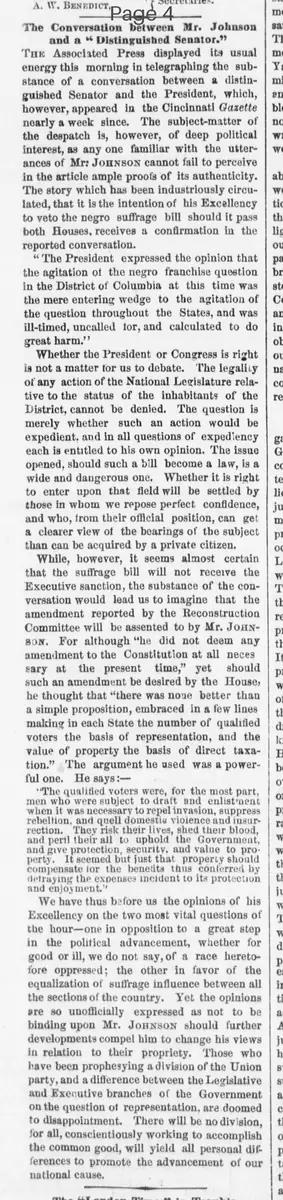
The Conversation between Mr. Johnson and a Distinguished Senator.
The Associated Press displayed its usual energy this morning in telegraphing the substance of a conversation between a distinguished Senator and the President, which, however, appeared in the Cincinnati Gazette nearly a week since. The subject-matter of the despatch is, however, of deep political interest, as any one familiar with the utterances of Mr. Johnson cannot fail to perceive in the article ample proofs of its authenticity. The story which has been industriously circulated that it is the intention of his Excellency to veto the negro suffrage bill should it pass both Houses, receives a confirmation in the reported conversation.
"The President expressed the opinion that the agitation of the negro franchise question in the District of Columbia at this time was the mere entering wedge to the agitation of the question throughout the States, and was ill-timed, uncalled for, and calculated to do great harm."
Whether the President or Congress is right is not a matter for us to debate. The legality of any action of the National Legislature relative to the status of the inhabitants of the District, cannot be denied. The question is merely whether such an action would be expedient, and in all questions of expediency each is entitled to his own opinion. The issue opened, should such a bill become a law, is a wide and dangerous one. Whether it is right to enter upon that field will be settled by those in whom we repose perfect confidence, and who, from their official position, can get a clearer view of the bearings of the subject than can be acquired by a private citizen.
While, however, it seems almost certain that the suffrage bill will not receive the Executive sanction, the substance of the conversation would lead us to imagine that the amendment reported by the Reconstruction Committee will be assented to by Mr. Johnson. For although "he did not deem any amendment to the Constitution at all necessary at the present time," yet should such an amendment be desired by the House, he thought that "there was none better than a simple proposition, embraced in a few lines making in each State the number of qualified voters the basis of representation, and the value of property the basis of direct taxation." The argument he used was a powerful one. He says:-
"The qualified voters were, for the most part, men who were subject to draft and enlistment when it was necessary to repel invasion, suppress rebellion, and quell domestic violence and insurrection. They risk their lives, shed their blood, and peril their all to uphold the Government, and give protection, security, and value to property. It seemed but just that property should compensate for the benefits thus conferred by defraying the expenses incident to its protection and enjoyment."
We have thus before us the opinions of his Excellency on the two most vital questions of the hour-one in opposition to a great step in the political advancement, whether for good or ill, we do not say, of a race heretofore oppressed: the other in favor of the equalization of suffrage influence between all the sections of the country. Yet the opinions are so unofficially expressed as not to be binding upon Mr. Johnson should further developments compel him to change his views in relation to their propriety. Those who have been prophesying a division of the Union party, and a difference between the Legislative and Executive branches of the Government on the question of representation, are doomed to disappointment. There will be no division, for all, conscientiously working to accomplish the common good, will yield all personal differences to promote the advancement of our national cause.
The Associated Press displayed its usual energy this morning in telegraphing the substance of a conversation between a distinguished Senator and the President, which, however, appeared in the Cincinnati Gazette nearly a week since. The subject-matter of the despatch is, however, of deep political interest, as any one familiar with the utterances of Mr. Johnson cannot fail to perceive in the article ample proofs of its authenticity. The story which has been industriously circulated that it is the intention of his Excellency to veto the negro suffrage bill should it pass both Houses, receives a confirmation in the reported conversation.
"The President expressed the opinion that the agitation of the negro franchise question in the District of Columbia at this time was the mere entering wedge to the agitation of the question throughout the States, and was ill-timed, uncalled for, and calculated to do great harm."
Whether the President or Congress is right is not a matter for us to debate. The legality of any action of the National Legislature relative to the status of the inhabitants of the District, cannot be denied. The question is merely whether such an action would be expedient, and in all questions of expediency each is entitled to his own opinion. The issue opened, should such a bill become a law, is a wide and dangerous one. Whether it is right to enter upon that field will be settled by those in whom we repose perfect confidence, and who, from their official position, can get a clearer view of the bearings of the subject than can be acquired by a private citizen.
While, however, it seems almost certain that the suffrage bill will not receive the Executive sanction, the substance of the conversation would lead us to imagine that the amendment reported by the Reconstruction Committee will be assented to by Mr. Johnson. For although "he did not deem any amendment to the Constitution at all necessary at the present time," yet should such an amendment be desired by the House, he thought that "there was none better than a simple proposition, embraced in a few lines making in each State the number of qualified voters the basis of representation, and the value of property the basis of direct taxation." The argument he used was a powerful one. He says:-
"The qualified voters were, for the most part, men who were subject to draft and enlistment when it was necessary to repel invasion, suppress rebellion, and quell domestic violence and insurrection. They risk their lives, shed their blood, and peril their all to uphold the Government, and give protection, security, and value to property. It seemed but just that property should compensate for the benefits thus conferred by defraying the expenses incident to its protection and enjoyment."
We have thus before us the opinions of his Excellency on the two most vital questions of the hour-one in opposition to a great step in the political advancement, whether for good or ill, we do not say, of a race heretofore oppressed: the other in favor of the equalization of suffrage influence between all the sections of the country. Yet the opinions are so unofficially expressed as not to be binding upon Mr. Johnson should further developments compel him to change his views in relation to their propriety. Those who have been prophesying a division of the Union party, and a difference between the Legislative and Executive branches of the Government on the question of representation, are doomed to disappointment. There will be no division, for all, conscientiously working to accomplish the common good, will yield all personal differences to promote the advancement of our national cause.
What sub-type of article is it?
Historical Event
Biography
What themes does it cover?
Justice
Moral Virtue
What keywords are associated?
Negro Suffrage
Veto Bill
Constitutional Amendment
Reconstruction
Political Conversation
Representation Basis
Qualified Voters
What entities or persons were involved?
Mr. Johnson
Distinguished Senator
President
Where did it happen?
District Of Columbia
Story Details
Key Persons
Mr. Johnson
Distinguished Senator
President
Location
District Of Columbia
Story Details
Reported conversation where President Johnson opposes negro suffrage in D.C. as premature and confirms intent to veto the bill, while supporting a constitutional amendment basing representation on qualified voters and taxation on property, arguing for fairness to those who defend the nation.