Thank you for visiting SNEWPapers!
Sign up free
The National Intelligencer And Washington Advertiser
Washington, District Of Columbia
What is this article about?
John Adams, in a letter dated January 9, 1809, from Quincy, critiques the British King's Proclamation of October 22, 1807, which authorizes impressment of British seamen from American merchant ships. He argues it violates natural rights, international law, and American citizenship, equating it to slavery and man-stealing, with historical and biblical references.
Merged-components note: Continuation of John Adams' letter on the British proclamation.
Clipping
OCR Quality
Full Text
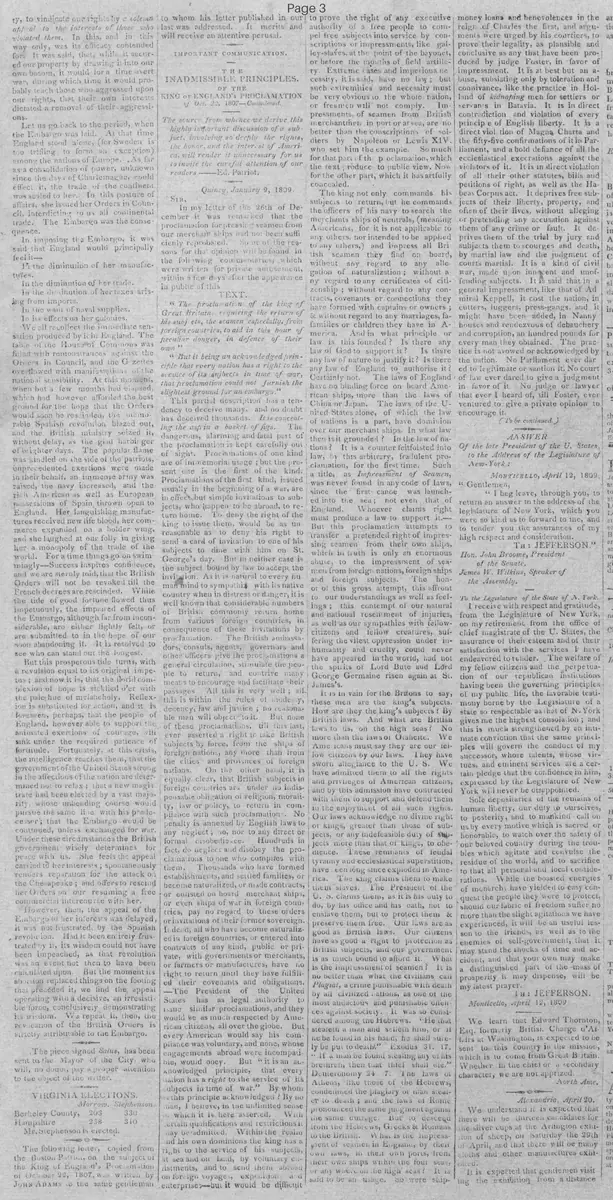
IMPORTANT COMMUNICATION.
THE INADMISSIBLE PRINCIPLES
OF THE
KING OF ENGLAND'S PROCLAMATION
of Oct. 22, 1807—Considered.
The source from whence we derive this highly important discussion of a subject, involving so deeply the rights, the honor, and the interest of America, will render it unnecessary for us to invite the careful attention of our readers --Ed. Patriot.
Quincy, January 9, 1809.
Sir,
In my letter of the 26th of December it was remarked that the proclamation for pressing seamen from our merchant ships had not been sufficiently reprobated. Some of the reasons for that opinion will be found in the following commentaries which were written for private amusement, within a few days after the appearance in public of this
TEXT.
"The proclamation of the king of Great Britain requiring the return of his subjects, the seamen especially, from foreign countries, to aid in this hour of peculiar danger, in defence of their own
But it being an acknowledged principle that every nation has a right to the service of its subjects in time of war, that proclamation could not furnish the slightest ground for an embargo."
This partial description has a tendency to deceive many, and no doubt has deceived thousands. It is concealing the asp in a basket of figs. The dangerous, alarming and fatal part of the proclamation is kept carefully out of sight. Proclamations of one kind are of immemorial usage; but the present one is the first of the kind. Proclamations of the first kind, issued usually in the beginning of a war, are in effect but simple invitations to subjects, who happen to be abroad, to return home. To deny the right of the king to issue them, would be as unreasonable as to deny his right to send a card of invitation to one of his subjects to dine with him on St. George's day. But in neither case is the subject bound by law to accept the invitation. As it is natural to every human mind to sympathize with its native country when in distress or danger, it is well known that considerable numbers of British commonly return home from various foreign countries, in consequence of these invitations by proclamation. The British ambassadors, consuls, agents, governors and other officers give the proclamations a general circulation, stimulate the people to return, and contrive many means to encourage and facilitate their passages. All this is very well; all this is within the rules of modesty, decency, law and justice; no reasonable man will object to it. But none of these proclamations, till this last, ever asserted a right to take British subjects by force, from the ships of foreign nations, any more than from the cities and provinces of foreign nations. On the other hand, it is equally clear, that British subjects in foreign countries are under no indispensable obligation of religion, morality, law or policy, to return in compliance with such proclamations. No penalty is annexed by English laws to any neglect; no, nor to any direct or formal disobedience. Hundreds in fact, do neglect and disobey the proclamations to one who complies with them. Thousands who have formed establishments, and settled families, or become naturalized, or made contracts, or enlisted on board merchant ships, or even ships of war in foreign countries, pay no regard to these orders or invitations of their former sovereign. Indeed, all who have become naturalized in foreign countries, or entered into contracts of any kind, public or private, with governments or merchants, or farmers or manufacturers, have no right to return until they have fulfilled their covenants and obligations.
—The President of the United States has as legal authority to issue similar proclamations, and they would be as much respected by American citizens, all over the globe. But every American would say his compliance was voluntary, and none, whose engagements abroad were incompatible, would obey. But "it is an acknowledged principle, that every nation has a right to the service of its subjects in time of war." By whom, this principle acknowledged? By no man, I believe, in the unlimited sense in which it is here asserted. With certain qualifications and restrictions it may be admitted. Within the realm and his own dominions the king has a right to the service of his subjects, at sea and on land, by voluntary enlistments, and to send them abroad on foreign voyages, expeditions and enterprises—but it would be difficult
to prove the right of any executive authority of a free people to compel free subjects into service by conscriptions or impressments, like galley-slaves, at the point of the bayonet, or before the mouths of field artillery. Extreme cases and imperious necessity, it is said, have no law; but such extremities and necessity must be very obvious to the whole nation, or freemen will not comply. Impressments, of seamen from British merchantmen in port or at sea, are no better than the conscriptions of soldiers by Napoleon or Lewis XIV. who set him the example. So much for that part of the proclamation, which the text produces to public view. Now for the other part, which it has artfully concealed.
The king not only commands his subjects to return, but he commands the officers of his navy to search the merchant ships of neutrals, (meaning Americans, for it is not applicable to any others, nor intended to be applied to any others,) and impress all British seamen they find on board, without any regard to any allegation of naturalization; without any regard to any certificates of citizenship; without regard to any contracts, covenants or connections they have formed with captains or owners; & without regard to any marriages, families or children they have in America. And in what principle or law is this founded? Is there any law of God to support it? Is there any law of nature to justify it? Is there any law of England to authorise it? Certainly not. The laws of England have no binding force on board American ships, more than the laws of China or Japan. The laws of the United States alone, of which the law of nations is a part, have dominion over our merchant ships. In what law then is it grounded? In the law of nations? It is a counterfeit foisted into law, by this arbitrary, fraudulent proclamation, for the first time. Such a title, as Impressment of Seamen, was never found in any code of laws, since the first canoe was launched into the sea; not even that of England. Whoever claims right must produce a law to support it.
But this proclamation attempts to transfer a pretended right of impressing seamen from their own ships, which in truth is only an enormous abuse, to the impressment of seamen from foreign nations, foreign ships and foreign subjects. The honor of this gross attempt, this affront to our understandings as well as feelings; this contempt of our natural and national resentment of injuries, as well as our sympathies with fellow-citizens and fellow creatures, suffering the vilest oppression under inhumanity and cruelty, could never have appeared in the world, had not the spirits of Lord Bute and Lord George Germaine risen again at St. James's.
It is in vain for the Britons to say, these men are the king's subjects. How are they the king's subjects? By British laws. And what are British laws to us, on the high seas? No more than the laws of Otaheite. We Americans must say they are our fellow citizens by our laws. They have sworn allegiance to the U. S. We have admitted them to all the rights and privileges of American citizens, and by this admission have contracted with them to support and defend them in the enjoyment of all such rights. Our laws acknowledge no divine right of kings, greater than those of subjects, or any indefeasible duty of subjects more than that of kings, to obedience. These remnants of feudal tyranny and ecclesiastical superstition, have been long since exploded in America. The king claims them to make them slaves. The President of the U. S. claims them, as it is his duty to do, by his office and his oath, not to enslave them, but to protect them & preserve them free. Our laws are as good as British laws. Our citizens have as good a right to protection as British subjects, and our government is as much bound to afford it. What is the impressment of seamen? It is no better than what the civilians call Plagiat, a crime punishable with death by all civilized nations, as one of the most audacious and punishable offences against society. It was so considered among the Hebrews. He that stealeth a man and selleth him, or if he be found in his hand, he shall surely be put to death." Exodus 21. 17.
If a man be found stealing any of his brethren, then that thief shall die." Deuteronomy 24 7. The laws of Athens, like those of the Hebrews, condemned the plagiary of man stealer to death; and the laws of Rome pronounced the same judgment against the same outrage. But to descend from the Hebrews, Greeks & Romans to the British. What is the impressment of seamen in England, by their own laws, in their own ports, from their own ships within the four seas, of any where on the high seas? It is said to be an usage. so were ship-money loans and benevolences in the reign of Charles the first, and arguments were urged by his courtiers, to prove their legality, as plausible and conclusive as any that have been produced by judge Foster, in favor of impressment. It is at best but an abuse, subsisting only by toleration and connivance, like the practice in Holland of kidnaping men for settlers or servants in Batavia. It is in direct contradiction and violation of every principle of English liberty. It is a direct violation of Magna Charta and the fifty-five confirmations of it in Parliament, and a bold defiance of all the ecclesiastical execrations against the violators of it. It is in direct violation of all their other statutes, bills and petitions of right, as well as the Habeas Corpus act. It deprives free subjects of their liberty, property, and often of their lives, without alleging or pretending any accusation against them of any crime or fault. It deprives them of the trial by jury and subjects them to scourges and death, by martial law and the judgment of courts martial. It is a kind of civil war, made upon innocent and unoffending subjects. It is said that in a general impressment, like that of Admiral Keppel, it cost the nation, in cutters, luggers, press-gangs, and it might have been added, in Nanny houses and rendezvous of debauchery and corruption, an hundred pounds for every man they obtained. The practice is not avowed or acknowledged by the nation. No Parliament ever dared to legitimate or sanction it. No court of law ever dared to give a judgment in favor of it. No judge or lawyer that ever I heard of, till Foster, ever ventured to give a private opinion to encourage it.
(To be continued.)
What sub-type of article is it?
What themes does it cover?
What keywords are associated?
What entities or persons were involved?
Letter to Editor Details
Author
John Adams
Recipient
Sir
Main Argument
the british king's proclamation of october 22, 1807, authorizing the impressment of british seamen from american merchant ships, is illegal, violates natural and international law, disregards american citizenship, and constitutes a form of slavery equivalent to man-stealing.
Notable Details