Thank you for visiting SNEWPapers!
Sign up free
Poem
September 30, 1785
Fowle's New Hampshire Gazette And General Advertiser
Portsmouth, Rockingham County, New Hampshire
What is this article about?
A poem by an amiable young lady from the Northern county defends women against a couplet accusing them of inherent guilt and sinful smiles. It references original sin, mutual temptation, divine mercy through Christ, gender roles, and concludes with a prayer for grace and eternal salvation.
Clipping
OCR Quality
95%
Excellent
Full Text
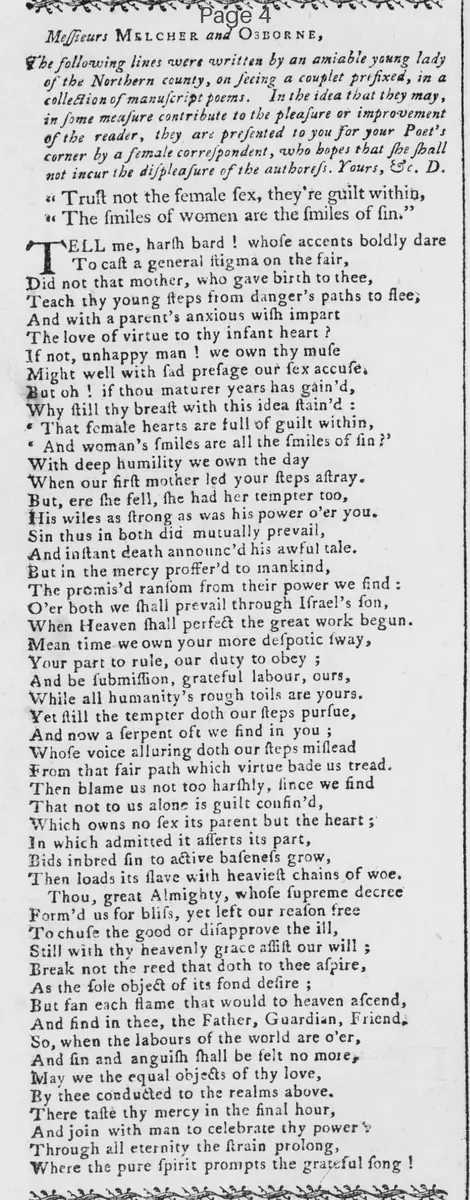
Messieurs Melcher and Osborne,
The following lines were written by an amiable young lady of the Northern county, on seeing a couplet prefixed, in a collection of manuscript poems. In the idea that they may, in some measure contribute to the pleasure or improvement of the reader, they are presented to you for your Poet's corner by a female correspondent, who hopes that she shall not incur the displeasure of the authoress. Yours, &c. D.
Trust not the female sex, they're guilt within,
"The smiles of women are the smiles of sin."
TELL me, harsh bard! whose accents boldly dare
A
To cast a general stigma on the fair,
Did not that mother, who gave birth to thee,
Teach thy young steps from danger's paths to flee,
And with a parent's anxious wish impart
The love of virtue to thy infant heart?
If not, unhappy man! we own thy muse
Might well with such preface our sex accuse.
But oh! if thou maturer years has gain'd,
Why still thy breast with this idea tain'd:
That female hearts are full of guilt within,
"And woman's smiles are all the smiles of sin?"
With deep humility we own the day
When our first mother led your steps astray.
But, ere she fell, she had her tempter too,
His wiles as strong as was his power o'er you.
Sin thus in both did mutually prevail,
And instant death announced his awful tale.
But in the mercy proffered to mankind,
The promised ransom from their power we find:
O'er both we shall prevail through Israel's son,
When Heaven shall perfect the great work begun.
Mean time we own your more despotic sway,
Your part to rule, our duty to obey;
And be submission, grateful labour, ours,
While all humanity's rough toils are yours.
Yet still the tempter doth our steps pursue,
And now a serpent oft we find in you;
Whose voice alluring doth our steps mislead
From that fair path which virtue bade us tread.
Then blame us not too harshly, since we find
That not to us alone is guilt confined,
Which owns no sex its parent but the heart;
In which admitted it asserts its part,
Bids inbred sin to active baseness grow,
Then loads its slave with heaviest chains of woe.
Thou, great Almighty, whose supreme decree
Form'd us for bliss, yet left our reason free
To choose the good or disapprove the ill,
Still with thy heavenly grace assist our will;
Break not the reed that doth to thee aspire,
As the sole object of its fond desire;
But fan each flame that would to heaven ascend.
And find in thee, the Father, Guardian, Friend.
So, when the labours of the world are o'er,
And sin and anguish shall be felt no more,
May we the equal objects of thy love,
By thee conducted to the realms above.
There taste thy mercy in the final hour,
And join with man to celebrate thy power
Through all eternity the strain prolong,
Where the pure spirit prompts the grateful song!
The following lines were written by an amiable young lady of the Northern county, on seeing a couplet prefixed, in a collection of manuscript poems. In the idea that they may, in some measure contribute to the pleasure or improvement of the reader, they are presented to you for your Poet's corner by a female correspondent, who hopes that she shall not incur the displeasure of the authoress. Yours, &c. D.
Trust not the female sex, they're guilt within,
"The smiles of women are the smiles of sin."
TELL me, harsh bard! whose accents boldly dare
A
To cast a general stigma on the fair,
Did not that mother, who gave birth to thee,
Teach thy young steps from danger's paths to flee,
And with a parent's anxious wish impart
The love of virtue to thy infant heart?
If not, unhappy man! we own thy muse
Might well with such preface our sex accuse.
But oh! if thou maturer years has gain'd,
Why still thy breast with this idea tain'd:
That female hearts are full of guilt within,
"And woman's smiles are all the smiles of sin?"
With deep humility we own the day
When our first mother led your steps astray.
But, ere she fell, she had her tempter too,
His wiles as strong as was his power o'er you.
Sin thus in both did mutually prevail,
And instant death announced his awful tale.
But in the mercy proffered to mankind,
The promised ransom from their power we find:
O'er both we shall prevail through Israel's son,
When Heaven shall perfect the great work begun.
Mean time we own your more despotic sway,
Your part to rule, our duty to obey;
And be submission, grateful labour, ours,
While all humanity's rough toils are yours.
Yet still the tempter doth our steps pursue,
And now a serpent oft we find in you;
Whose voice alluring doth our steps mislead
From that fair path which virtue bade us tread.
Then blame us not too harshly, since we find
That not to us alone is guilt confined,
Which owns no sex its parent but the heart;
In which admitted it asserts its part,
Bids inbred sin to active baseness grow,
Then loads its slave with heaviest chains of woe.
Thou, great Almighty, whose supreme decree
Form'd us for bliss, yet left our reason free
To choose the good or disapprove the ill,
Still with thy heavenly grace assist our will;
Break not the reed that doth to thee aspire,
As the sole object of its fond desire;
But fan each flame that would to heaven ascend.
And find in thee, the Father, Guardian, Friend.
So, when the labours of the world are o'er,
And sin and anguish shall be felt no more,
May we the equal objects of thy love,
By thee conducted to the realms above.
There taste thy mercy in the final hour,
And join with man to celebrate thy power
Through all eternity the strain prolong,
Where the pure spirit prompts the grateful song!
What sub-type of article is it?
Ode
What themes does it cover?
Moral Virtue
Religious Faith
What keywords are associated?
Female Sex
Smiles Of Sin
Harsh Bard
Original Sin
Divine Mercy
Israel's Son
Gender Roles
Heavenly Grace
Eternal Song
What entities or persons were involved?
An Amiable Young Lady Of The Northern County
Poem Details
Author
An Amiable Young Lady Of The Northern County
Subject
On Seeing A Couplet Prefixed, In A Collection Of Manuscript Poems
Form / Style
Rhymed Couplets
Key Lines
Trust Not The Female Sex, They're Guilt Within,
"The Smiles Of Women Are The Smiles Of Sin."
Tell Me, Harsh Bard! Whose Accents Boldly Dare
A
To Cast A General Stigma On The Fair,
With Deep Humility We Own The Day
When Our First Mother Led Your Steps Astray.
Thou, Great Almighty, Whose Supreme Decree
Form'd Us For Bliss, Yet Left Our Reason Free
So, When The Labours Of The World Are O'er,
And Sin And Anguish Shall Be Felt No More,