Thank you for visiting SNEWPapers!
Sign up free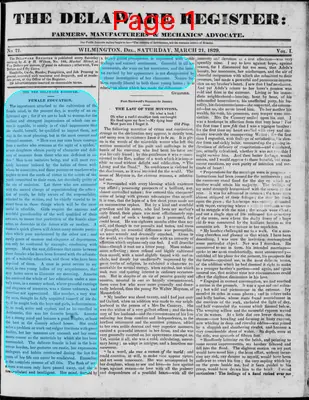
Editorial
March 21, 1829
The Delaware Register, Or, Farmers', Manufacturers' & Mechanics' Advocate
Wilmington, New Castle County, Delaware
What is this article about?
An editorial advocating the importance of proper female education to cultivate virtue, grace, and intelligence in women, using examples of two young ladies to illustrate the impact of educational quality on character and manners.
Clipping
OCR Quality
98%
Excellent
Full Text
FOR THE DELAWARE REGISTER.
FEMALE EDUCATION.
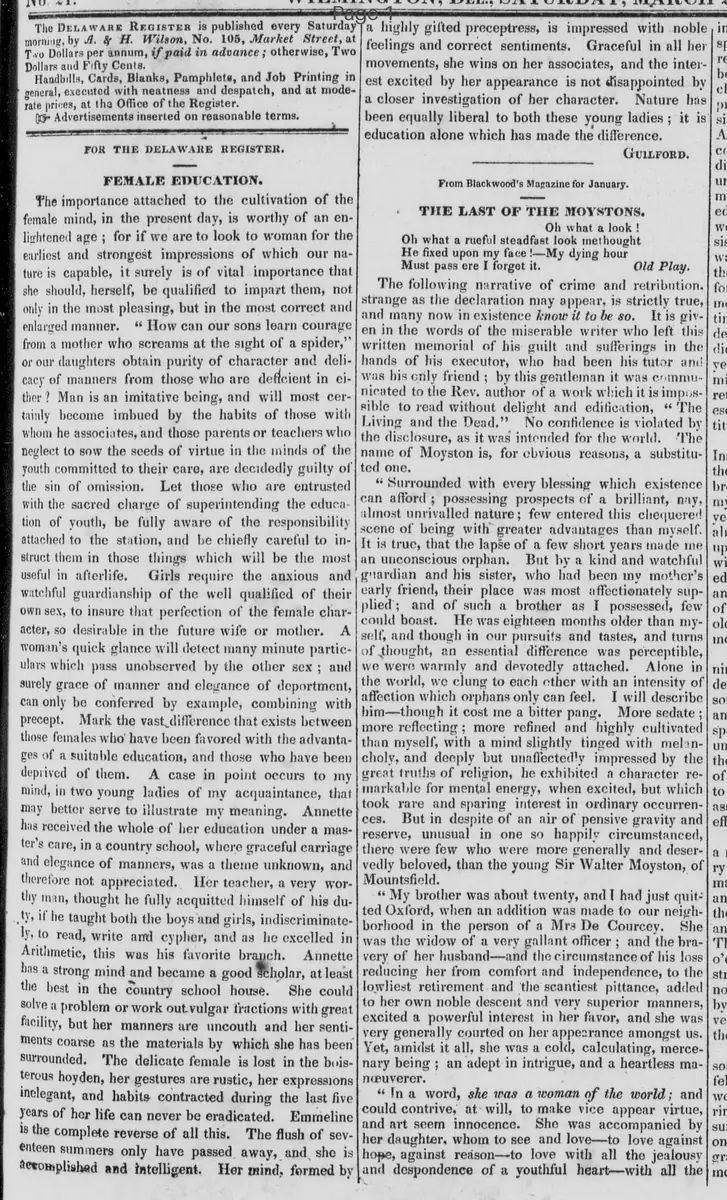
The importance attached to the cultivation of the female mind, in the present day, is worthy of an enlightened age; for if we are to look to woman for the earliest and strongest impressions of which our nature is capable, it surely is of vital importance that she should, herself, be qualified to impart them, not only in the most pleasing, but in the most correct and enlarged manner.
"How can our sons learn courage from a mother who screams at the sight of a spider, or our daughters obtain purity of character and delicacy of manners from those who are deficient in either? Man is an imitative being, and will most certainly become imbued by the habits of those with whom he associates, and those parents or teachers who neglect to sow the seeds of virtue in the minds of the youth committed to their care, are decidedly guilty of the sin of omission. Let those who are entrusted with the sacred charge of superintending the education of youth, be fully aware of the responsibility attached to the station, and be chiefly careful to instruct them in those things which will be the most useful in afterlife. Girls require the anxious and watchful guardianship of the well qualified of their own sex, to insure that perfection of the female character, so desirable in the future wife or mother. A woman's quick glance will detect many minute particulars which pass unobserved by the other sex; and surely grace of manner and elegance of deportment, can only be conferred by example, combining with precept. Mark the vast difference that exists between those females who have been favored with the advantages of a suitable education, and those who have been deprived of them.
A case in point occurs to my mind, in two young ladies of my acquaintance, that may better serve to illustrate my meaning. Annette has received the whole of her education under a master's care, in a country school, where graceful carriage and elegance of manners, was a theme unknown, and therefore not appreciated. Her teacher, a very worthy man, thought he fully acquitted himself of his duty, if he taught both the boys and girls, indiscriminately, to read, write and cypher, and as he excelled in Arithmetic, this was his favorite branch. Annette has a strong mind and became a good scholar, at least the best in the country school house. She could solve a problem or work out vulgar fractions with great facility, but her manners are uncouth and her sentiments coarse as the materials by which she has been surrounded. The delicate female is lost in the boisterous hoyden, her gestures are rustic, her expressions inelegant, and habits contracted during the last five years of her life can never be eradicated. Emmeline is the complete reverse of all this. The flush of seventeen summers only have passed away, and she is accomplished and intelligent. Her mind, formed by a highly gifted preceptress, is impressed with noble feelings and correct sentiments. Graceful in all her movements, she wins on her associates, and the interest excited by her appearance is not disappointed by a closer investigation of her character. Nature has been equally liberal to both these young ladies; it is education alone which has made the difference.
FEMALE EDUCATION.
The importance attached to the cultivation of the female mind, in the present day, is worthy of an enlightened age; for if we are to look to woman for the earliest and strongest impressions of which our nature is capable, it surely is of vital importance that she should, herself, be qualified to impart them, not only in the most pleasing, but in the most correct and enlarged manner.
"How can our sons learn courage from a mother who screams at the sight of a spider, or our daughters obtain purity of character and delicacy of manners from those who are deficient in either? Man is an imitative being, and will most certainly become imbued by the habits of those with whom he associates, and those parents or teachers who neglect to sow the seeds of virtue in the minds of the youth committed to their care, are decidedly guilty of the sin of omission. Let those who are entrusted with the sacred charge of superintending the education of youth, be fully aware of the responsibility attached to the station, and be chiefly careful to instruct them in those things which will be the most useful in afterlife. Girls require the anxious and watchful guardianship of the well qualified of their own sex, to insure that perfection of the female character, so desirable in the future wife or mother. A woman's quick glance will detect many minute particulars which pass unobserved by the other sex; and surely grace of manner and elegance of deportment, can only be conferred by example, combining with precept. Mark the vast difference that exists between those females who have been favored with the advantages of a suitable education, and those who have been deprived of them.
A case in point occurs to my mind, in two young ladies of my acquaintance, that may better serve to illustrate my meaning. Annette has received the whole of her education under a master's care, in a country school, where graceful carriage and elegance of manners, was a theme unknown, and therefore not appreciated. Her teacher, a very worthy man, thought he fully acquitted himself of his duty, if he taught both the boys and girls, indiscriminately, to read, write and cypher, and as he excelled in Arithmetic, this was his favorite branch. Annette has a strong mind and became a good scholar, at least the best in the country school house. She could solve a problem or work out vulgar fractions with great facility, but her manners are uncouth and her sentiments coarse as the materials by which she has been surrounded. The delicate female is lost in the boisterous hoyden, her gestures are rustic, her expressions inelegant, and habits contracted during the last five years of her life can never be eradicated. Emmeline is the complete reverse of all this. The flush of seventeen summers only have passed away, and she is accomplished and intelligent. Her mind, formed by a highly gifted preceptress, is impressed with noble feelings and correct sentiments. Graceful in all her movements, she wins on her associates, and the interest excited by her appearance is not disappointed by a closer investigation of her character. Nature has been equally liberal to both these young ladies; it is education alone which has made the difference.
What sub-type of article is it?
Education
Feminism
Social Reform
What keywords are associated?
Female Education
Women's Roles
Moral Instruction
Elegance Of Manners
Educational Reform
What entities or persons were involved?
Annette
Emmeline
Mothers
Teachers
Preceptress
Editorial Details
Primary Topic
Importance Of Female Education For Character And Manners
Stance / Tone
Advocacy For Qualified Female Education
Key Figures
Annette
Emmeline
Mothers
Teachers
Preceptress
Key Arguments
Women Impart Earliest Impressions, So Must Be Educated Correctly
Neglecting Virtue In Youth Is A Sin Of Omission
Girls Need Guardianship By Qualified Women For Perfect Character
Education By Example And Precept Develops Grace And Elegance
Contrast Between Poorly Educated Annette (Uncouth Manners) And Well Educated Emmeline (Accomplished And Graceful)