Thank you for visiting SNEWPapers!
Sign up free
The Virginia Gazette
Williamsburg, Virginia
What is this article about?
In Philadelphia on September 20, 1770, merchants voted by majority to alter the 1769 non-importation agreement, allowing imports from Britain except tea and revenue-duty items, effective after January 15, 1771. Several committee members resigned. Includes London letters on British reactions to colonial resolve.
Merged-components note: Continuation of the Philadelphia domestic news item across the page break, including extracts from London letters relevant to American affairs.
Clippings
1 of 2
OCR Quality
Full Text
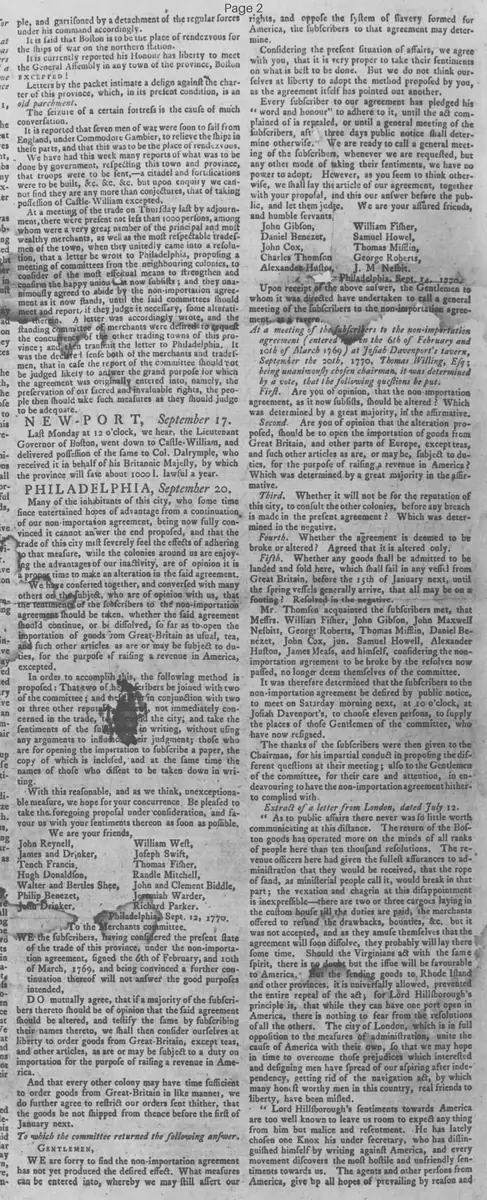
Many of the inhabitants of this city, who some time since entertained hopes of advantage from a continuation of our non-importation agreement, being now fully convinced it cannot answer the end proposed, and that the trade of this city must severely feel the effects of adhering to that measure, while the colonies around us are enjoying the advantages of our inactivity, are of opinion it is a proper time to make an alteration in the said agreement.
We have conferred together, and conversed with many others on the subject, who are of opinion with us, that the sentiments of the subscribers to the non-importation agreement should be taken, whether the said agreement should continue, or be dissolved, so far as to open the importation of goods from Great-Britain as usual, tea, and such other articles as are or may be subject to duties, for the purpose of raising a revenue in America, excepted.
In order to accomplish this, the following method is proposed: That two of the subscribers be joined with two of the committee; and these four in conjunction with two or three other reputable persons not immediately concerned in the trade, to go through the city; and take the sentiments of the subscribers in writing, without using any arguments to influence their judgment; those who are for opening the importation to subscribe a paper, the copy of which is enclosed, and at the same time the names of those who dissent to be taken down in writing.
With this reasonable, and as we think, unexceptionable measure, we hope for your concurrence. Be pleased to take the foregoing proposal under consideration, and favour us with your sentiments thereon as soon as possible.
We are your friends,
John Reynell,
William West,
James and Drinker,
Joseph Swift,
Tench Francis
Thomas Fisher,
Hugh Donaldson,
Randle Mitchell,
Walter and Bertles Shee,
John and Clement Biddle,
Philip Benezet,
Jeremiah Warder,
John Drinker,
Richard Parker.
Philadelphia, Sept. 12, 1770.
To the Merchants committee.
WE, the subscribers, having considered the present state of the trade of this province, under the non-importation agreement, signed the 6th of February, and 10th of March, 1769, and being convinced a further continuation thereof will not answer the good purposes intended,
DO mutually agree, that if a majority of the subscribers thereto should be of opinion that the said agreement should be altered, and testify the same by subscribing their names thereto, we shall then consider ourselves at liberty to order goods from Great-Britain, except teas, and other articles, as are or may be subject to a duty on importation for the purpose of raising a revenue in America.
And that every other colony may have time sufficient to order goods from Great-Britain in like manner, we do further agree to restrict our orders sent thither, that the goods be not shipped from thence before the first of January next.
To which the committee returned the following answer.
GENTLEMEN,
WE are sorry to find the non-importation agreement has not yet produced the desired effect. What measures can be entered into, whereby we may still assert our rights, and oppose the system of slavery formed for America, the subscribers to that agreement may determine.
Considering the present situation of affairs, we agree with you, that it is very proper to take their sentiments on what is best to be done. But we do not think ourselves at liberty to adopt the method proposed by you, as the agreement itself has pointed out another.
Every subscriber to our agreement has pledged his "word and honour" to adhere to it, until the act complained of is repealed, or until a general meeting of the subscribers, after three days public notice shall determine otherwise." We are ready to call a general meeting of the subscribers, whenever we are requested, but any other mode of taking their sentiments, we have no power to adopt. However, as you seem to think otherwise, we shall lay the article of our agreement, together with your proposal, and this our answer before the public, and let them judge.
We are your assured friends, and humble servants
John Gibson,
William Fisher,
Daniel Benezet,
Samuel Howell,
John Cox,
Thomas Mifflin,
Charles Thomson
George Roberts,
Alexander Houston
J. M. Nesbitt.
Philadelphia, Sept 14. 1770.
Upon receipt of the above answer, the Gentlemen to whom it was directed have undertaken to call a general meeting of the subscribers to the non-importation agreement, at a tavern,
At a meeting of the subscribers to the non-importation agreement (entered into on the 6th of February and 10th of March 1769) at Josiah Davenport's tavern, September the 20th, 1770, Thomas Willing, Esq: being unanimously chosen chairman, it was determined by a vote, that the following questions be put.
First. Are you of opinion, that the non-importation agreement, as it now subsists, should be altered? Which was determined by a great majority, in the affirmative.
Second. Are you of opinion that the alteration proposed, should be to open the importation of goods from Great Britain, and other parts of Europe, except teas, and such other articles as are, or may be, subject to duties, for the purpose of raising a revenue in America? Which was determined by a great majority in the affirmative.
Third. Whether it will not be for the reputation of this city, to consult the other colonies, before any breach is made in the present agreement? Which was determined in the negative.
Fourth. Whether the agreement is deemed to be broke or altered? Agreed that it is altered only.
Fifth. Whether any goods shall be admitted to be landed and sold here, which shall sail in any vessel from Great Britain, before the 15th of January next, until the spring vessels generally arrive, that all may be on footing? Resolved in the negative.
Mr. Thomson acquainted the subscribers met, that Messrs. William Fisher, John Gibson, John Maxwell Nesbitt, George Roberts, Thomas Mifflin, Daniel Benezet, John Cox, jun. Samuel Howell, Alexander Houston, James Mease, and himself, considering the non-importation agreement to be broke by the resolves now passed, no longer deem themselves of the committee.
It was therefore determined that the subscribers to the non-importation agreement be desired by public notice, to meet on Saturday morning next, at 10 o'clock, at Josiah Davenport's, to choose eleven persons, to supply the places of those Gentlemen of the committee, who have now resigned.
The thanks of the subscribers were then given to the Chairman, for his impartial conduct in proposing the different questions at their meeting; also to the Gentlemen of the committee, for their care and attention, in endeavouring to have the non-importation agreement hitherto complied with.
Extract of a letter from London, dated July 12.
"As to public affairs there never was so little worth communicating at this distance. The return of the Boston goods has operated more on the minds of all ranks of people here than ten thousand resolutions. The revenue officers here had given the fullest assurances to administration that they would be received, that the rope of sand, as ministerial people call it, would break in that part; the vexation and chagrin at this disappointment is inexpressible—there are two or three cargoes laying in the custom house till the duties are paid, the merchants offered to refund the drawbacks, bounties, &c. but it was not accepted, and as they amuse themselves that the agreement will soon dissolve, they probably will lay there some time. Should the Virginians act with the same spirit, there is no doubt but the issue will be favourable to America. But the sending goods to Rhode Island and other provinces, it is universally allowed, prevented the entire repeal of the act; for Lord Hillsborough's principle is, that while they can have one port open in America, there is nothing to fear from the resolutions of all the others. The city of London, which is in full opposition to the measures of administration, unite the cause of America with their own, so that we may hope in time to overcome those prejudices which interested and designing men have spread of our aspiring after independency, getting rid of the navigation act, by which many honest worthy men in this country, real friends to liberty, have been misled.
Lord Hillsborough's sentiments towards America are too well known to leave us room to expect any thing from him but malice and resentment. He has lately chosen one Knox his under secretary, who has distinguished himself by writing against America, and every movement discovers the most hostile and unfriendly sentiments towards us. The agents and other persons from America, give up all hopes of prevailing by reason and
argument against such fixed, rooted prejudice and resentment, so that they do nothing but what is merely official. The manufacturers and merchants must now soon feel the force of these resolutions, unless some secret iniquitous scheme is devised to counteract them by keeping their people employed at the public expense, which is often suggested.
They confess they feel every day more sensibly, that there is no doubt but our perseverance will be crowned with success.
Extract of another letter from London, dated July 12.
As to public affairs, tho' America has been the subject of two or three late councils, nothing has transpired. The reports of the day are, that it is under consideration to bring a bill into Parliament, making all associations for non-importation, &c. very penal. In short, to put the merchants on the same footing as the journeymen taylors, weavers, &c. whose combinations, as they style our resolutions, are, by act of Parliament, made highly criminal. To change the constitution of Massachusetts-Bay, as that province is considered to be the source and fountain of the present unhappy division. I do not give you these other than reports. But this you may be assured of, that the return of the Boston's, and the declared adherence of New York and Philadelphia to the agreement, has given a most sensible alarm; and occasioned these meetings of council. But their feelings upon it are not those of conviction so much as resentment, which there is no doubt they would give very sensible proofs of, if repeated disappointments in American affairs had not made them extremely cautious and apprehensive. But even the enemies of America do justice to the public virtue and patriotism of its inhabitants, which they allow is unparallelled in modern times.
I was very much pleased with the applause given yesterday to the new member for the city of London, who spoke of America in very respectful terms. The opposition carry every thing in the city by a great majority. Upon our own virtue and firmness, and upon their assistance to give them due efficacy, all our hopes depend.
What sub-type of article is it?
What keywords are associated?
What entities or persons were involved?
Where did it happen?
Domestic News Details
Primary Location
Philadelphia
Event Date
September 20, 1770
Key Persons
Outcome
non-importation agreement altered by majority vote to allow imports from great britain except tea and revenue-duty items, effective after january 15, 1771; several committee members resigned.
Event Details
Merchants proposed polling subscribers on altering the 1769 non-importation agreement; committee suggested a general meeting instead. At the meeting on September 20, 1770, at Josiah Davenport's tavern, subscribers voted affirmatively to alter the agreement as proposed, without consulting other colonies, deeming it altered not broken, and restricting early shipments. Eleven committee members resigned, and a new meeting was called to elect replacements.