Thank you for visiting SNEWPapers!
Sign up free
Editorial
July 10, 1925
The Cordele Dispatch And Daily Sentinel
Cordele, Crisp County, Georgia
What is this article about?
The editorial reflects on the impending Scopes trial in Dayton, Tennessee, as a modern instance of persecution against scientific inquiry into evolution, akin to historical religious heresy cases from colonial America to ancient times. It praises the ongoing search for truth despite opposition.
Merged-components note: Merged continuation text of the editorial on the history of heresy trials related to the Scopes case.
Clipping
OCR Quality
92%
Excellent
Full Text
ALL DOWN THE AGES
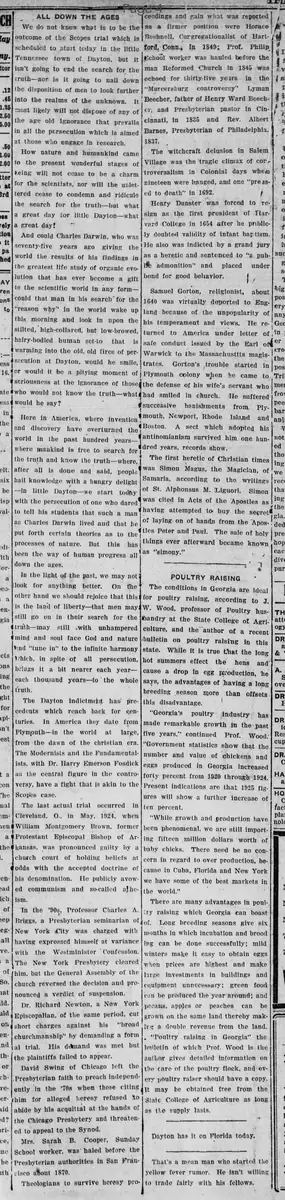
We do not know what is to be the outcome of the Scopes trial which is scheduled to start today in the little Tennessee town of Dayton, but it isn't going to end the search for the truth-nor is it going to nail down the disposition of men to look further into the realms of the unknown. It most likely will not dispose of any of the age old ignorance that prevails in all the persecution which is aimed at those who engage in research. How nature and humankind came to the present wonderful stages of being will not cease to be a charm for the scientists, nor will the unlettered cease to condemn and ridicule the search for the truth-but what a great day for little Dayton-what a great day!
And could Charles Darwin, who was seventy-five years ago giving the world the results of his findings in the greatest life study of organic evolution that has ever become a gift to the scientific world in any form- could that man in his search for the "reason why" in the world wake up this morning and look in upon the stilted, "high-collared, but low-browed, hairy-bodied human set-to" that is here in America, where invention and discovery have overturned the world in the past hundred years- where mankind is free to search for the truth and know the truth-where, after all is done and said, people hail knowledge with a hungry delight -in little Dayton-we start today with the persecution of one who dared to tell his students that such a man as Charles Darwin lived and that he put forth certain theories as to the processes of nature. But this has been the way of human progress all down the ages.
In the light of the past, we may not look for anything better. On the other hand we should rejoice that this is the land of liberty-that men may still go on in their search for the truth-may still with unhampered mind and soul face God and nature and "tune in" to the infinite harmony which, in spite of all persecution, brings it a bit nearer each year-- each thousand years--to the whole truth.
The Dayton indictment has precedents which reach back for centuries. In America they date from Plymouth-in the world at large, from the dawn of the christian era. The Modernists and the Fundamental- ists, with Dr. Harry Emerson Fosdick as the central figure in the contro versy. have a fight that is akin to the Scopes case.
The last actual trial occurred in Cleveland, O., in May, 1924, when William Montgomery Brown, former Protestant Episcopal Bishop of Ar- kansas, was pronounced guilty by a church court of holding beliefs at odds with the accepted doctrine of his denomination. He publicly avow- ed communism and so-called atheism.
In the '90s, Professor Charles A. Briggs. a Presbyterian seminarian of New York City was charged with having expressed himself at variance with the Westminister Confession. The New York Presbytery cleared him, but the General Assembly of the church reversed the decision and pro- nounced a verdict of suspension.
Dr. Richard Newton, a New York Episcopalian, of the same period, cut short charges against his "broad churchmanship" by demanding a form al trial. His demand was met but the plaintiffs failed to appear.
David Swing of Chicago left the Presbyterian faith to preach independ- ently in the '70s when those citing him for alleged heresy refused to abide by his acquittal at the hands of the Chicago Presbytery and threaten- ed to appeal to the Synod.
Mrs. Sarah B. Cooper, Sunday School worker. was' haled before the Presbyterian authorities in San Fran cisco about 1870.
Theologians to survive heresy, pro-
ceedings and gain what was reported as a firmer position were Horace Bushnell. Congregationalist of Hart- ford, Conn., in 1849; Prof. Philip Schaff of the German Reformed Church in 1845 was echoed for thirty-five years in the "Mercersburg controversy" Lyman Beecher, father of Henry Ward Beecher, and Presbyterian pastor in Cin- cinnati, in 1835 and Rev. Albert Barnes, Presbyterian of Philadelphia, 1837.
The witchcraft delusion in Salem Village was the tragic climax of cor- troversalism in Colonial days when nineteen were hanged, and one "press- ed to death" in 1692.
Henry Dunster was forced to re- sign as the first president of Har- vard College in 1654 after he publicly doubted validity of infant baptism. He also was indicted by a grand jury as a heretic and sentenced to "a. pub- lic admonition" and placed under bond for good behavior.
Samuel Gorton,, religionist, : about 1640 was virtually. deported 'to Eng- land because of the unpopularity of turned to America under letter. of safe conduct: issued by the Earl of Warwick to the Massachusetts magis-
The first heretic of Christian times was Simon Magus, the Magician, of Samaria, according to the writings of St. Alphonsus M. Liguori. Simon was cited in Acts of the Apostles as having attempted to buy the secret of laying on of hands from the Apostles Peter and Paul. The sale of holy things ever afterward became known as "simony."
We do not know what is to be the outcome of the Scopes trial which is scheduled to start today in the little Tennessee town of Dayton, but it isn't going to end the search for the truth-nor is it going to nail down the disposition of men to look further into the realms of the unknown. It most likely will not dispose of any of the age old ignorance that prevails in all the persecution which is aimed at those who engage in research. How nature and humankind came to the present wonderful stages of being will not cease to be a charm for the scientists, nor will the unlettered cease to condemn and ridicule the search for the truth-but what a great day for little Dayton-what a great day!
And could Charles Darwin, who was seventy-five years ago giving the world the results of his findings in the greatest life study of organic evolution that has ever become a gift to the scientific world in any form- could that man in his search for the "reason why" in the world wake up this morning and look in upon the stilted, "high-collared, but low-browed, hairy-bodied human set-to" that is here in America, where invention and discovery have overturned the world in the past hundred years- where mankind is free to search for the truth and know the truth-where, after all is done and said, people hail knowledge with a hungry delight -in little Dayton-we start today with the persecution of one who dared to tell his students that such a man as Charles Darwin lived and that he put forth certain theories as to the processes of nature. But this has been the way of human progress all down the ages.
In the light of the past, we may not look for anything better. On the other hand we should rejoice that this is the land of liberty-that men may still go on in their search for the truth-may still with unhampered mind and soul face God and nature and "tune in" to the infinite harmony which, in spite of all persecution, brings it a bit nearer each year-- each thousand years--to the whole truth.
The Dayton indictment has precedents which reach back for centuries. In America they date from Plymouth-in the world at large, from the dawn of the christian era. The Modernists and the Fundamental- ists, with Dr. Harry Emerson Fosdick as the central figure in the contro versy. have a fight that is akin to the Scopes case.
The last actual trial occurred in Cleveland, O., in May, 1924, when William Montgomery Brown, former Protestant Episcopal Bishop of Ar- kansas, was pronounced guilty by a church court of holding beliefs at odds with the accepted doctrine of his denomination. He publicly avow- ed communism and so-called atheism.
In the '90s, Professor Charles A. Briggs. a Presbyterian seminarian of New York City was charged with having expressed himself at variance with the Westminister Confession. The New York Presbytery cleared him, but the General Assembly of the church reversed the decision and pro- nounced a verdict of suspension.
Dr. Richard Newton, a New York Episcopalian, of the same period, cut short charges against his "broad churchmanship" by demanding a form al trial. His demand was met but the plaintiffs failed to appear.
David Swing of Chicago left the Presbyterian faith to preach independ- ently in the '70s when those citing him for alleged heresy refused to abide by his acquittal at the hands of the Chicago Presbytery and threaten- ed to appeal to the Synod.
Mrs. Sarah B. Cooper, Sunday School worker. was' haled before the Presbyterian authorities in San Fran cisco about 1870.
Theologians to survive heresy, pro-
ceedings and gain what was reported as a firmer position were Horace Bushnell. Congregationalist of Hart- ford, Conn., in 1849; Prof. Philip Schaff of the German Reformed Church in 1845 was echoed for thirty-five years in the "Mercersburg controversy" Lyman Beecher, father of Henry Ward Beecher, and Presbyterian pastor in Cin- cinnati, in 1835 and Rev. Albert Barnes, Presbyterian of Philadelphia, 1837.
The witchcraft delusion in Salem Village was the tragic climax of cor- troversalism in Colonial days when nineteen were hanged, and one "press- ed to death" in 1692.
Henry Dunster was forced to re- sign as the first president of Har- vard College in 1654 after he publicly doubted validity of infant baptism. He also was indicted by a grand jury as a heretic and sentenced to "a. pub- lic admonition" and placed under bond for good behavior.
Samuel Gorton,, religionist, : about 1640 was virtually. deported 'to Eng- land because of the unpopularity of turned to America under letter. of safe conduct: issued by the Earl of Warwick to the Massachusetts magis-
The first heretic of Christian times was Simon Magus, the Magician, of Samaria, according to the writings of St. Alphonsus M. Liguori. Simon was cited in Acts of the Apostles as having attempted to buy the secret of laying on of hands from the Apostles Peter and Paul. The sale of holy things ever afterward became known as "simony."
What sub-type of article is it?
Science Or Medicine
Moral Or Religious
What keywords are associated?
Scopes Trial
Charles Darwin
Evolution
Religious Persecution
Heresy Trials
Scientific Inquiry
Dayton Tennessee
What entities or persons were involved?
John Scopes
Charles Darwin
Harry Emerson Fosdick
William Montgomery Brown
Charles A. Briggs
Richard Newton
David Swing
Sarah B. Cooper
Horace Bushnell
Philip Schaff
Lyman Beecher
Albert Barnes
Henry Dunster
Samuel Gorton
Simon Magus
Editorial Details
Primary Topic
Scopes Trial And Historical Persecution Of Scientific And Religious Inquiry
Stance / Tone
Supportive Of Scientific Progress And Critical Of Religious Persecution
Key Figures
John Scopes
Charles Darwin
Harry Emerson Fosdick
William Montgomery Brown
Charles A. Briggs
Richard Newton
David Swing
Sarah B. Cooper
Horace Bushnell
Philip Schaff
Lyman Beecher
Albert Barnes
Henry Dunster
Samuel Gorton
Simon Magus
Key Arguments
The Scopes Trial Will Not End The Search For Truth Or Scientific Inquiry.
Persecution Of Researchers Has Been A Constant Throughout History.
America's Liberty Allows Continued Pursuit Of Knowledge Despite Opposition.
Historical Precedents Include Church Trials For Heresy From The 17th Century To Modern Times.
The Trial Echoes Ancient Christian Heresies Like That Of Simon Magus.