Thank you for visiting SNEWPapers!
Sign up free
Editorial
September 9, 1940
The Key West Citizen
Key West, Monroe County, Florida
What is this article about?
This editorial, first in a series by the National Defense Advisory Commission, outlines the US Navy's global role as first line of defense, detailing its personnel needs, organizational structure including key bureaus and reserves, and the importance of supply readiness for operations.
Merged-components note: Merged editorial on U.S. Navy defense with its continuation on page 2.
Clippings
1 of 2
OCR Quality
88%
Good
Full Text
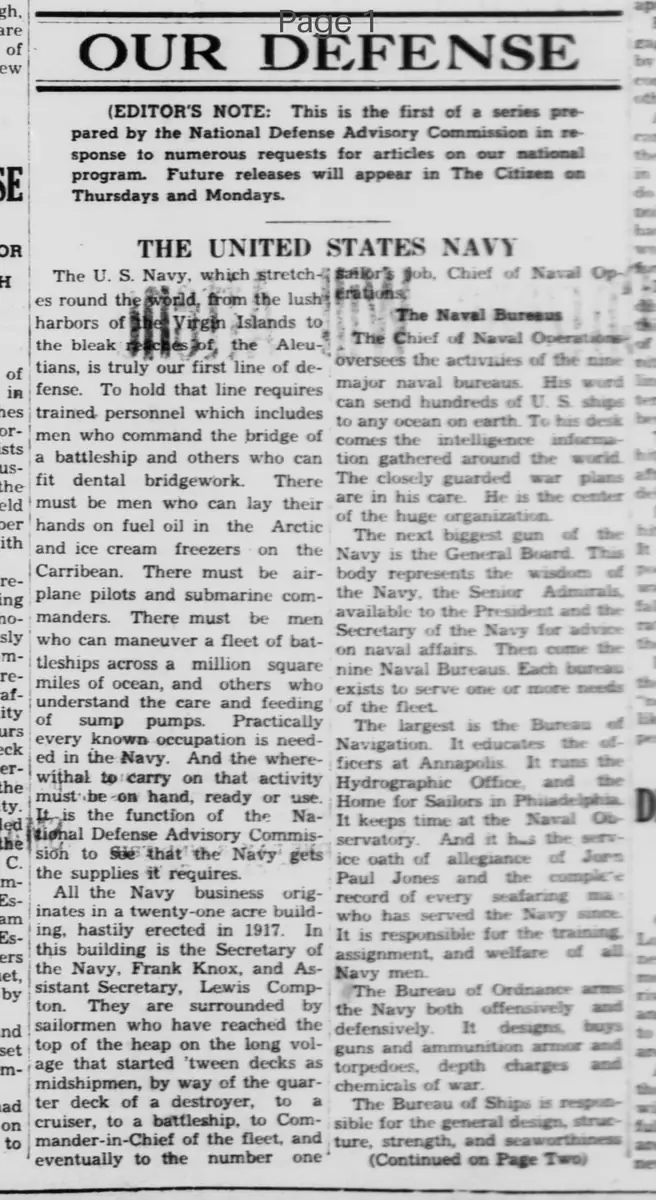
OUR DEFENSE (EDITOR'S NOTE: This is the first of a series prepared by the National Defense Advisory Commission in response to numerous requests for articles on the national defense program. Future releases will appear in The Citizen on Thursdays and Mondays.)
THE UNITED STATES NAVY
The U. S. Navy, which stretches round the world, from the lush harbors of the Virgin Islands to the bleak reaches of the Aleutians, is truly our first line of defense. To hold that line requires trained personnel which includes men who command the bridge of a battleship and others who can fit dental bridgework.
There must be men who can lay their hands on fuel oil in the Arctic and ice cream freezers on the Caribbean. There must be airplane pilots and submarine commanders. There must be men who can maneuver a fleet of battleships across a million square miles of ocean, and others who understand the care and feeding of sump pumps.
Practically every known occupation is needed in the Navy. And the wherewithal to carry on that activity must be on hand, ready for use.
It is the function of the National Defense Advisory Commission to see that the Navy gets the supplies it requires.
All the Navy business originates in a twenty-one acre building, hastily erected in 1917. In this building is the Secretary of the Navy, Frank Knox, and Assistant Secretary, Lewis Compton.
They are surrounded by sailormen who have reached the top of the heap on the long voyage that started 'tween decks as midshipmen, by way of the quarter deck of a destroyer, to a cruiser, to a battleship, to Commander-in-Chief of the fleet, and eventually to the number one
sailor's job, Chief of Operations
The Naval Bureaus The Chief of Naval Operations oversees the activities of the major naval bureaus. His office can send hundreds of U. S. ships to any ocean on earth. To it comes the intelligence
gathered around the The closely guarded war plans are in his care. He is the head of the huge organization
The next biggest gun in the Navy is the General Board. This body represents the wisdom of the Navy, the Senior Admiral available to the President and Secretary of the Navy for advice on naval affairs. Then come the nine Naval Bureaus. Each bureau exists to serve one or more men of the fleet.
The largest is the Bureau of Navigation. It educates three officers at Annapolis. It runs the Hydrographic Office and Home for Sailors in Philadelphia. It keeps time at the Naval Observatory. And it has the service oath of allegiance of John Paul Jones and the complete record of every seafaring man who has served the Navy since
It is responsible for the training, assignment, and welfare of all Navy men
The Bureau of Ordnance arms the Navy both offensively and defensively. It designs guns and ammunition, armor and torpedoes, depth charges chemicals of war
The Bureau of Ships is responsible for the general design, structure, strength, and seaworthiness (Continued on Page Two)
OUR DEFENSE
(Continued from Page One)
of all ships in the Navy, and for the engines that drive the vessels. In addition, it designs such items as machine guns and gas masks, minesweeping equipment, and operates the new experimental model basin built with P. W. A. funds near Washington, where the new types of war designs may be tested.
When the Bureau of Ships wants a little something in the line of battleship building, the Bureau of Yards and Docks provides the shipyards, drydocks, marine railways, wharves, locomotives, derricks, trucks, as well as the horses and teams necessary for the operation of the Navy Yard.
The Bureau of Aeronautics must provide the fleet with powerful and efficient naval air service.
The Bureau of Supplies and Accounts must acquire the material, fuel, and other necessities of the Navy.
The Bureau of Medicine and Surgery provides medical care for the Navy and Marine Corps, and is represented not only in this country, but in outlying territories and aboard every Navy vessel in active commission.
The office of the Judge Advocate General, who really ought to be called the Judge Advocate Admiral, is the legal part of the Navy. Aside from keeping the Navy out of the toils of the law, this office interprets the bills and resolutions of Congress and helps with the proposed legislation arising in the Navy Department.
The Navy Examining Board conducts the examinations which every officer must take as he advances through the successive ranks from ensign to admiral.
The Naval Reserve
Like the Army, the U. S. Navy has a Reserve. It consists of 16,000 officers and 65,000 enlisted men (including the Marine Corps Reserve) ready to step into their positions on fighting ships. First is the Fleet Reserve, men who have served with the fleet. These ex-service men, with the regular naval forces, are the backbone of our expanded fleet.
Next is the Organized Reserve. Like the National Guard, it is composed of men willing to perform annual training so that they will be available for immediate mobilization.
Then there is the Volunteer Reserve, mostly composed of specialists qualified by experience to help the Navy in technical and professional fields, where this experience can be of value to the organization.
There is also the Merchant Marine Reserve. These are the men now serving on merchant vessels, who in time of emergency would serve largely on those same vessels engaged in naval service, such as supply ships, etc.
The Rear Admirals in charge of the nine Bureaus help the Chief of Naval Operations run the Navy.
There is still one branch that can't be overlooked in running the Navy. That is the Marine Corps. This component of the naval service exists primarily to support the fleet, but in case of national emergency the marines are called on for any duty.
Members of the Marine Corps are really seagoing soldiers responsible to the Commander-In-Chief.
Of course, there must be a large establishment ashore to keep the fleet afloat, and ready for anything.
The National Defense Advisory Commission helps the shore stations get what the fleet needs in steel, in machinery, in fuel, in arms and ammunition, in food and clothing.
That takes considerable looking ahead, for when the fleet goes into action, and it is discovered that there isn't enough silk available for the powder bags for the big guns, the Commander can't call up the enemy and say, "Would you pardon us for a month till we can send back to Paterson, New Jersey, and get a few more supplies." The necessary supplies have to be there, and the National Defense Advisory Commission is helping the Navy get them there when needed.
THE UNITED STATES NAVY
The U. S. Navy, which stretches round the world, from the lush harbors of the Virgin Islands to the bleak reaches of the Aleutians, is truly our first line of defense. To hold that line requires trained personnel which includes men who command the bridge of a battleship and others who can fit dental bridgework.
There must be men who can lay their hands on fuel oil in the Arctic and ice cream freezers on the Caribbean. There must be airplane pilots and submarine commanders. There must be men who can maneuver a fleet of battleships across a million square miles of ocean, and others who understand the care and feeding of sump pumps.
Practically every known occupation is needed in the Navy. And the wherewithal to carry on that activity must be on hand, ready for use.
It is the function of the National Defense Advisory Commission to see that the Navy gets the supplies it requires.
All the Navy business originates in a twenty-one acre building, hastily erected in 1917. In this building is the Secretary of the Navy, Frank Knox, and Assistant Secretary, Lewis Compton.
They are surrounded by sailormen who have reached the top of the heap on the long voyage that started 'tween decks as midshipmen, by way of the quarter deck of a destroyer, to a cruiser, to a battleship, to Commander-in-Chief of the fleet, and eventually to the number one
sailor's job, Chief of Operations
The Naval Bureaus The Chief of Naval Operations oversees the activities of the major naval bureaus. His office can send hundreds of U. S. ships to any ocean on earth. To it comes the intelligence
gathered around the The closely guarded war plans are in his care. He is the head of the huge organization
The next biggest gun in the Navy is the General Board. This body represents the wisdom of the Navy, the Senior Admiral available to the President and Secretary of the Navy for advice on naval affairs. Then come the nine Naval Bureaus. Each bureau exists to serve one or more men of the fleet.
The largest is the Bureau of Navigation. It educates three officers at Annapolis. It runs the Hydrographic Office and Home for Sailors in Philadelphia. It keeps time at the Naval Observatory. And it has the service oath of allegiance of John Paul Jones and the complete record of every seafaring man who has served the Navy since
It is responsible for the training, assignment, and welfare of all Navy men
The Bureau of Ordnance arms the Navy both offensively and defensively. It designs guns and ammunition, armor and torpedoes, depth charges chemicals of war
The Bureau of Ships is responsible for the general design, structure, strength, and seaworthiness (Continued on Page Two)
OUR DEFENSE
(Continued from Page One)
of all ships in the Navy, and for the engines that drive the vessels. In addition, it designs such items as machine guns and gas masks, minesweeping equipment, and operates the new experimental model basin built with P. W. A. funds near Washington, where the new types of war designs may be tested.
When the Bureau of Ships wants a little something in the line of battleship building, the Bureau of Yards and Docks provides the shipyards, drydocks, marine railways, wharves, locomotives, derricks, trucks, as well as the horses and teams necessary for the operation of the Navy Yard.
The Bureau of Aeronautics must provide the fleet with powerful and efficient naval air service.
The Bureau of Supplies and Accounts must acquire the material, fuel, and other necessities of the Navy.
The Bureau of Medicine and Surgery provides medical care for the Navy and Marine Corps, and is represented not only in this country, but in outlying territories and aboard every Navy vessel in active commission.
The office of the Judge Advocate General, who really ought to be called the Judge Advocate Admiral, is the legal part of the Navy. Aside from keeping the Navy out of the toils of the law, this office interprets the bills and resolutions of Congress and helps with the proposed legislation arising in the Navy Department.
The Navy Examining Board conducts the examinations which every officer must take as he advances through the successive ranks from ensign to admiral.
The Naval Reserve
Like the Army, the U. S. Navy has a Reserve. It consists of 16,000 officers and 65,000 enlisted men (including the Marine Corps Reserve) ready to step into their positions on fighting ships. First is the Fleet Reserve, men who have served with the fleet. These ex-service men, with the regular naval forces, are the backbone of our expanded fleet.
Next is the Organized Reserve. Like the National Guard, it is composed of men willing to perform annual training so that they will be available for immediate mobilization.
Then there is the Volunteer Reserve, mostly composed of specialists qualified by experience to help the Navy in technical and professional fields, where this experience can be of value to the organization.
There is also the Merchant Marine Reserve. These are the men now serving on merchant vessels, who in time of emergency would serve largely on those same vessels engaged in naval service, such as supply ships, etc.
The Rear Admirals in charge of the nine Bureaus help the Chief of Naval Operations run the Navy.
There is still one branch that can't be overlooked in running the Navy. That is the Marine Corps. This component of the naval service exists primarily to support the fleet, but in case of national emergency the marines are called on for any duty.
Members of the Marine Corps are really seagoing soldiers responsible to the Commander-In-Chief.
Of course, there must be a large establishment ashore to keep the fleet afloat, and ready for anything.
The National Defense Advisory Commission helps the shore stations get what the fleet needs in steel, in machinery, in fuel, in arms and ammunition, in food and clothing.
That takes considerable looking ahead, for when the fleet goes into action, and it is discovered that there isn't enough silk available for the powder bags for the big guns, the Commander can't call up the enemy and say, "Would you pardon us for a month till we can send back to Paterson, New Jersey, and get a few more supplies." The necessary supplies have to be there, and the National Defense Advisory Commission is helping the Navy get them there when needed.
What sub-type of article is it?
Military Affairs
What keywords are associated?
Us Navy
National Defense
Naval Bureaus
Chief Of Naval Operations
Naval Reserve
Marine Corps
Defense Supplies
Fleet Preparedness
What entities or persons were involved?
National Defense Advisory Commission
Secretary Of The Navy Frank Knox
Assistant Secretary Lewis Compton
Chief Of Naval Operations
Bureau Of Navigation
Bureau Of Ordnance
Bureau Of Ships
Bureau Of Yards And Docks
Bureau Of Aeronautics
Bureau Of Supplies And Accounts
Bureau Of Medicine And Surgery
Judge Advocate General
Navy Examining Board
Naval Reserve
Marine Corps
Editorial Details
Primary Topic
Structure And Operations Of The Us Navy As First Line Of Defense
Stance / Tone
Informative And Promotional For National Defense Preparedness
Key Figures
National Defense Advisory Commission
Secretary Of The Navy Frank Knox
Assistant Secretary Lewis Compton
Chief Of Naval Operations
Bureau Of Navigation
Bureau Of Ordnance
Bureau Of Ships
Bureau Of Yards And Docks
Bureau Of Aeronautics
Bureau Of Supplies And Accounts
Bureau Of Medicine And Surgery
Judge Advocate General
Navy Examining Board
Naval Reserve
Marine Corps
Key Arguments
The Us Navy Requires Diverse Trained Personnel From Commanders To Technicians For Global Defense
National Defense Advisory Commission Ensures Supply Of Necessary Materials
Navy Operations Originate From A Building Housing Key Officials And Bureaus
Chief Of Naval Operations Oversees Bureaus And War Plans
Naval Bureaus Handle Specific Functions Like Navigation, Ordnance, Ship Design, And Medical Care
Naval Reserve Includes Fleet, Organized, Volunteer, And Merchant Marine Reserves For Rapid Mobilization
Marine Corps Supports The Fleet And Handles Emergency Duties
Advance Planning For Supplies Like Steel, Fuel, And Ammunition Is Critical For Fleet Readiness