Thank you for visiting SNEWPapers!
Sign up free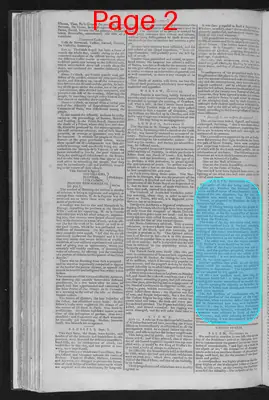
Gazette Of The United States
New York, New York County, New York
What is this article about?
In Paris on September 15, the National Assembly voted 849-89 for a single chamber legislature, rejecting a Senate proposal. They thanked M. d'Estaing for militia arrangements, refused to read M. Necker's report, affirmed the king's right to refuse consent to edicts (730-143), adopted a suspensive refusal (673-325), and deferred suspension duration. On Saturday, Cardinal de Rohan was applauded, and triennial parliaments were approved after debate.
Clipping
OCR Quality
Full Text
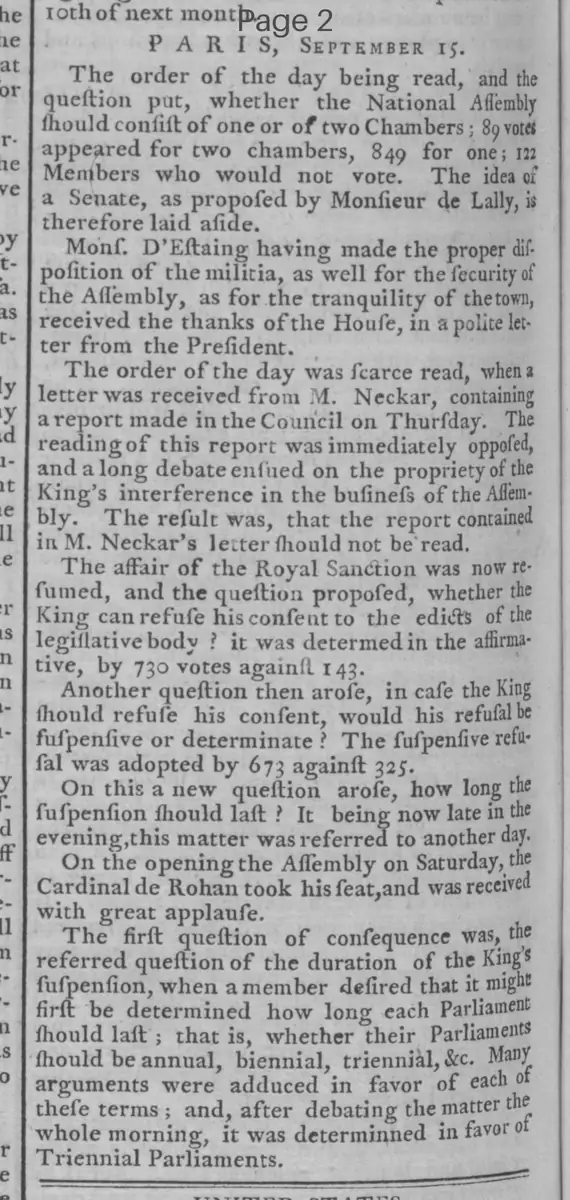
The order of the day being read, and the question put, whether the National Assembly should consist of one or of two Chambers; 89 votes appeared for two chambers, 849 for one; 122 Members who would not vote. The idea of a Senate, as proposed by Monsieur de Lally, is therefore laid aside.
M. d'Estaing having made the proper disposition of the militia, as well for the security of the Assembly, as for the tranquility of the town, received the thanks of the House, in a polite letter from the President.
The order of the day was scarce read, when a letter was received from M. Necker, containing a report made in the Council on Thursday. The reading of this report was immediately opposed, and a long debate ensued on the propriety of the King's interference in the business of the Assembly. The result was, that the report contained in M. Necker's letter should not be read.
The affair of the Royal Sanction was now resumed, and the question proposed, whether the King can refuse his consent to the edicts of the legislative body? it was determined in the affirmative, by 730 votes against 143.
Another question then arose. in case the King should refuse his consent, would his refusal be suspensive or determinate? The suspensive refusal was adopted by 673 against 325.
On this a new question arose, how long the suspension should last? It being now late in the evening, this matter was referred to another day.
On the opening the Assembly on Saturday, the Cardinal de Rohan took his seat, and was received with great applause.
The first question of consequence was, the referred question of the duration of the King's suspension, when a member desired that it might first be determined how long each Parliament should last; that is, whether their Parliaments should be annual, biennial, triennial, &c. Many of these terms; and, after debating the matter the whole morning, it was determined in favor of Triennial Parliaments.
What sub-type of article is it?
What keywords are associated?
What entities or persons were involved?
Where did it happen?
Foreign News Details
Primary Location
Paris
Event Date
September 15
Key Persons
Outcome
votes: 849-89 for one chamber; 730-143 affirming king's refusal right; 673-325 for suspensive refusal; triennial parliaments approved.
Event Details
The National Assembly debated and voted on legislative structure, rejecting two chambers and a Senate; thanked M. d'Estaing for militia; opposed reading M. Necker's report; resumed royal sanction discussions, affirming king's consent refusal as suspensive; deferred suspension duration; on Saturday, Cardinal de Rohan seated with applause, and triennial parliaments determined after debate.