Thank you for visiting SNEWPapers!
Sign up free
Martinsburgh Gazette
Martinsburg, Berkeley County, West Virginia
What is this article about?
British Parliament received additional papers on April 22, 1823, regarding negotiations with Spain, including a 1814 treaty's separate article prohibiting Spanish alliances harming British interests, kept secret at France's request. Documents detail Spain's moderation and diplomatic disavowals.
Clipping
OCR Quality
Full Text
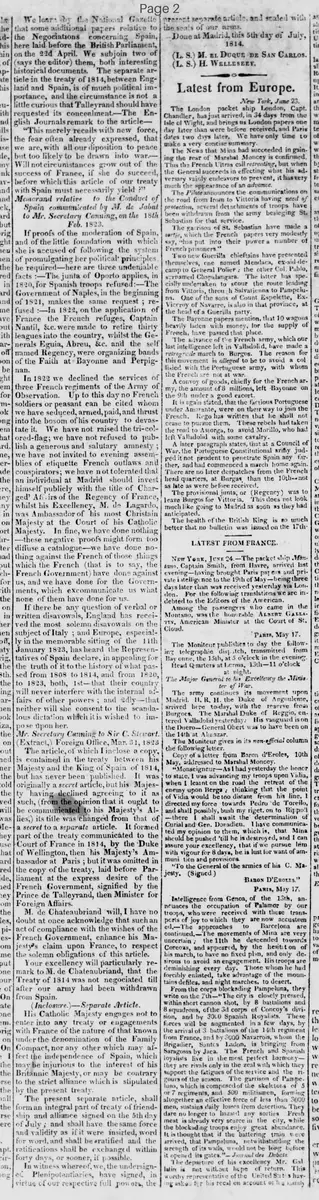
"This merely recalls with new force the fear often already expressed, that we are, with all our disposition to peace but too likely to be drawn into war.—Will not circumstances grow out of the success of France, if she do succeed, before which this article of our treaty with Spain must necessarily yield?"
Memorandum relative to the Conduct of Spain communicated by M. de Jabl to Mr. Secretary Canning, on the 18th Feb. 1823.
If proofs of the moderation of Spain, and of the little foundation with which she is accused of following the system of promulgating her political principles be required—here are three undeniable facts:—The junta of Oporto applies, in 1820, for Spanish troops refused:—The Government of Naples, in the beginning of 1821, makes the same request; refused:—In 1822, on the application of France the French refugees, Captain Nantil, &c. were made to retire thirty leagues into the country, whilst the Generals Eguia, Abreu, &c. and the self named Regency, were organizing bands of the Faith at Bayonne and Perpignan.
In 1822 we declined the services of three French regiments of the Army of Observation. Up to this day no French soldiers or peasant can be cited whom we have seduced, armed, paid, and thrust into the bosom of his country to devastate it. We have not raised the tri-colored flag; we have not refused to publish a generous and salutary amnesty; we have not invited to evening assemblies of etiquette French outlaws and conspirators; we have not tolerated that an individual at Madrid should invest himself publicly with the title of Charged' Affairs of the Regency of France, whilst his Excellency, M. de Lagardo, was Ambassador of his most Christian Majesty at the Court of his Catholic Majesty. In fine, we have done nothing—these negative proofs might form too diffuse a catalogue—we have done nothing against the French of those things which the French (that is to say, the French Government) have done against us, and we have done for the Governments, which excommunicate us what none of them have done for us.
If there be any question of verbal or written disavowals, England has received the most solemn disavowals on the subject of Italy; and Europe, especially in the memorable sitting of the 11th January 1823, has heard the Representatives of Spain declare, in appealing for the truth of it to the history of what passed from 1808 to 1814, and from 1820, to 1823, both. 1st—that their country will never interfere with the internal affairs of other powers; and 2dly—that neither will she consent to the scandalous dictation which it is wished to impose upon her.
Mr. Secretary Canning to Sir C. Stewart (Extract.) Foreign Office, Mar. 31, 1823.
The article, of which I inclose a copy, is contained in the treaty between his Majesty and the King of Spain of 1814, but has never been published. It was originally a secret article, but his Majesty having declined agreeing to it as such, (from the opinion that it ought to be communicated to his Majesty's Allies,) its title was changed from that of a secret to a separate article. It formed part of the treaty communicated to the Court of France in 1814, by the Duke of Wellington, then his Majesty's Ambassador at Paris; but it was omitted in the copy of the treaty, laid before Parliament at the express desire of the French Government, signified by the Prince de Talleyrand, then Minister for Foreign Affairs.
M. de Chateaubriand will, I have no doubt at once acknowledge that such an act of compliance with the wishes of the French Government, enhances his Majesty's claim upon France, to respect the solemn obligations of this article. Your excellency will particularly remark to M. de Chateaubriand, that the Treaty of 1814 was not negotiated till after our army had been withdrawn from Spain.
(Inclosure.)—Separate Article.
His Catholic Majesty engages not to enter into any treaty or engagements with France of the nature of that known under the denomination of the Family Compact, nor any other which may affect the independence of Spain, which may be injurious to the interest of his Britannic Majesty, or may be contrary to the strict alliance which is stipulated by the present treaty.
The present separate article, shall form an integral part of treaty of friendship and alliance signed on the 5th day of July: and shall have the same force and validity as if it were inserted, word for word, and shall be ratified and the ratifications shall be exchanged within forty days, or sooner, if possible.
In witness whereof, we, the undersigned Plenipotentiaries, have signed, in virtue of our respective full powers, the present separate article. and sealed with the seals of our arms.
—Done at Madrid, this 5th day of July, 1814.
(L. S.) M. EL DUQUE DE San Carlos.
(L. S.) H. WELLESLEY.
What sub-type of article is it?
What keywords are associated?
What entities or persons were involved?
Where did it happen?
Foreign News Details
Primary Location
Spain
Event Date
22 April 1823
Key Persons
Outcome
revelation of 1814 treaty's separate article prohibiting spanish alliances injurious to britain; spain's disavowals of interference in other nations' affairs; diplomatic tensions with france highlighted.
Event Details
Additional papers on negotiations with Spain presented to British Parliament on April 22, 1823, including a memorandum from M. de Jabl to Canning detailing Spain's moderation and refusals to aid revolutionary movements, and an extract from Canning to Sir C. Stewart revealing a 1814 separate treaty article kept secret at Talleyrand's request, binding Spain against certain French alliances.