Thank you for visiting SNEWPapers!
Sign up free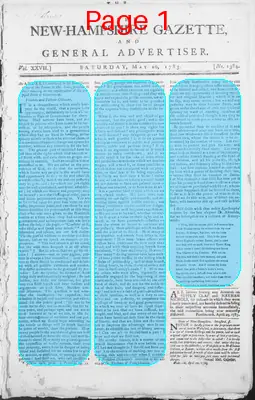
Editorial
May 10, 1783
The New Hampshire Gazette And General Advertiser
Portsmouth, Exeter, Rockingham County, New Hampshire
What is this article about?
An address to town inhabitants urging careful consideration and ratification of a proposed constitution to secure liberty, property, and good government, emphasizing revolutionary sacrifices and the rare opportunity to form their own government.
Clipping
OCR Quality
95%
Excellent
Full Text
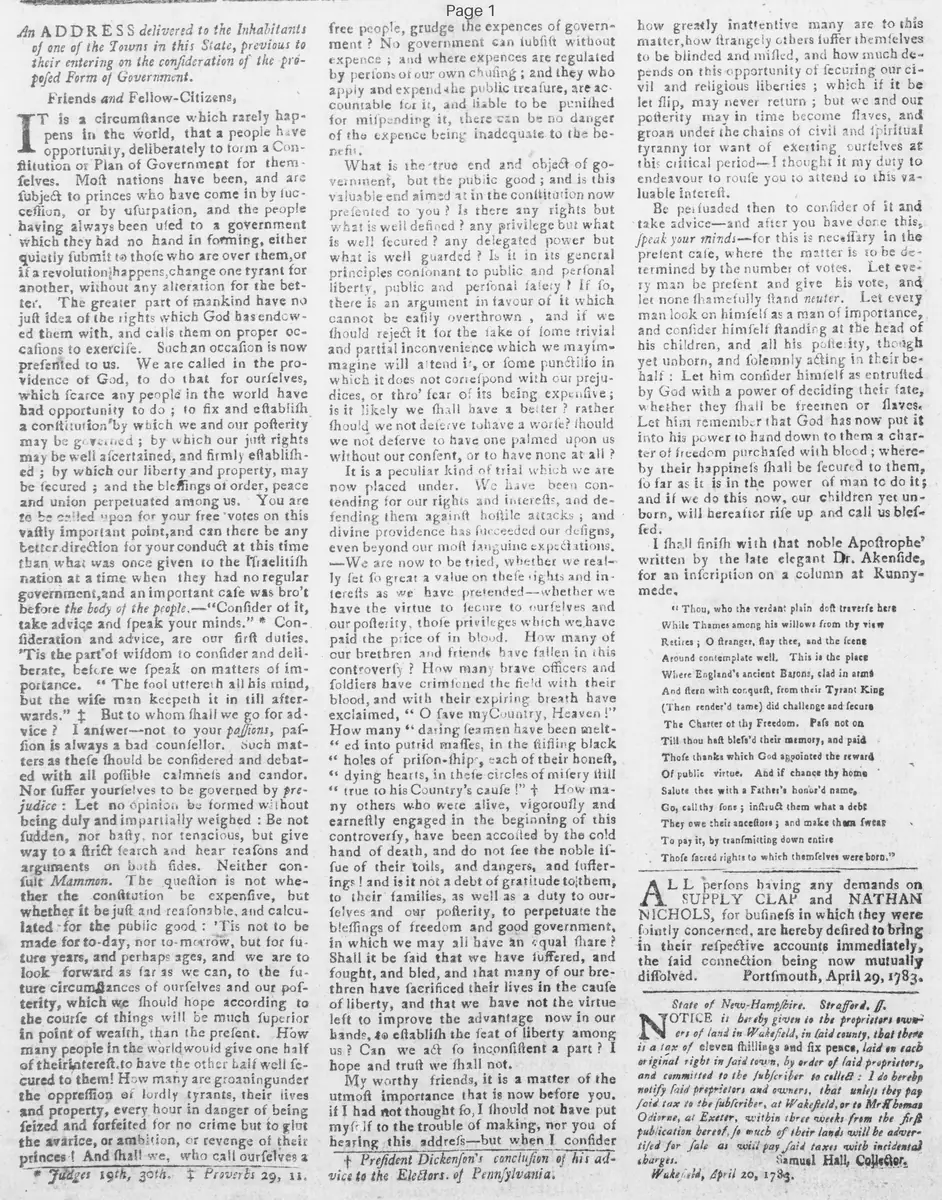
An ADDRESS delivered to the Inhabitants of one of the Towns in this State, previous to their entering on the consideration of the proposed Form of Government.
Friends and Fellow-Citizens:
It is a circumstance which rarely happens in the world, that a people have opportunity, deliberately to form a Constitution or Plan of Government for themselves. Most nations have been, and are subject to princes who have come in by succession, or by usurpation, and the people having always been used to a government which they had no hand in forming, either quietly submit to those who are over them, or if a revolution happens, change one tyrant for another, without any alteration for the better.
The greater part of mankind have no just idea of the rights which God has endowed them with, and calls them on proper occasions to exercise. Such an occasion is now presented to us. We are called in the providence of God, to do that for ourselves, which scarce any people in the world have had opportunity to do; to fix and establish a constitution by which we and our posterity may be governed: by which our just rights may be well ascertained, and firmly established: by which our liberty and property, may be secured: and the blessings of order, peace and union perpetuated among us. You are to be called upon for your free votes on this vastly important point, and can there be any better direction for your conduct at this time than what was once given to the Israelitish nation at a time when they had no regular government, and an important case was brought before the body of the people. "Consider of it, take advice and speak your minds." Consideration and advice, are our first duties. "Tis the part of wisdom to consider and deliberate, before we speak on matters of importance. The fool uttereth all his mind, but the wise man keepeth it in till afterwards." But to whom shall we go for advice? I answer--not to your passions, passion is always a bad counsellor. Such matters as these should be considered and debated with all possible calmness and candor. Nor suffer yourselves to be governed by prejudice: Let no opinion be formed without being duly and impartially weighed: Be not sudden, nor hasty, nor tenacious, but give way to a strict search and hear reasons and arguments on both sides. Neither consult Mammon. The question is not whether the constitution be expensive, but whether it be just and reasonable, and calculated for the public good: 'Tis not to be made for to-day, nor to-morrow, but for future years, and perhaps ages, and we are to look forward as far as we can, to the future circumstances of ourselves and our posterity, which we should hope according to the course of things will be much superior in point of wealth, than the present. How many people in the world would give one half of their interest, to have the other half well secured to them! How many are groaning under the oppression of lordly tyrants, their lives and property, every hour in danger of being seized and forfeited for no crime but to glut the avarice, or ambition, or revenge of their princes! And shall we, who call ourselves a
free people, grudge the expenses of government? No government can subsist without expense; and where expenses are regulated by persons of our own choosing; and they who apply and expend the public treasure, are accountable for it, and liable to be punished for misspending it, there can be no danger of the expense being inadequate to the benefit.
What is the true end and object of government, but the public good; and is this valuable end aimed at in the constitution now presented to you? Is there any rights but what is well defined? any privilege but what is well secured? any delegated power but what is well guarded? Is it in its general principles consonant to public and personal liberty, public and personal safety? If so, there is an argument in favour of it which cannot be easily overthrown, and if we should reject it for the sake of some trivial and partial inconvenience which we may imagine will attend it, or some punctilio in which it does not correspond with our prejudices, or thro' fear of its being expensive; is it likely we shall have a better? rather should we not deserve to have a worse? should we not deserve to have one palmed upon us without our consent, or to have none at all?
It is a peculiar kind of trial which we are now placed under. We have been contending for our rights and interests, and defending them against hostile attacks; and divine providence has succeeded our designs, even beyond our most sanguine expectations. We are now to be tried, whether we really set so great a value on these rights and interests as we have pretended--whether we have the virtue to secure to ourselves and our posterity, those privileges which we have paid the price of in blood. How many of our brethren and friends have fallen in this controversy? How many brave officers and soldiers have crimsoned the field with their blood, and with their expiring breath have exclaimed, "O save my Country, Heaven!" How many "daring seamen have been melted into putrid masses, in the stifling black "holes of prison-ship, each of their honest, "dying hearts, in these circles of misery still "true to his Country's cause!" How many others who were alive, vigorously and earnestly engaged in the beginning of this controversy, have been accosted by the cold hand of death, and do not see the noble issue of their toils, and dangers, and sufferings! and is it not a debt of gratitude to them, to their families, as well as a duty to ourselves and our posterity, to perpetuate the blessings of freedom and good government, in which we may all have an equal share?
Shall it be said that we have suffered, and fought, and bled, and that many of our brethren have sacrificed their lives in the cause of liberty, and that we have not the virtue left to improve the advantage now in our hands, to establish the seat of liberty among us? Can we act so inconsistent a part? I hope and trust we shall not.
My worthy friends, it is a matter of the utmost importance that is now before you. If I had not thought so, I should not have put myself to the trouble of making, nor you of hearing this address--but when I consider President Dickinson's conclusion of his advice to the Electors of Pennsylvania.
how greatly inattentive many are to this matter, how strangely others suffer themselves to be blinded and misled, and how much depends on this opportunity of securing our civil and religious liberties: which if it be let slip, may never return; but we and our posterity may in time become slaves, and groan under the chains of civil and spiritual tyranny for want of exerting ourselves at this critical period--I thought it my duty to endeavour to rouse you to attend to this valuable interest.
Be persuaded then to consider of it and take advice--and after you have done this, speak your minds--for this is necessary in the present case, where the matter is to be determined by the number of votes. Let every man be present and give his vote, and let none shamefully stand neuter. Let every man look on himself as a man of importance, and consider himself standing at the head of his children, and all his posterity, though yet unborn, and solemnly acting in their behalf: Let him consider himself as entrusted by God with a power of deciding their fate, whether they shall be freemen or slaves. Let him remember that God has now put it into his power to hand down to them a charter of freedom purchased with blood; whereby their happiness shall be secured to them, so far as it is in the power of man to do it; and if we do this now, our children yet unborn, will hereafter rise up and call us blessed.
I shall finish with that noble Apostrophe written by the late elegant Dr. Akenside for an inscription on a column at Runnymede.
"Thou, who the verdant plain dost traverse here While Thames among his willows from thy view Retires; O stranger, stay thee, and the scene Around contemplate well. This is the place Where England's ancient Barons, clad in arms And stern with conquest, from their Tyrant King (Then render'd tame) did challenge and secure The Charter of thy Freedom. Pass not on Till thou hast bless'd their memory, and paid Those thanks which God appointed the reward Of public virtue. And if chance thy home Salute thee with a Father's honour'd name, Go, call thy sons; instruct them what a debt They owe their ancestors; and make them wear To pay it, by transmitting down entire Those sacred rights to which themselves were born."
Friends and Fellow-Citizens:
It is a circumstance which rarely happens in the world, that a people have opportunity, deliberately to form a Constitution or Plan of Government for themselves. Most nations have been, and are subject to princes who have come in by succession, or by usurpation, and the people having always been used to a government which they had no hand in forming, either quietly submit to those who are over them, or if a revolution happens, change one tyrant for another, without any alteration for the better.
The greater part of mankind have no just idea of the rights which God has endowed them with, and calls them on proper occasions to exercise. Such an occasion is now presented to us. We are called in the providence of God, to do that for ourselves, which scarce any people in the world have had opportunity to do; to fix and establish a constitution by which we and our posterity may be governed: by which our just rights may be well ascertained, and firmly established: by which our liberty and property, may be secured: and the blessings of order, peace and union perpetuated among us. You are to be called upon for your free votes on this vastly important point, and can there be any better direction for your conduct at this time than what was once given to the Israelitish nation at a time when they had no regular government, and an important case was brought before the body of the people. "Consider of it, take advice and speak your minds." Consideration and advice, are our first duties. "Tis the part of wisdom to consider and deliberate, before we speak on matters of importance. The fool uttereth all his mind, but the wise man keepeth it in till afterwards." But to whom shall we go for advice? I answer--not to your passions, passion is always a bad counsellor. Such matters as these should be considered and debated with all possible calmness and candor. Nor suffer yourselves to be governed by prejudice: Let no opinion be formed without being duly and impartially weighed: Be not sudden, nor hasty, nor tenacious, but give way to a strict search and hear reasons and arguments on both sides. Neither consult Mammon. The question is not whether the constitution be expensive, but whether it be just and reasonable, and calculated for the public good: 'Tis not to be made for to-day, nor to-morrow, but for future years, and perhaps ages, and we are to look forward as far as we can, to the future circumstances of ourselves and our posterity, which we should hope according to the course of things will be much superior in point of wealth, than the present. How many people in the world would give one half of their interest, to have the other half well secured to them! How many are groaning under the oppression of lordly tyrants, their lives and property, every hour in danger of being seized and forfeited for no crime but to glut the avarice, or ambition, or revenge of their princes! And shall we, who call ourselves a
free people, grudge the expenses of government? No government can subsist without expense; and where expenses are regulated by persons of our own choosing; and they who apply and expend the public treasure, are accountable for it, and liable to be punished for misspending it, there can be no danger of the expense being inadequate to the benefit.
What is the true end and object of government, but the public good; and is this valuable end aimed at in the constitution now presented to you? Is there any rights but what is well defined? any privilege but what is well secured? any delegated power but what is well guarded? Is it in its general principles consonant to public and personal liberty, public and personal safety? If so, there is an argument in favour of it which cannot be easily overthrown, and if we should reject it for the sake of some trivial and partial inconvenience which we may imagine will attend it, or some punctilio in which it does not correspond with our prejudices, or thro' fear of its being expensive; is it likely we shall have a better? rather should we not deserve to have a worse? should we not deserve to have one palmed upon us without our consent, or to have none at all?
It is a peculiar kind of trial which we are now placed under. We have been contending for our rights and interests, and defending them against hostile attacks; and divine providence has succeeded our designs, even beyond our most sanguine expectations. We are now to be tried, whether we really set so great a value on these rights and interests as we have pretended--whether we have the virtue to secure to ourselves and our posterity, those privileges which we have paid the price of in blood. How many of our brethren and friends have fallen in this controversy? How many brave officers and soldiers have crimsoned the field with their blood, and with their expiring breath have exclaimed, "O save my Country, Heaven!" How many "daring seamen have been melted into putrid masses, in the stifling black "holes of prison-ship, each of their honest, "dying hearts, in these circles of misery still "true to his Country's cause!" How many others who were alive, vigorously and earnestly engaged in the beginning of this controversy, have been accosted by the cold hand of death, and do not see the noble issue of their toils, and dangers, and sufferings! and is it not a debt of gratitude to them, to their families, as well as a duty to ourselves and our posterity, to perpetuate the blessings of freedom and good government, in which we may all have an equal share?
Shall it be said that we have suffered, and fought, and bled, and that many of our brethren have sacrificed their lives in the cause of liberty, and that we have not the virtue left to improve the advantage now in our hands, to establish the seat of liberty among us? Can we act so inconsistent a part? I hope and trust we shall not.
My worthy friends, it is a matter of the utmost importance that is now before you. If I had not thought so, I should not have put myself to the trouble of making, nor you of hearing this address--but when I consider President Dickinson's conclusion of his advice to the Electors of Pennsylvania.
how greatly inattentive many are to this matter, how strangely others suffer themselves to be blinded and misled, and how much depends on this opportunity of securing our civil and religious liberties: which if it be let slip, may never return; but we and our posterity may in time become slaves, and groan under the chains of civil and spiritual tyranny for want of exerting ourselves at this critical period--I thought it my duty to endeavour to rouse you to attend to this valuable interest.
Be persuaded then to consider of it and take advice--and after you have done this, speak your minds--for this is necessary in the present case, where the matter is to be determined by the number of votes. Let every man be present and give his vote, and let none shamefully stand neuter. Let every man look on himself as a man of importance, and consider himself standing at the head of his children, and all his posterity, though yet unborn, and solemnly acting in their behalf: Let him consider himself as entrusted by God with a power of deciding their fate, whether they shall be freemen or slaves. Let him remember that God has now put it into his power to hand down to them a charter of freedom purchased with blood; whereby their happiness shall be secured to them, so far as it is in the power of man to do it; and if we do this now, our children yet unborn, will hereafter rise up and call us blessed.
I shall finish with that noble Apostrophe written by the late elegant Dr. Akenside for an inscription on a column at Runnymede.
"Thou, who the verdant plain dost traverse here While Thames among his willows from thy view Retires; O stranger, stay thee, and the scene Around contemplate well. This is the place Where England's ancient Barons, clad in arms And stern with conquest, from their Tyrant King (Then render'd tame) did challenge and secure The Charter of thy Freedom. Pass not on Till thou hast bless'd their memory, and paid Those thanks which God appointed the reward Of public virtue. And if chance thy home Salute thee with a Father's honour'd name, Go, call thy sons; instruct them what a debt They owe their ancestors; and make them wear To pay it, by transmitting down entire Those sacred rights to which themselves were born."
What sub-type of article is it?
Constitutional
What keywords are associated?
Constitution Ratification
American Liberty
Government Formation
Revolutionary Sacrifices
Civil Rights
Public Good
What entities or persons were involved?
President Dickinson
Dr. Akenside
Israelitish Nation
Editorial Details
Primary Topic
Urging Ratification Of Proposed Constitution
Stance / Tone
Exhortatory Support For Constitution
Key Figures
President Dickinson
Dr. Akenside
Israelitish Nation
Key Arguments
Rare Opportunity To Form Own Government
Consider Calmly Without Passion Or Prejudice
Constitution Secures Rights, Liberty, Property
Debt To Revolutionary Sacrifices
Rejecting It Risks Worse Outcomes Or Tyranny
Vote To Secure Freedom For Posterity