Thank you for visiting SNEWPapers!
Sign up free
Story
April 4, 1814
Daily National Intelligencer
Washington, District Of Columbia
What is this article about?
Mr. Lowndes delivers a speech in the House of Representatives critiquing the Loan Bill and war policy, arguing that U.S. capital is insufficient for loans without harming commerce, contrasting with Britain's situation, and opposing the war over impressment and neutral rights.
Clipping
OCR Quality
98%
Excellent
Full Text
CONGRESS.
HOUSE OF REPRESENTATIVES
DEBATE ON THE LOAN BILL.
MR. LOWNDES'S SPEECH
(Continued.)
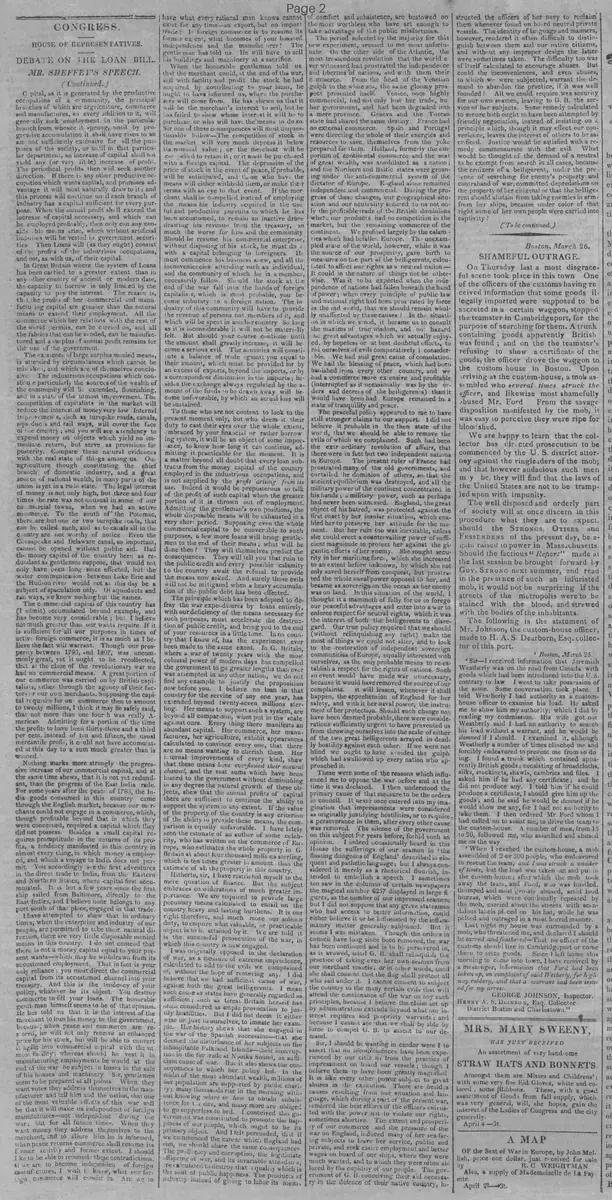
Capital, as it is generated by the productive occupations of a community, the principal branches of which are agriculture, commerce and manufactures, so every addition to it, will generally seek employment in the particular branch from whence it sprung, until by progressive accumulation it shall have risen to an amount sufficiently extensive for all the purposes of the society, or until in that particular department, an increase of capital shall not yield any (or very little) increase of profit. The periodical profits then will seek another direction. If there is any other productive occupation which wants capital, and promises advantage it will most naturally draw to it; and this process will continue until each branch of industry has a capital sufficient for every purpose. When the annual profit shall exceed the increase of capital necessary, and which can be employed profitably, then only can any considerable means arise, which without artificial impulses will be vested in government securities. Then Loans will (as they ought) consist of the profits of the industrious occupations, and not, as with us, of their capital.
In Great Britain where the system of Loans has been carried to a greater extent than in any other country of ancient or modern date, the capacity to borrow is only limited by the capacity to pay the interest. The reason is, that the profits of her commercial and manufacturing capital are greater than the natural means to extend their employment. All the commerce which her relations with the rest of the world permits, can be carried on, and all the fabrics that can be vended, can be manufactured and a surplus of annual profit remains for the use of the government.
The existence of large surplus monied means, is attended by circumstances which cannot be mistaken, and which are of themselves conclusive. The industrious occupations which constitute particularly the sources of the wealth of the community will be extended, flourishing, and in a state of the utmost improvement. The competition of capitalists in the market will reduce the interest of money very low. Internal improvements, such as turnpike roads, canals, aqueducts and rail ways, will cover the face of the country; and you will see a tendency to expend money on objects which yield no immediate return, but serve as provisions for posterity. Compare these natural evidences with the real state of things among us. Our agriculture though constituting the chief branch of domestic industry, and a great source of national wealth, in many parts of the union is yet in a rude state. The legal interest of money is not only high, but three and four times the rate was not unusual in some of our commercial towns, when we had an active commerce. To the south of the Potomac, there are but one or two turnpike roads, that can be called such, and as to canals all in the country are not worthy of notice. Even the Chesapeake and Delaware canal, so important, cannot be opened without public aid. Had the money capital of the country been as redundant as gentlemen suppose, that would not only have been long since effected, but the water communication between Lake Erie and the Hudson river would not at this day be a subject of speculation only. Of aqueducts and rail ways, we know nothing but the names.
The commercial capital of this country has (I admit) accumulated beyond example, and has become very considerable; but I believe not much greater than our wants require. If it is sufficient for all our purposes in times of active foreign commerce, it is as much as I believe the fact will warrant. Though our prosperity between 1793, and 1807, was uncommonly great, yet it ought to be recollected, that at the close of the revolutionary war we had no commercial means. A great portion of our commerce was carried on by British capitalists, either through the agency of their factors or our own merchants. Supposing the capital requisite for our commerce then to amount to twenty millions, I think it may be safely said, that not more than one fourth was really American. Admitting for a portion of the time the profits to have been thirty-three and a third per cent. instead of ten and fifteen, the usual mercantile profit, it could not have accumulated at this day to a sum much greater than is wanted.
Nothing marks more strongly the progressive increase of our commercial capital, and at the same time shews, that it is not yet redundant, than the progress of the East India trade. For some years after the peace of 1783, the India goods consumed in this country came through the English market, because our merchants could not engage in a commerce, which, though profitable beyond that in which they were concerned, required a capital which they did not possess. Besides a small capital requires promptitude in the returns of its profits, a tendency manifested in this country in almost every thing, in which money is employed, and which a voyage to India does not permit. You accordingly see the first adventures in the direct trade to India, from the Eastern and Northern States, where capital first accumulated. It is but a few years since the first ship sailed from Baltimore, directly to the East Indies, and I believe none belongs to any port south of that place, engaged in that trade.
I have attempted to shew that in ordinary times, when the enterprize and industry of our people, are permitted to take their natural direction, there are very little disposable monied means in this country. I do not contend that there is not a money capital equal to your present wants--which may be withdrawn from its accustomed employment. That in fact is your only reliance; you must direct the commercial capital from its accustomed channel into your treasury. And this is the tendency of your policy, whatever be its object. You destroy Commerce to fill your loans. The honorable gentleman himself seems to be of that opinion. He has told us that it is the interest of the merchant to loan his money to the government, because, when peace and commerce are restored, he will not only receive an enhanced price for his stock, but will be able to convert it again into commercial capital with the utmost facility: whereas should he vest it in manufacturing employments he would at the end of the war be subject to losses in the sale of his houses and machinery. Sir, gentlemen seem to be prepared at all points. When they want votes they address themselves to the manufacturer and tell him and the nation, that one of the most valuable effects of this war will be that it will make us independent of foreign manufactures—not independent during the war; but for all future times. When they want money they address themselves to the merchant, and to allure him he is informed, when peace returns commerce shall resume its former activity and former extent. I should like to be able to reconcile these contradictions. If we are to become independent of foreign manufactures, I wish to know, what our foreign commerce will consist in. Are we to exist for any time--an export, but no import trade? If foreign commerce is to resume its former extent, what becomes of your boasted independence and the manufacturer? The gentleman has told us. He will have to sell his buildings and machinery at a sacrifice.
When the honorable gentleman told us that the merchant could, at the end of the war, sell with facility and profit the stock he had acquired by contributing to your loans, he ought to have informed us, where the purchasers will come from. He has shewn us that it will be the merchant's interest to sell, but he has failed to shew whose interest it will be to purchase, or who will have the means to do so. Sir one of these consequences will most unquestionably follow--The competition of stock in the market will very much depress it below its nominal value: or the merchant will be compelled to retain it; or it must be purchased with a foreign capital. The depression of the price of stock in the event of peace, if probable, will be anticipated, and those who have the means will either withhold them, or make their terms with an eye to that event. If the merchant shall be compelled instead of employing the means his industry acquired in the use ful and productive pursuits to which he has been accustomed, to remain an inactive drone drawing his revenue from the treasury, so much the worse for him and the community. Should he resume his commercial enterprise, without disposing of his stock, he must do it with a capital belonging to foreigners. He must commence his business anew, and all the inconveniencies attending such an individual, and the community of which he is a member, necessarily follow. Should the stock at the end of the war fall into the hands of foreign capitalists, which is most probable, you become tributary to a foreign nation. The industry of this community will have to provide the revenue of persons not members of it, and which will be spent in another country. So long as it is inconsiderable it will not be materially felt. But should your course continue until the amount shall greatly increase, it will become a serious evil. The annuities will constitute a balance of trade against you equal to their amount, which must be provided for by an excess of exports, beyond the imports, or by a correspondent diminution in the imports; besides the exchange always regulated by the amount of the funds to be drawn away will become unfavorable, by which an actual loss will be sustained.
To those who are not content to look to the present moment only, but who deem it their duty to cast their eyes over the whole extent, embraced by your financial or rather borrowing system, it will be an object of some importance, to know how long it can continue, admitting it practicable for the moment. It is a matter beyond all doubt that every loan subtracts from the money capital of the country employed in the industrious occupations, and is not supplied by the profit arising from its use. Indeed it would be preposterous to talk of the profit of such capital when the greater portion of it is thrown out of employment. Admitting the gentleman's own positions, the whole disposable means will be exhausted in a very short period. Supposing even the whole commercial capital to be convertible to such purposes, a few more loans will bring gentlemen to the end of their means; what will be done then? They will themselves predict the consequences. They will tell you that ruin to the public credit and every possible calamity to the country await the refusal to provide the means now asked. And surely those evils will not be mitigated when a heavy accumulation of the public debt has been effected.
The principle which has been adopted to defray the war expenditures by loans entirely, with our deficiency of the means necessary for such purposes, must accelerate the destruction of public credit, and bring you to the end of your resources in a little time. In no country that I know of, has the experiment ever been made to the same extent. In G. Britain, where a war of twenty years with the most colossai power of modern days has compelled the government to go greater lengths than ever was attempted in any other nation, we do not find any example to justify the proposition now before you. I believe no loan in that country for the service of any one year, has extended beyond twenty-seven millions sterling. Her means to support such a system, are beyond all comparison, when put in the scale against ours. Every thing there manifests an abundant capital. Her commerce, her manufactures, her agriculture, exhibit appearances calculated to convince every one, that there are no means wanting to cherish them. Her internal improvements of every kind, shew that these means have overflored their natural channel, and the vast sums which have been loaned to the government without diminishing in any degree the natural growth of these objects, shew that the annual profits of capital there are sufficient to continue the ability to support the system to any extent. If the value of the property of the country is any criterion of the ability to provide these means, the comparison is equally unfavorable. I have lately seen the estimate of an author of some celebrity, who has written on the commerce of Europe, who estimates the whole property in G. Britain at about four thousand millions sterling, which is ten times greater in amount than the estimate of all the property in this country.
Hitherto, sir, I have restricted myself to the mere question of finance. But the subject embraces considerations of much greater importance. We are required to provide large pecuniary means calculated to entail on the country heavy and lasting burthens. It is our right therefore, and much more our solemn duty, to enquire what valuable, or practicable object is to be attained by it. We are told it is the successful prosecution of the war, in which this country is now engaged.
I was originally opposed to the declaration of war, as a measure of extreme imprudence, calculated to add to the evils we complained of, without the hope of removing any. I did believe that we had sufficient cause of war, against both the great belligerents. I mean such cause as states have generally regarded as sufficient; such as Great Britain herself has once considered as ample provocation to justify hostilities. But I did not deem it either wise or just to ourselves, to imitate her example. Her history shews that she engaged in the war of the Spanish succession--that she deemed the disturbance of her subjects on the inhospitable Falkland Islands--their interruption in the fur trade at Nootka Sound, as sufficient cause of war. But it also shews the consequences to which her policy led. In the midst of the most abundant wealth, millions of her population are supported by public charity; many thousands rise in the morning without knowing where or how to obtain subsistence for the day, and many more are obliged to go supperless to bed. I conceived this government was constituted to promote the happiness of our people, which ought to be its primary object. And I felt persuaded, that if we commenced the career which England had run, we should share the same consequences. The profligacy and corruption, the legitimate offspring of war, and its invariable attendants, calculated to destroy that equality which is the soul of public happiness. The products of industry instead of giving to labor its means of comfort and subsistence, are bestowed on the most worthless who have art enough to take advantage of the public misfortunes.
The period selected by the majority for this new experiment, seemed to me most unfortunate. On the other side of the Atlantic, the most tremendous revolution that the world ever witnessed had prostrated the independence and liberties of nations, and with them their commerce. From the head of the Venetian gulph to the white sea, the same gloomy prospect presented itself. Venice, once highly commercial, had not only lost her trade, but her government, and had been degraded into a mere province. Geneva and the Tuscan state had shared the same destiny. France had no external commerce. Spain and Portugal were directing the whole of their energies and resources to save themselves from the yoke prepared for them. Holland, formerly the emporium of continental commerce and the seat of great wealth, was annihilated as a nation; and the Northern and Baltic states were groaning under the anti-commercial system of the dictator of Europe. England alone remained independent and commercial. During the progress of these changes, our geographical situation and our neutrality secured to us not only the profitable trade of the British dominions where our products had no competition in the market, but the remaining commerce of the continent. We profited largely by the calamities which had befallen Europe. The unparalleled state of the world, however, while it was the source of our prosperity, gave birth to measures on the part of the belligerents, calculated to affect our rights as a neutral nation. It could in the nature of things not be otherwise. Was it to be expected when the independence of nations had fallen beneath the hand of power; when every principle of public law and national right had been prostrated by force in the old world, that we should remain wholly unaffected by these causes? In the situation in which we stood, it became us to consult the maxims of true wisdom, and not hazard the great advantages which we actually enjoyed, by hopeless or at best doubtful efforts, to rid ourselves of evils comparatively inconsiderable. We had still great cause of consolation. We had the blessing of peace, which had been banished from every other country, and we had a commerce more extensive and profitable (interrupted as it occasionally was by the orders and decrees of the belligerents) than it would have been had Europe remained in a state of tranquility and peace.
The peaceful policy appeared to me to have still stronger claims to our support. I did not believe it probable in the then state of the world, that we should be able to remove the evils of which we complained. Such had been the extraordinary revolution of affairs, that there were in fact but two independent nations in Europe. The present ruler of France had prostrated many of the old governments, and curtailed the dominion of others, so that the ancient equilibrium was destroyed, and all the military power of the continent concentrated in his hands; a military power, such as perhaps had never been witnessed. England, the great object of his hatred, was protected against the first onset by her insular situation, which enabled her to preserve her attitude for the moment. But her ruin too was inevitable, unless she could erect a countervailing power of sufficient magnitude to protect her against the gigantic efforts of her enemy. She sought security in her maritime force, which she increased to an extent before unknown, by which she not only saved herself from conquest, but prostrated the whole naval power opposed to her, and became as sovereign on the ocean as her enemy was on land. In this situation of the world, I thought it a mark of folly for us to forego our peaceful advantages and enter into a war to enforce respect for neutral rights, which it was the interest of both the belligerents to disregard. Our true policy required that we should (without relinquishing any right) make the most of things we could not alter, and to look to the restoration of independent sovereign communities of Europe, equally interested with ourselves, as the only probable means to re-establish a respect for the rights of nations. Such an event would have made war unnecessary, because it would have removed the source of our complaints. It will lessen, whenever it shall happen, the apprehension of England for her safety, and with it her naval power, the instrument of her protection. Should such change not have been deemed probable, there were considerations sufficiently urgent to have prevented us from throwing ourselves into the scale of either of the two great belligerents arrayed in deadly hostility against each other. If we were not blind we ought to have avoided the gulph which had swallowed up every nation who approached it.
These were some of the reasons which influenced me to oppose the war before and at the time it was declared. I then understood the primary cause of that measure to be the orders in council. It never once entered into my imagination that impressments were considered as originally justifying hostilities, or to require a perseverance in them, after every other cause was removed. The silence of the government on this subject for years before, forbid such an opinion. I indeed occasionally heard in this House the sufferings of our seamen in 'the floating dungeons of England' described in eloquent and pathetic language; but I always considered it merely as a rhetorical flourish, intended to embellish a speech. I sometimes too saw in the columns of certain newspapers the magical number 6257 displayed in large figures, as the number of our impressed seamen; but I did not suppose that any grave statesman who had access to better information, could either believe it or be influenced by the inflammatory matter generally subjoined. But it seems I was mistaken. Though the orders in council have long since been removed, the war has been continued and is to be persevered in, as is avowed, until G. B. shall relinquish the practice of taking even her own seamen from our merchant vessels; or in other words, until she shall consent that the flag shall protect all who sail under it. I cannot consent to subject the country to the many certain evils that will attend the continuance of the war on any such principles, because I believe the claim set up by administration extends beyond what our interest requires and propriety warrants; and because I cannot see that we shall be able by force to compel G. B. to assent to our demand.
Sir, I should be wanting in candor were I to assert that no inconveniences have been experienced by our citizens from the practice of impressment on board our vessels; though I believe them to have been greatly magnified. It is like every other power subject to great abuses in the execution. There are besides causes resulting from our situation and language, which during a part of the present war, rendered the best efforts of the officers entrusted with the power not to violate our rights, sometimes abortive. The extent and prosperity of our commerce and the pressure of the war on England, induced many of her sea-faring subjects to leave her service, public and private, and seek easier employment and better wages on board of our ships, where they were much wanted, and to which they were often allured by the cupidity of our people. The government of G. B. conceiving their aid necessary in the defence of their native country, instructed the officers of her navy to reclaim them whenever found on board neutral private vessels. The identity of language and manners, however, rendered it often difficult to distinguish between them and our native citizens, and without any improper design the latter were sometimes taken. The difficulty too was of itself calculated to encourage abuses. But could the inconveniences, and even abuses, to which we were subjected, warrant the demand to abandon the practice, if it was well founded? All we could require was security for our own seamen, leaving to G. B. the service of her subjects. Some remedy calculated to secure both ought to have been attempted by friendly negociation, instead of insisting on a principle which, though it may effect our convenience, leaves the interest of others to be sacrificed. Justice would be satisfied with a remedy commensurate with the evil. What would be thought of the demand of a neutral to be exempt from search in all cases, because the cruizers of a belligerent, under the pretence of searching for enemy's property and contraband of war, committed depredations on the property of her citizens? or that the belligerent should abstain from taking enemies in arms from her ships, because under color of that right some of her own people were carried into captivity?
(To be continued.)
HOUSE OF REPRESENTATIVES
DEBATE ON THE LOAN BILL.
MR. LOWNDES'S SPEECH
(Continued.)
Capital, as it is generated by the productive occupations of a community, the principal branches of which are agriculture, commerce and manufactures, so every addition to it, will generally seek employment in the particular branch from whence it sprung, until by progressive accumulation it shall have risen to an amount sufficiently extensive for all the purposes of the society, or until in that particular department, an increase of capital shall not yield any (or very little) increase of profit. The periodical profits then will seek another direction. If there is any other productive occupation which wants capital, and promises advantage it will most naturally draw to it; and this process will continue until each branch of industry has a capital sufficient for every purpose. When the annual profit shall exceed the increase of capital necessary, and which can be employed profitably, then only can any considerable means arise, which without artificial impulses will be vested in government securities. Then Loans will (as they ought) consist of the profits of the industrious occupations, and not, as with us, of their capital.
In Great Britain where the system of Loans has been carried to a greater extent than in any other country of ancient or modern date, the capacity to borrow is only limited by the capacity to pay the interest. The reason is, that the profits of her commercial and manufacturing capital are greater than the natural means to extend their employment. All the commerce which her relations with the rest of the world permits, can be carried on, and all the fabrics that can be vended, can be manufactured and a surplus of annual profit remains for the use of the government.
The existence of large surplus monied means, is attended by circumstances which cannot be mistaken, and which are of themselves conclusive. The industrious occupations which constitute particularly the sources of the wealth of the community will be extended, flourishing, and in a state of the utmost improvement. The competition of capitalists in the market will reduce the interest of money very low. Internal improvements, such as turnpike roads, canals, aqueducts and rail ways, will cover the face of the country; and you will see a tendency to expend money on objects which yield no immediate return, but serve as provisions for posterity. Compare these natural evidences with the real state of things among us. Our agriculture though constituting the chief branch of domestic industry, and a great source of national wealth, in many parts of the union is yet in a rude state. The legal interest of money is not only high, but three and four times the rate was not unusual in some of our commercial towns, when we had an active commerce. To the south of the Potomac, there are but one or two turnpike roads, that can be called such, and as to canals all in the country are not worthy of notice. Even the Chesapeake and Delaware canal, so important, cannot be opened without public aid. Had the money capital of the country been as redundant as gentlemen suppose, that would not only have been long since effected, but the water communication between Lake Erie and the Hudson river would not at this day be a subject of speculation only. Of aqueducts and rail ways, we know nothing but the names.
The commercial capital of this country has (I admit) accumulated beyond example, and has become very considerable; but I believe not much greater than our wants require. If it is sufficient for all our purposes in times of active foreign commerce, it is as much as I believe the fact will warrant. Though our prosperity between 1793, and 1807, was uncommonly great, yet it ought to be recollected, that at the close of the revolutionary war we had no commercial means. A great portion of our commerce was carried on by British capitalists, either through the agency of their factors or our own merchants. Supposing the capital requisite for our commerce then to amount to twenty millions, I think it may be safely said, that not more than one fourth was really American. Admitting for a portion of the time the profits to have been thirty-three and a third per cent. instead of ten and fifteen, the usual mercantile profit, it could not have accumulated at this day to a sum much greater than is wanted.
Nothing marks more strongly the progressive increase of our commercial capital, and at the same time shews, that it is not yet redundant, than the progress of the East India trade. For some years after the peace of 1783, the India goods consumed in this country came through the English market, because our merchants could not engage in a commerce, which, though profitable beyond that in which they were concerned, required a capital which they did not possess. Besides a small capital requires promptitude in the returns of its profits, a tendency manifested in this country in almost every thing, in which money is employed, and which a voyage to India does not permit. You accordingly see the first adventures in the direct trade to India, from the Eastern and Northern States, where capital first accumulated. It is but a few years since the first ship sailed from Baltimore, directly to the East Indies, and I believe none belongs to any port south of that place, engaged in that trade.
I have attempted to shew that in ordinary times, when the enterprize and industry of our people, are permitted to take their natural direction, there are very little disposable monied means in this country. I do not contend that there is not a money capital equal to your present wants--which may be withdrawn from its accustomed employment. That in fact is your only reliance; you must direct the commercial capital from its accustomed channel into your treasury. And this is the tendency of your policy, whatever be its object. You destroy Commerce to fill your loans. The honorable gentleman himself seems to be of that opinion. He has told us that it is the interest of the merchant to loan his money to the government, because, when peace and commerce are restored, he will not only receive an enhanced price for his stock, but will be able to convert it again into commercial capital with the utmost facility: whereas should he vest it in manufacturing employments he would at the end of the war be subject to losses in the sale of his houses and machinery. Sir, gentlemen seem to be prepared at all points. When they want votes they address themselves to the manufacturer and tell him and the nation, that one of the most valuable effects of this war will be that it will make us independent of foreign manufactures—not independent during the war; but for all future times. When they want money they address themselves to the merchant, and to allure him he is informed, when peace returns commerce shall resume its former activity and former extent. I should like to be able to reconcile these contradictions. If we are to become independent of foreign manufactures, I wish to know, what our foreign commerce will consist in. Are we to exist for any time--an export, but no import trade? If foreign commerce is to resume its former extent, what becomes of your boasted independence and the manufacturer? The gentleman has told us. He will have to sell his buildings and machinery at a sacrifice.
When the honorable gentleman told us that the merchant could, at the end of the war, sell with facility and profit the stock he had acquired by contributing to your loans, he ought to have informed us, where the purchasers will come from. He has shewn us that it will be the merchant's interest to sell, but he has failed to shew whose interest it will be to purchase, or who will have the means to do so. Sir one of these consequences will most unquestionably follow--The competition of stock in the market will very much depress it below its nominal value: or the merchant will be compelled to retain it; or it must be purchased with a foreign capital. The depression of the price of stock in the event of peace, if probable, will be anticipated, and those who have the means will either withhold them, or make their terms with an eye to that event. If the merchant shall be compelled instead of employing the means his industry acquired in the use ful and productive pursuits to which he has been accustomed, to remain an inactive drone drawing his revenue from the treasury, so much the worse for him and the community. Should he resume his commercial enterprise, without disposing of his stock, he must do it with a capital belonging to foreigners. He must commence his business anew, and all the inconveniencies attending such an individual, and the community of which he is a member, necessarily follow. Should the stock at the end of the war fall into the hands of foreign capitalists, which is most probable, you become tributary to a foreign nation. The industry of this community will have to provide the revenue of persons not members of it, and which will be spent in another country. So long as it is inconsiderable it will not be materially felt. But should your course continue until the amount shall greatly increase, it will become a serious evil. The annuities will constitute a balance of trade against you equal to their amount, which must be provided for by an excess of exports, beyond the imports, or by a correspondent diminution in the imports; besides the exchange always regulated by the amount of the funds to be drawn away will become unfavorable, by which an actual loss will be sustained.
To those who are not content to look to the present moment only, but who deem it their duty to cast their eyes over the whole extent, embraced by your financial or rather borrowing system, it will be an object of some importance, to know how long it can continue, admitting it practicable for the moment. It is a matter beyond all doubt that every loan subtracts from the money capital of the country employed in the industrious occupations, and is not supplied by the profit arising from its use. Indeed it would be preposterous to talk of the profit of such capital when the greater portion of it is thrown out of employment. Admitting the gentleman's own positions, the whole disposable means will be exhausted in a very short period. Supposing even the whole commercial capital to be convertible to such purposes, a few more loans will bring gentlemen to the end of their means; what will be done then? They will themselves predict the consequences. They will tell you that ruin to the public credit and every possible calamity to the country await the refusal to provide the means now asked. And surely those evils will not be mitigated when a heavy accumulation of the public debt has been effected.
The principle which has been adopted to defray the war expenditures by loans entirely, with our deficiency of the means necessary for such purposes, must accelerate the destruction of public credit, and bring you to the end of your resources in a little time. In no country that I know of, has the experiment ever been made to the same extent. In G. Britain, where a war of twenty years with the most colossai power of modern days has compelled the government to go greater lengths than ever was attempted in any other nation, we do not find any example to justify the proposition now before you. I believe no loan in that country for the service of any one year, has extended beyond twenty-seven millions sterling. Her means to support such a system, are beyond all comparison, when put in the scale against ours. Every thing there manifests an abundant capital. Her commerce, her manufactures, her agriculture, exhibit appearances calculated to convince every one, that there are no means wanting to cherish them. Her internal improvements of every kind, shew that these means have overflored their natural channel, and the vast sums which have been loaned to the government without diminishing in any degree the natural growth of these objects, shew that the annual profits of capital there are sufficient to continue the ability to support the system to any extent. If the value of the property of the country is any criterion of the ability to provide these means, the comparison is equally unfavorable. I have lately seen the estimate of an author of some celebrity, who has written on the commerce of Europe, who estimates the whole property in G. Britain at about four thousand millions sterling, which is ten times greater in amount than the estimate of all the property in this country.
Hitherto, sir, I have restricted myself to the mere question of finance. But the subject embraces considerations of much greater importance. We are required to provide large pecuniary means calculated to entail on the country heavy and lasting burthens. It is our right therefore, and much more our solemn duty, to enquire what valuable, or practicable object is to be attained by it. We are told it is the successful prosecution of the war, in which this country is now engaged.
I was originally opposed to the declaration of war, as a measure of extreme imprudence, calculated to add to the evils we complained of, without the hope of removing any. I did believe that we had sufficient cause of war, against both the great belligerents. I mean such cause as states have generally regarded as sufficient; such as Great Britain herself has once considered as ample provocation to justify hostilities. But I did not deem it either wise or just to ourselves, to imitate her example. Her history shews that she engaged in the war of the Spanish succession--that she deemed the disturbance of her subjects on the inhospitable Falkland Islands--their interruption in the fur trade at Nootka Sound, as sufficient cause of war. But it also shews the consequences to which her policy led. In the midst of the most abundant wealth, millions of her population are supported by public charity; many thousands rise in the morning without knowing where or how to obtain subsistence for the day, and many more are obliged to go supperless to bed. I conceived this government was constituted to promote the happiness of our people, which ought to be its primary object. And I felt persuaded, that if we commenced the career which England had run, we should share the same consequences. The profligacy and corruption, the legitimate offspring of war, and its invariable attendants, calculated to destroy that equality which is the soul of public happiness. The products of industry instead of giving to labor its means of comfort and subsistence, are bestowed on the most worthless who have art enough to take advantage of the public misfortunes.
The period selected by the majority for this new experiment, seemed to me most unfortunate. On the other side of the Atlantic, the most tremendous revolution that the world ever witnessed had prostrated the independence and liberties of nations, and with them their commerce. From the head of the Venetian gulph to the white sea, the same gloomy prospect presented itself. Venice, once highly commercial, had not only lost her trade, but her government, and had been degraded into a mere province. Geneva and the Tuscan state had shared the same destiny. France had no external commerce. Spain and Portugal were directing the whole of their energies and resources to save themselves from the yoke prepared for them. Holland, formerly the emporium of continental commerce and the seat of great wealth, was annihilated as a nation; and the Northern and Baltic states were groaning under the anti-commercial system of the dictator of Europe. England alone remained independent and commercial. During the progress of these changes, our geographical situation and our neutrality secured to us not only the profitable trade of the British dominions where our products had no competition in the market, but the remaining commerce of the continent. We profited largely by the calamities which had befallen Europe. The unparalleled state of the world, however, while it was the source of our prosperity, gave birth to measures on the part of the belligerents, calculated to affect our rights as a neutral nation. It could in the nature of things not be otherwise. Was it to be expected when the independence of nations had fallen beneath the hand of power; when every principle of public law and national right had been prostrated by force in the old world, that we should remain wholly unaffected by these causes? In the situation in which we stood, it became us to consult the maxims of true wisdom, and not hazard the great advantages which we actually enjoyed, by hopeless or at best doubtful efforts, to rid ourselves of evils comparatively inconsiderable. We had still great cause of consolation. We had the blessing of peace, which had been banished from every other country, and we had a commerce more extensive and profitable (interrupted as it occasionally was by the orders and decrees of the belligerents) than it would have been had Europe remained in a state of tranquility and peace.
The peaceful policy appeared to me to have still stronger claims to our support. I did not believe it probable in the then state of the world, that we should be able to remove the evils of which we complained. Such had been the extraordinary revolution of affairs, that there were in fact but two independent nations in Europe. The present ruler of France had prostrated many of the old governments, and curtailed the dominion of others, so that the ancient equilibrium was destroyed, and all the military power of the continent concentrated in his hands; a military power, such as perhaps had never been witnessed. England, the great object of his hatred, was protected against the first onset by her insular situation, which enabled her to preserve her attitude for the moment. But her ruin too was inevitable, unless she could erect a countervailing power of sufficient magnitude to protect her against the gigantic efforts of her enemy. She sought security in her maritime force, which she increased to an extent before unknown, by which she not only saved herself from conquest, but prostrated the whole naval power opposed to her, and became as sovereign on the ocean as her enemy was on land. In this situation of the world, I thought it a mark of folly for us to forego our peaceful advantages and enter into a war to enforce respect for neutral rights, which it was the interest of both the belligerents to disregard. Our true policy required that we should (without relinquishing any right) make the most of things we could not alter, and to look to the restoration of independent sovereign communities of Europe, equally interested with ourselves, as the only probable means to re-establish a respect for the rights of nations. Such an event would have made war unnecessary, because it would have removed the source of our complaints. It will lessen, whenever it shall happen, the apprehension of England for her safety, and with it her naval power, the instrument of her protection. Should such change not have been deemed probable, there were considerations sufficiently urgent to have prevented us from throwing ourselves into the scale of either of the two great belligerents arrayed in deadly hostility against each other. If we were not blind we ought to have avoided the gulph which had swallowed up every nation who approached it.
These were some of the reasons which influenced me to oppose the war before and at the time it was declared. I then understood the primary cause of that measure to be the orders in council. It never once entered into my imagination that impressments were considered as originally justifying hostilities, or to require a perseverance in them, after every other cause was removed. The silence of the government on this subject for years before, forbid such an opinion. I indeed occasionally heard in this House the sufferings of our seamen in 'the floating dungeons of England' described in eloquent and pathetic language; but I always considered it merely as a rhetorical flourish, intended to embellish a speech. I sometimes too saw in the columns of certain newspapers the magical number 6257 displayed in large figures, as the number of our impressed seamen; but I did not suppose that any grave statesman who had access to better information, could either believe it or be influenced by the inflammatory matter generally subjoined. But it seems I was mistaken. Though the orders in council have long since been removed, the war has been continued and is to be persevered in, as is avowed, until G. B. shall relinquish the practice of taking even her own seamen from our merchant vessels; or in other words, until she shall consent that the flag shall protect all who sail under it. I cannot consent to subject the country to the many certain evils that will attend the continuance of the war on any such principles, because I believe the claim set up by administration extends beyond what our interest requires and propriety warrants; and because I cannot see that we shall be able by force to compel G. B. to assent to our demand.
Sir, I should be wanting in candor were I to assert that no inconveniences have been experienced by our citizens from the practice of impressment on board our vessels; though I believe them to have been greatly magnified. It is like every other power subject to great abuses in the execution. There are besides causes resulting from our situation and language, which during a part of the present war, rendered the best efforts of the officers entrusted with the power not to violate our rights, sometimes abortive. The extent and prosperity of our commerce and the pressure of the war on England, induced many of her sea-faring subjects to leave her service, public and private, and seek easier employment and better wages on board of our ships, where they were much wanted, and to which they were often allured by the cupidity of our people. The government of G. B. conceiving their aid necessary in the defence of their native country, instructed the officers of her navy to reclaim them whenever found on board neutral private vessels. The identity of language and manners, however, rendered it often difficult to distinguish between them and our native citizens, and without any improper design the latter were sometimes taken. The difficulty too was of itself calculated to encourage abuses. But could the inconveniences, and even abuses, to which we were subjected, warrant the demand to abandon the practice, if it was well founded? All we could require was security for our own seamen, leaving to G. B. the service of her subjects. Some remedy calculated to secure both ought to have been attempted by friendly negociation, instead of insisting on a principle which, though it may effect our convenience, leaves the interest of others to be sacrificed. Justice would be satisfied with a remedy commensurate with the evil. What would be thought of the demand of a neutral to be exempt from search in all cases, because the cruizers of a belligerent, under the pretence of searching for enemy's property and contraband of war, committed depredations on the property of her citizens? or that the belligerent should abstain from taking enemies in arms from her ships, because under color of that right some of her own people were carried into captivity?
(To be continued.)
What sub-type of article is it?
Historical Event
What themes does it cover?
Justice
Misfortune
Moral Virtue
What keywords are associated?
Loan Bill
War Finance
Commercial Capital
Impressment
Neutral Rights
British Loans
East India Trade
What entities or persons were involved?
Mr. Lowndes
Honorable Gentleman
Where did it happen?
House Of Representatives
Story Details
Key Persons
Mr. Lowndes
Honorable Gentleman
Location
House Of Representatives
Story Details
Mr. Lowndes argues against the Loan Bill, claiming U.S. capital is not surplus like Britain's, loans will drain commerce, critiques war policy over impressment and neutral rights, opposes continuing war after orders in council repeal.