Thank you for visiting SNEWPapers!
Sign up free
Editorial
May 30, 1877
The Indiana State Sentinel
Indianapolis, Marion County, Indiana
What is this article about?
Editorial criticizes the Radical party's currency contraction policies under Hayes and Sherman, linking them to widespread business failures and disasters since 1865, predicting further distress from forced specie resumption in 1879, and calls for protest against these 'financial vandalism'.
Clipping
OCR Quality
95%
Excellent
Full Text
THE RADICAL PLAN TO BANKRUPT THE COUNTRY.
The business interests of the country are of such admitted importance as to almost displace all other questions from the public mind. It is supreme folly to attempt to dwarf the magnitude or silence discussion; nay, more, it would be little less than a crime not to bring them forward into the boldest possible prominence. It is a fact that can not be denied, that the contraction of the currency already accomplished by the radical party, as also the further contraction proposed by it, with a view to forced resumption of specie payment on the 1st of January, 1879, have resulted in the severest business disasters to the country. With this fact, which is daily becoming more hideous and haggard, Hayes proclaims his intentions to force resumption on the 1st day of January, 1879, and John Sherman is moving in the same direction in defiance of law.
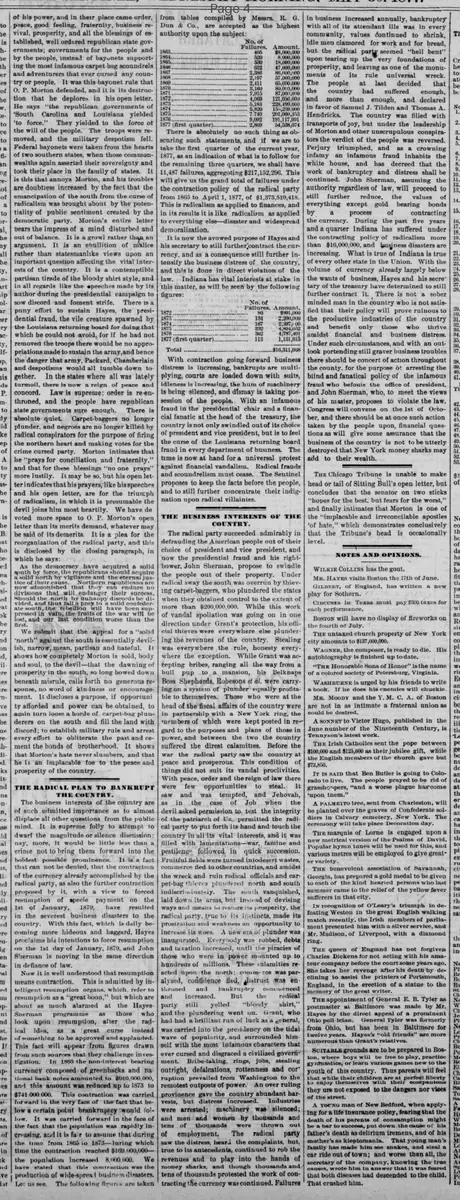
Now it is well understood that resumption means contraction. This is admitted by intelligent resumption organs, which refer to resumption as a "great boon," but which are about as much alarmed at the Hayes-Sherman programme as those who look upon resumption, after the radical idea, as a great curse instead of something to be approved and applauded. This fact will appear from figures drawn from such sources that they challenge investigation. In 1865 the non-interest bearing currency composed of greenbacks and national bank notes amounted to $910,000,000, and this amount was reduced up to 1873 to $741,000,000. This contraction was carried forward in the very face of the fact that below a certain point bankruptcy would follow. It was carried forward in the face of the fact that the population was rapidly increasing, and it is fair to assume that during the time from 1865 to 1873—during which time the contraction reached $169,000,000—the population increased 8,000,000. We have stated that this contraction was the production of wide-spread business disasters. Let us see. The following figures are taken from tables compiled by Messrs. R. G. Dun & Co., are accepted as the highest authority upon the subject:
There is absolutely no such thing as obscuring such statements, and if we are to take the first quarter of the current year, 1877, as an indication of what is to follow for the remaining three quarters, we shall have 11,487 failures, aggregating $217,152,296. This will give us the grand total of failures under the contraction policy of the radical party from 1865 to April 1, 1877, of $1,373,510,418. This is radicalism as applied to finances, and in its results it is like radicalism as applied to everything else—disaster and widespread demoralization.
It is now the avowed purpose of Hayes and his secretary to still further contract the currency, and as a consequence still further intensify the business distress of the country, and this is done in direct violation of the law. Indiana has vital interests at stake in this matter, as will be seen by the following figures:
Total $16,311,068
With contraction going forward business distress is increasing, bankrupts are multiplying, courts are loaded down with suits, idleness is increasing, the hum of machinery is being silenced, and dismay is taking possession of the people. With an infamous fraud in the presidential chair and a financial fanatic at the head of the treasury, the country is not only swindled out of its choice of president and vice president, but is to feel the curse of the Louisiana returning board fraud in every department of business. The time is now at hand for a universal protest against financial vandalism. Radical frauds and scoundrelism must cease. The Sentinel proposes to keep the facts before the people, and to still further concentrate their indignation upon radical villainies.
The business interests of the country are of such admitted importance as to almost displace all other questions from the public mind. It is supreme folly to attempt to dwarf the magnitude or silence discussion; nay, more, it would be little less than a crime not to bring them forward into the boldest possible prominence. It is a fact that can not be denied, that the contraction of the currency already accomplished by the radical party, as also the further contraction proposed by it, with a view to forced resumption of specie payment on the 1st of January, 1879, have resulted in the severest business disasters to the country. With this fact, which is daily becoming more hideous and haggard, Hayes proclaims his intentions to force resumption on the 1st day of January, 1879, and John Sherman is moving in the same direction in defiance of law.
Now it is well understood that resumption means contraction. This is admitted by intelligent resumption organs, which refer to resumption as a "great boon," but which are about as much alarmed at the Hayes-Sherman programme as those who look upon resumption, after the radical idea, as a great curse instead of something to be approved and applauded. This fact will appear from figures drawn from such sources that they challenge investigation. In 1865 the non-interest bearing currency composed of greenbacks and national bank notes amounted to $910,000,000, and this amount was reduced up to 1873 to $741,000,000. This contraction was carried forward in the very face of the fact that below a certain point bankruptcy would follow. It was carried forward in the face of the fact that the population was rapidly increasing, and it is fair to assume that during the time from 1865 to 1873—during which time the contraction reached $169,000,000—the population increased 8,000,000. We have stated that this contraction was the production of wide-spread business disasters. Let us see. The following figures are taken from tables compiled by Messrs. R. G. Dun & Co., are accepted as the highest authority upon the subject:
There is absolutely no such thing as obscuring such statements, and if we are to take the first quarter of the current year, 1877, as an indication of what is to follow for the remaining three quarters, we shall have 11,487 failures, aggregating $217,152,296. This will give us the grand total of failures under the contraction policy of the radical party from 1865 to April 1, 1877, of $1,373,510,418. This is radicalism as applied to finances, and in its results it is like radicalism as applied to everything else—disaster and widespread demoralization.
It is now the avowed purpose of Hayes and his secretary to still further contract the currency, and as a consequence still further intensify the business distress of the country, and this is done in direct violation of the law. Indiana has vital interests at stake in this matter, as will be seen by the following figures:
Total $16,311,068
With contraction going forward business distress is increasing, bankrupts are multiplying, courts are loaded down with suits, idleness is increasing, the hum of machinery is being silenced, and dismay is taking possession of the people. With an infamous fraud in the presidential chair and a financial fanatic at the head of the treasury, the country is not only swindled out of its choice of president and vice president, but is to feel the curse of the Louisiana returning board fraud in every department of business. The time is now at hand for a universal protest against financial vandalism. Radical frauds and scoundrelism must cease. The Sentinel proposes to keep the facts before the people, and to still further concentrate their indignation upon radical villainies.
What sub-type of article is it?
Economic Policy
Partisan Politics
What keywords are associated?
Currency Contraction
Specie Resumption
Business Disasters
Radical Policy
Financial Fraud
Hayes Sherman Programme
Business Failures
What entities or persons were involved?
Hayes
John Sherman
Radical Party
R. G. Dun & Co.
Louisiana Returning Board
Editorial Details
Primary Topic
Opposition To Radical Currency Contraction And Forced Specie Resumption
Stance / Tone
Strongly Critical Of Radical Financial Policies
Key Figures
Hayes
John Sherman
Radical Party
R. G. Dun & Co.
Louisiana Returning Board
Key Arguments
Contraction Of Currency By Radicals Has Caused Severe Business Disasters
Resumption Of Specie Payment On January 1, 1879, Requires Further Contraction
Currency Reduced From $910,000,000 In 1865 To $741,000,000 In 1873 Despite Population Growth
Business Failures Totaled $1,373,510,418 From 1865 To April 1, 1877
Hayes And Sherman Defy Law In Pursuing Contraction
Indiana Business Losses: $16,311,068
Policies Lead To Increasing Idleness, Silenced Machinery, And Public Dismay
Radical Fraud In Presidency Extends To Financial Vandalism