Thank you for visiting SNEWPapers!
Sign up free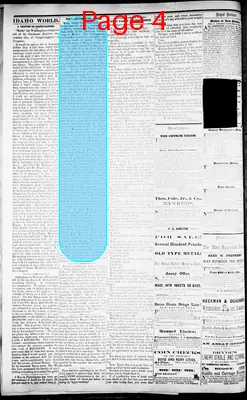
Story
February 4, 1869
The Idaho World
Idaho City, Boise County, Idaho
What is this article about?
Historical survey of unconventional currencies used worldwide, from shells and leather in ancient times to paper and tobacco in colonial eras, culminating in the adoption of precious metals for coinage.
Clipping
OCR Quality
98%
Excellent
Full Text
WHAT HAS PASSED FOR MONEY.
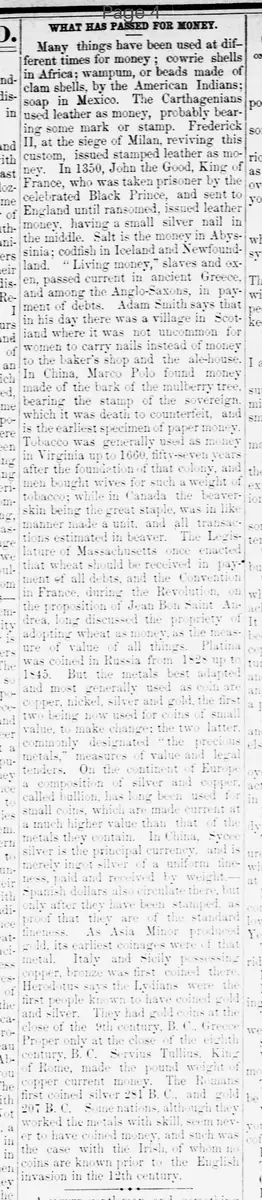
Many things have been used at different times for money: cowrie shells in Africa; wampum, or beads made of clam shells, by the American Indians; soap in Mexico. The Carthagenians used leather as money, probably bearing some mark or stamp. Frederick II, at the siege of Milan, reviving this custom, issued stamped leather as money. In 1350, John the Good, King of France, who was taken prisoner by the celebrated Black Prince, and sent to England until ransomed, issued leather money, having a small silver nail in the middle. Salt is the money in Abyssinia; codfish in Iceland and Newfoundland. "Living money," slaves and oxen, passed current in ancient Greece and among the Anglo-Saxons, in payment of debts. Adam Smith says that in his day there was a village in Scotland where it was not uncommon for women to carry nails instead of money to the baker's shop and the ale-house. In China, Marco Polo found money made of the bark of the mulberry tree, bearing the stamp of the sovereign which it was death to counterfeit, and is the earliest specimen of paper money. Tobacco was generally used as money in Virginia up to 1660, fifty-seven years after the foundation of that colony, and men bought wives for such a weight of tobacco; while in Canada the beaver-skin being the great staple, was in like manner made a unit, and all transactions estimated in beaver. The Legislature of Massachusetts once enacted that wheat should be received in payment of all debts, and the Convention in France, during the Revolution, on the proposition of Jean Bon St. Andre, long discussed the propriety of adopting wheat as money, as the measure of value of all things. Platina was coined in Russia from 1820 up to 1845. But the metals best adapted and most generally used as coin are copper, nickel, silver and gold, the first two being now used for coins of small value, to make change; the two latter, commonly designated "the precious metals," measures of value and legal tenders. On the continent of Europe a composition of silver and copper, called billon, has long been used for small coins, which are made current at a much higher value than that of the metals they contain. In China, sycee silver is the principal currency, and is merely ingot silver of a uniform fineness, paid and received by weight. Spanish dollars also circulate there, but only after they have been stamped as proof that they are of the standard fineness. As Asia Minor produced gold, its earliest coinages were of that metal. Italy and Sicily possessing copper, bronze was first coined there. Herodotus says the Lydians were the first people known to have coined gold and silver. They had gold coins at the close of the 7th century, B.C. Greece proper only at the close of the eighth century, B.C. Servius Tullius, King of Rome, made the pound weight of copper current money. The Romans first coined silver 269 B.C. and gold 207 B.C. Some nations, although they worked the metals with skill, seem never to have coined money, and such was the case with the Irish, of whom no coins are known prior to the English invasion in the 12th century.
Many things have been used at different times for money: cowrie shells in Africa; wampum, or beads made of clam shells, by the American Indians; soap in Mexico. The Carthagenians used leather as money, probably bearing some mark or stamp. Frederick II, at the siege of Milan, reviving this custom, issued stamped leather as money. In 1350, John the Good, King of France, who was taken prisoner by the celebrated Black Prince, and sent to England until ransomed, issued leather money, having a small silver nail in the middle. Salt is the money in Abyssinia; codfish in Iceland and Newfoundland. "Living money," slaves and oxen, passed current in ancient Greece and among the Anglo-Saxons, in payment of debts. Adam Smith says that in his day there was a village in Scotland where it was not uncommon for women to carry nails instead of money to the baker's shop and the ale-house. In China, Marco Polo found money made of the bark of the mulberry tree, bearing the stamp of the sovereign which it was death to counterfeit, and is the earliest specimen of paper money. Tobacco was generally used as money in Virginia up to 1660, fifty-seven years after the foundation of that colony, and men bought wives for such a weight of tobacco; while in Canada the beaver-skin being the great staple, was in like manner made a unit, and all transactions estimated in beaver. The Legislature of Massachusetts once enacted that wheat should be received in payment of all debts, and the Convention in France, during the Revolution, on the proposition of Jean Bon St. Andre, long discussed the propriety of adopting wheat as money, as the measure of value of all things. Platina was coined in Russia from 1820 up to 1845. But the metals best adapted and most generally used as coin are copper, nickel, silver and gold, the first two being now used for coins of small value, to make change; the two latter, commonly designated "the precious metals," measures of value and legal tenders. On the continent of Europe a composition of silver and copper, called billon, has long been used for small coins, which are made current at a much higher value than that of the metals they contain. In China, sycee silver is the principal currency, and is merely ingot silver of a uniform fineness, paid and received by weight. Spanish dollars also circulate there, but only after they have been stamped as proof that they are of the standard fineness. As Asia Minor produced gold, its earliest coinages were of that metal. Italy and Sicily possessing copper, bronze was first coined there. Herodotus says the Lydians were the first people known to have coined gold and silver. They had gold coins at the close of the 7th century, B.C. Greece proper only at the close of the eighth century, B.C. Servius Tullius, King of Rome, made the pound weight of copper current money. The Romans first coined silver 269 B.C. and gold 207 B.C. Some nations, although they worked the metals with skill, seem never to have coined money, and such was the case with the Irish, of whom no coins are known prior to the English invasion in the 12th century.
What sub-type of article is it?
Curiosity
Historical Event
What keywords are associated?
Money Substitutes
Historical Currency
Leather Money
Paper Money
Tobacco Currency
Metal Coinage
What entities or persons were involved?
Frederick Ii
John The Good
Black Prince
Adam Smith
Marco Polo
Jean Bon St. Andre
Servius Tullius
Herodotus
Where did it happen?
Various Global Locations
Story Details
Key Persons
Frederick Ii
John The Good
Black Prince
Adam Smith
Marco Polo
Jean Bon St. Andre
Servius Tullius
Herodotus
Location
Various Global Locations
Story Details
Overview of diverse items used as money historically, including cowrie shells, wampum, soap, leather, salt, codfish, slaves, oxen, nails, mulberry bark paper, tobacco, beaver skins, wheat, and metals like copper, silver, gold; details origins of coinage in Lydia, Greece, Rome, and others.