Thank you for visiting SNEWPapers!
Sign up free
Literary
September 5, 1771
The Virginia Gazette
Richmond, Williamsburg, Richmond County, Virginia
What is this article about?
This essay examines the Roman Republic's early simplicity and agricultural virtues under kings and consuls, where patricians and plebeians united in labor and moderation despite internal strife. It contrasts this with post-conquest corruption by luxury and riches, citing examples like Cincinnatus, Curius, Cato, and Scipio, warning of moral decline as per Sallust and Cato.
Clipping
OCR Quality
95%
Excellent
Full Text
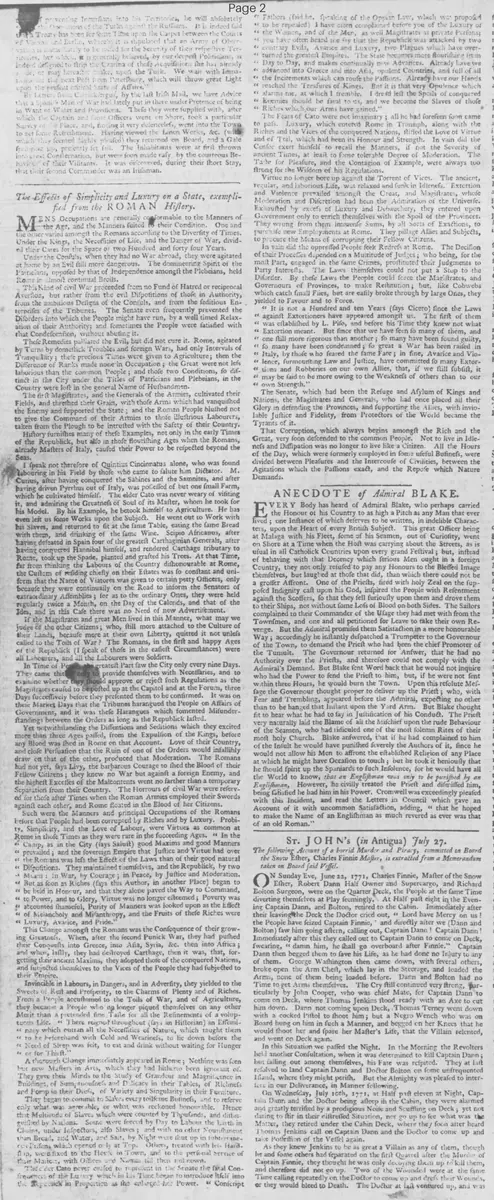
The Effects of Simplicity and Luxury on a State, exemplified from the ROMAN History.
MENS
Romans according to the Diversity of Times. Under the Kings, the Necessities of Life, and the Danger of War, divided their Cares for the Space of two Hundred and forty four Years. Under the Consuls, when they had no War abroad, they were agitated at home by an Evil still more dangerous. The domineering Spirit of the Patricians, opposed by that of Independence amongst the Plebeians, held Rome in almost continual Broils.
This Kind of civil War proceeded from no Fund of Hatred or reciprocal Aversion, but rather from the evil Dispositions of those in Authority, from the ambitious Designs of the Consuls, and from the seditious Enterprises of the Tribunes. The Senate even frequently prevented the Disorders into which the People might have run, by a well timed Relaxation of their Authority; and sometimes the People were satisfied with that Condescension, without abusing it.
These Remedies palliated the Evil, but did not cure it. Rome, agitated by Turns by domestick Troubles and foreign Wars, had only Intervals of Tranquillity; these precious Times were given to Agriculture; then the Difference of Ranks made none in Occupation; the Great were not less laborious than the common People; and those two Conditions, so distinct in the City under the Titles of Patricians and Plebeians, in the Country were lost in the general Name of Husbandmen.
The first Magistrates, and the Generals of the Armies, cultivated their Fields, and threshed their Grain, with those Arms which had vanquished the Enemy and supported the State; and the Roman People blushed not to give the Command of their Armies to those illustrious Labourers, taken from the Plough to be intrusted with the Safety of their Country.
History furnishes many of these Examples, not only in the early Times of the Republick, but also in those flourishing Ages when the Romans, already Masters of Italy, caused their Power to be respected beyond the Seas.
I speak not therefore of Quintius Cincinnatus alone, who was found labouring in his Field by those who came to salute him Dictator. M. Curius, after having conquered the Sabines and the Samnites, and after having driven Pyrrhus out of Italy, was possessed of but one small Farm, which he cultivated himself. The elder Cato was never weary of visiting it, and admiring the Greatness of Soul of its Master, whom he took for his Model. By his Example, he betook himself to Agriculture. He has even left us some Works upon the Subject. He went out to Work with his Slaves, and returned to sit at the same Table, eating the same Bread with them, and drinking of the same Wine. Scipio Africanus, after having defeated in Spain four of the greatest Carthaginian Generals, after having conquered Hannibal himself, and rendered Carthage tributary to Rome, took up the Spade, planted and grafted his Trees. At that Time, far from thinking the Labours of the Country dishonourable at Rome, the Custom of residing chiefly on their Estates was so constant and uniform that the Name of Viatores was given to certain petty Officers, only because they were continually on the Road to inform the Senators of extraordinary Assemblies; for as to the ordinary Ones, they were held regularly twice a Month, on the Day of the Calends, and that of the Ides, and in this Case there was no Need of new Advertisement.
If the Magistrates and great Men lived in this Manner, what may we judge of the other Citizens; who, still more attached to the Culture of their Lands, because more at their own Liberty, quitted it not unless called to the Toils of War? The Romans, in the first and happy Ages of the Republick (I speak of those in the easiest Circumstances) were all Labourers, and all the Labourers were Soldiers.
In Time of Peace the greatest Part saw the City only every nine Days. They came thither to provide themselves with Necessaries, and to examine whether they should approve or reject such Regulations as the Magistrates caused to be posted up at the Capitol and at the Forum, three Days successively before they presented them to be confirmed. It was on these Market Days that the Tribunes harangued the People on Affairs of Government, and it was these Harangues which fomented Misunderstandings between the Orders as long as the Republick lasted.
Yet notwithstanding the Dissensions and Seditions which they excited more than three Ages passed, from the Expulsion of the Kings, before any Blood was Shed in Rome on that Account. Love of their Country, and close Persuasion that the Ruin of one of the Orders would infallibly draw on that of the other, produced that Moderation. The Romans had not yet, says Livy, the barbarous Courage to shed the Blood of their Fellow Citizens; they knew no War but against a foreign Enemy, and the highest Excesses of the Malcontents went no farther than a temporary Separation from their Country. The Horrours of civil War were reserved for those after Times when the Roman Armies employed their Swords against each other, and Rome floated in the Blood of her Citizens.
Such were the Manners and principal Occupations of the Romans before that People had been corrupted by Riches and by Luxury. Probity, Simplicity, and the Love of Labour, were Virtues as common at Rome in those Times as they were rare in the succeeding Ages. "In the Camp, as in the City (says Sallust) good Maxims and good Manners prevailed; and the sovereign Empire that Justice and Virtue had over the Romans was less the Effect of the Laws than of their good natural Dispositions. They maintained themselves, and the Republick, by two Means: in War, by Courage; in Peace, by Justice and Moderation."
But as soon as Riches (says this Author, in another Place) began to "be held in Honour, and that they alone paved the Way to Command, to Power, and to Glory, Virtue was no longer esteemed; Poverty was accounted shameful, Purity of Manners was looked upon as the Effect of Melancholy and Misanthropy, and the Fruits of these Riches were Luxury, Avarice, and Pride."
This Change amongst the Romans was the Consequence of their growing Greatness. When, after the second Punic War, they had pushed their Conquests into Greece, into Asia, Syria, &c. then into Africa; and when, lastly, they had destroyed Carthage, then it was, that, forgetting their ancient Maxims, they adopted those of the conquered Nations, and subjected themselves to the Vices of the People they had subjected to their Empire.
Invincible in Labours, in Dangers, and in Adversity, they yielded to the Sweets of Rest and Prosperity, to the Charms of Plenty and of Riches. From a People accustomed to the Toils of War, and of Agriculture, they became a People who no longer piqued themselves on any other Merit than a pretended fine Taste for all the Refinements of a voluptuous Life. "There reigned throughout (says an Historian) an Effeminacy which outran all the Necessities of Nature, which taught them to provide beforehand with Cold and Weariness, to lie down before the Need of Sleep was felt, to eat and drink without waiting for Hunger or for Thirst."
A thorough Change immediately appeared in Rome; Nothing was seen but new Masters in Arts, which they had hitherto been ignorant of. They gave their Minds to the Study of Grandeur and Magnificence in Buildings, of Sumptuousness and Delicacy in their Tables, of Richness and Pomp in their Dress, of Variety and Singularity in their Furniture.
They began to commit to Slaves every toilsome Business, and to reserve only what was agreeable, or what was reckoned honourable. Hence that Multitude of Slaves which were counted by Thousands, and distinguished by Nations. Some were forced by Day to Labour the Earth in Chains, under Inspectors, also Slaves; and with no other Nourishment than Bread, and Water, and Salt, by Night were shut up in subterraneous Pens which opened only at Top. Others, treated with less Hardship, were fixed to the Horse in Town, and to the personal Service of their Masters, with Offices and Names till then unknown.
The elder Cato never ceased to represent in the Senate the fatal Consequences of the Luxury which in his Time began to introduce itself into the Republick in Proportion as she enlarged her Power. "Conscript Fathers (said he, speaking of the Oppian Law, which was proposed to be repealed) I have often complained before you of the Luxury of the Women, and of the Men, as well Magistrates as private Persons; you have often heard me say that the Republick was attacked by two contrary Evils, Avarice and Luxury, two Plagues which have overturned the greatest Empires. The State becomes more flourishing from Day to Day, and makes continually new Advances. Already have we advanced into Greece and into Asia, opulent Countries, and full of all the Incitements which can rouze the Passions. Already have our Hands reached the Treasures of Kings. But it is that very Opulence which alarms me, at which I tremble. I dread lest the Spoils of conquered Enemies should be fatal to us, and we become the Slaves of those Riches which our Arms have gained."
MENS
Romans according to the Diversity of Times. Under the Kings, the Necessities of Life, and the Danger of War, divided their Cares for the Space of two Hundred and forty four Years. Under the Consuls, when they had no War abroad, they were agitated at home by an Evil still more dangerous. The domineering Spirit of the Patricians, opposed by that of Independence amongst the Plebeians, held Rome in almost continual Broils.
This Kind of civil War proceeded from no Fund of Hatred or reciprocal Aversion, but rather from the evil Dispositions of those in Authority, from the ambitious Designs of the Consuls, and from the seditious Enterprises of the Tribunes. The Senate even frequently prevented the Disorders into which the People might have run, by a well timed Relaxation of their Authority; and sometimes the People were satisfied with that Condescension, without abusing it.
These Remedies palliated the Evil, but did not cure it. Rome, agitated by Turns by domestick Troubles and foreign Wars, had only Intervals of Tranquillity; these precious Times were given to Agriculture; then the Difference of Ranks made none in Occupation; the Great were not less laborious than the common People; and those two Conditions, so distinct in the City under the Titles of Patricians and Plebeians, in the Country were lost in the general Name of Husbandmen.
The first Magistrates, and the Generals of the Armies, cultivated their Fields, and threshed their Grain, with those Arms which had vanquished the Enemy and supported the State; and the Roman People blushed not to give the Command of their Armies to those illustrious Labourers, taken from the Plough to be intrusted with the Safety of their Country.
History furnishes many of these Examples, not only in the early Times of the Republick, but also in those flourishing Ages when the Romans, already Masters of Italy, caused their Power to be respected beyond the Seas.
I speak not therefore of Quintius Cincinnatus alone, who was found labouring in his Field by those who came to salute him Dictator. M. Curius, after having conquered the Sabines and the Samnites, and after having driven Pyrrhus out of Italy, was possessed of but one small Farm, which he cultivated himself. The elder Cato was never weary of visiting it, and admiring the Greatness of Soul of its Master, whom he took for his Model. By his Example, he betook himself to Agriculture. He has even left us some Works upon the Subject. He went out to Work with his Slaves, and returned to sit at the same Table, eating the same Bread with them, and drinking of the same Wine. Scipio Africanus, after having defeated in Spain four of the greatest Carthaginian Generals, after having conquered Hannibal himself, and rendered Carthage tributary to Rome, took up the Spade, planted and grafted his Trees. At that Time, far from thinking the Labours of the Country dishonourable at Rome, the Custom of residing chiefly on their Estates was so constant and uniform that the Name of Viatores was given to certain petty Officers, only because they were continually on the Road to inform the Senators of extraordinary Assemblies; for as to the ordinary Ones, they were held regularly twice a Month, on the Day of the Calends, and that of the Ides, and in this Case there was no Need of new Advertisement.
If the Magistrates and great Men lived in this Manner, what may we judge of the other Citizens; who, still more attached to the Culture of their Lands, because more at their own Liberty, quitted it not unless called to the Toils of War? The Romans, in the first and happy Ages of the Republick (I speak of those in the easiest Circumstances) were all Labourers, and all the Labourers were Soldiers.
In Time of Peace the greatest Part saw the City only every nine Days. They came thither to provide themselves with Necessaries, and to examine whether they should approve or reject such Regulations as the Magistrates caused to be posted up at the Capitol and at the Forum, three Days successively before they presented them to be confirmed. It was on these Market Days that the Tribunes harangued the People on Affairs of Government, and it was these Harangues which fomented Misunderstandings between the Orders as long as the Republick lasted.
Yet notwithstanding the Dissensions and Seditions which they excited more than three Ages passed, from the Expulsion of the Kings, before any Blood was Shed in Rome on that Account. Love of their Country, and close Persuasion that the Ruin of one of the Orders would infallibly draw on that of the other, produced that Moderation. The Romans had not yet, says Livy, the barbarous Courage to shed the Blood of their Fellow Citizens; they knew no War but against a foreign Enemy, and the highest Excesses of the Malcontents went no farther than a temporary Separation from their Country. The Horrours of civil War were reserved for those after Times when the Roman Armies employed their Swords against each other, and Rome floated in the Blood of her Citizens.
Such were the Manners and principal Occupations of the Romans before that People had been corrupted by Riches and by Luxury. Probity, Simplicity, and the Love of Labour, were Virtues as common at Rome in those Times as they were rare in the succeeding Ages. "In the Camp, as in the City (says Sallust) good Maxims and good Manners prevailed; and the sovereign Empire that Justice and Virtue had over the Romans was less the Effect of the Laws than of their good natural Dispositions. They maintained themselves, and the Republick, by two Means: in War, by Courage; in Peace, by Justice and Moderation."
But as soon as Riches (says this Author, in another Place) began to "be held in Honour, and that they alone paved the Way to Command, to Power, and to Glory, Virtue was no longer esteemed; Poverty was accounted shameful, Purity of Manners was looked upon as the Effect of Melancholy and Misanthropy, and the Fruits of these Riches were Luxury, Avarice, and Pride."
This Change amongst the Romans was the Consequence of their growing Greatness. When, after the second Punic War, they had pushed their Conquests into Greece, into Asia, Syria, &c. then into Africa; and when, lastly, they had destroyed Carthage, then it was, that, forgetting their ancient Maxims, they adopted those of the conquered Nations, and subjected themselves to the Vices of the People they had subjected to their Empire.
Invincible in Labours, in Dangers, and in Adversity, they yielded to the Sweets of Rest and Prosperity, to the Charms of Plenty and of Riches. From a People accustomed to the Toils of War, and of Agriculture, they became a People who no longer piqued themselves on any other Merit than a pretended fine Taste for all the Refinements of a voluptuous Life. "There reigned throughout (says an Historian) an Effeminacy which outran all the Necessities of Nature, which taught them to provide beforehand with Cold and Weariness, to lie down before the Need of Sleep was felt, to eat and drink without waiting for Hunger or for Thirst."
A thorough Change immediately appeared in Rome; Nothing was seen but new Masters in Arts, which they had hitherto been ignorant of. They gave their Minds to the Study of Grandeur and Magnificence in Buildings, of Sumptuousness and Delicacy in their Tables, of Richness and Pomp in their Dress, of Variety and Singularity in their Furniture.
They began to commit to Slaves every toilsome Business, and to reserve only what was agreeable, or what was reckoned honourable. Hence that Multitude of Slaves which were counted by Thousands, and distinguished by Nations. Some were forced by Day to Labour the Earth in Chains, under Inspectors, also Slaves; and with no other Nourishment than Bread, and Water, and Salt, by Night were shut up in subterraneous Pens which opened only at Top. Others, treated with less Hardship, were fixed to the Horse in Town, and to the personal Service of their Masters, with Offices and Names till then unknown.
The elder Cato never ceased to represent in the Senate the fatal Consequences of the Luxury which in his Time began to introduce itself into the Republick in Proportion as she enlarged her Power. "Conscript Fathers (said he, speaking of the Oppian Law, which was proposed to be repealed) I have often complained before you of the Luxury of the Women, and of the Men, as well Magistrates as private Persons; you have often heard me say that the Republick was attacked by two contrary Evils, Avarice and Luxury, two Plagues which have overturned the greatest Empires. The State becomes more flourishing from Day to Day, and makes continually new Advances. Already have we advanced into Greece and into Asia, opulent Countries, and full of all the Incitements which can rouze the Passions. Already have our Hands reached the Treasures of Kings. But it is that very Opulence which alarms me, at which I tremble. I dread lest the Spoils of conquered Enemies should be fatal to us, and we become the Slaves of those Riches which our Arms have gained."
What sub-type of article is it?
Essay
What themes does it cover?
Moral Virtue
Political
Agriculture Rural
What keywords are associated?
Roman History
Simplicity
Luxury
Agriculture
Virtue
Decline
Cato
Cincinnatus
Sallust
Literary Details
Title
The Effects Of Simplicity And Luxury On A State, Exemplified From The Roman History.
Subject
Exemplified From The Roman History
Key Lines
I Speak Not Therefore Of Quintius Cincinnatus Alone, Who Was Found Labouring In His Field By Those Who Came To Salute Him Dictator.
The Elder Cato Was Never Weary Of Visiting It, And Admiring The Greatness Of Soul Of Its Master, Whom He Took For His Model.
"In The Camp, As In The City (Says Sallust) Good Maxims And Good Manners Prevailed; And The Sovereign Empire That Justice And Virtue Had Over The Romans Was Less The Effect Of The Laws Than Of Their Good Natural Dispositions."
But As Soon As Riches (Says This Author, In Another Place) Began To "Be Held In Honour, And That They Alone Paved The Way To Command, To Power, And To Glory, Virtue Was No Longer Esteemed; Poverty Was Accounted Shameful, Purity Of Manners Was Looked Upon As The Effect Of Melancholy And Misanthropy, And The Fruits Of These Riches Were Luxury, Avarice, And Pride."
"Conscript Fathers (Said He, Speaking Of The Oppian Law, Which Was Proposed To Be Repealed) I Have Often Complained Before You Of The Luxury Of The Women, And Of The Men, As Well Magistrates As Private Persons; You Have Often Heard Me Say That The Republick Was Attacked By Two Contrary Evils, Avarice And Luxury, Two Plagues Which Have Overturned The Greatest Empires."