Thank you for visiting SNEWPapers!
Sign up free
Editorial
December 16, 1875
The Anti Monopolist
Saint Paul, Ramsey County, Minnesota
What is this article about?
Editorial laments declining enthusiasm in the Minnesota State Grange, criticizing its apolitical constitution amid corrupt parties and monopolies exploiting farmers. Urges political engagement to achieve reforms, noting minimal legislative impact despite 20,000 members.
Clipping
OCR Quality
95%
Excellent
Full Text
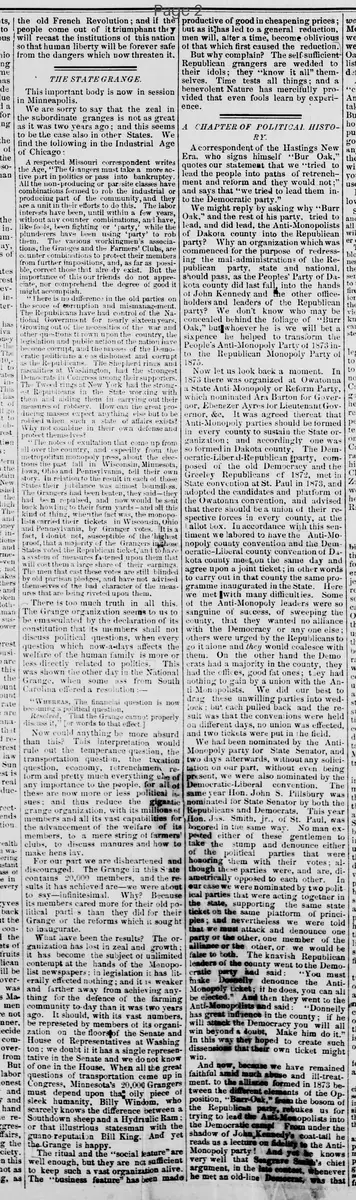
THE STATE GRANGE.
This important body is now in session in Minneapolis.
We are sorry to say that the zeal in the subordinate granges is not as great as it was two years ago; and this seems to be the case also in other States. We find the following in the Industrial Age of Chicago:
A respected Missouri correspondent writes the Age, "The Grangers must take a more active part in politics or pass into bankruptcy. All the non-producing or parasite classes have combinations formed to rob the industrial or producing part of the community, and they are a unit in their efforts to do this. The labor interests have been, until within a few years, without any counter combinations, and have, like fools, been fighting 'for party,' while the plunderers have been using 'party' to rob them. The various workingmen's associations, the Granges and the Farmers' Clubs, are counter combinations to protect their members from further impositions, and, as far as possible, correct those that already exist. But the importance of this our friends do not appreciate, nor comprehend the degree of good it might accomplish."
"There is no difference in the old parties on the score of corruption and mismanagement. The Republicans have had control of the National Government for nearly sixteen years. Growing out of the necessities of the war and other questions thrown upon the country, the legislation and public action of the nation have become corrupt, and the masses of the Democratic politicians are as dishonest and corrupt as the Republicans. The Shepherd rings and rascalities at Washington, had the strongest Democrats in Congress among their supporters. The Tweed rings at New York had the strongest Republicans in the State working with and aiding them in carrying out their measures of robbery. How can the great producing masses expect anything else but to be robbed when such a state of affairs exists? Why not combine in their own defense and protect themselves?"
"The notes of exultation that come up from all over the country, and especially from the metropolitan monopoly press, about the elections the past fall in Wisconsin, Minnesota, Iowa, Ohio and Pennsylvania, tell their own story. In relation to the result in each of those States their jubilance was almost boundless. The Grangers had been beaten, they said—they had been repulsed, and now would be sent back howling to their farm yards—and all this kind of thing, when the fact was, the monopolists carried their tickets in Wisconsin, Ohio and Pennsylvania, by Granger votes. It is a fact, I doubt not, susceptible of the highest proof, that a majority of the Grangers in those States voted the Republican ticket, and to have a system of measures fastened upon them that will cost them a large share of their earnings. The men that cast these votes are still blinded by old partisan pledges, and have not advised themselves of the bad character of the measures that are being riveted upon them."
There is too much truth in all this.
The Grange organization seems to us to be emasculated by the declaration of its constitution that its members shall not discuss political questions, when every question which now-a-days affects the welfare of the human family is more or less directly related to politics.
This was shown the other day in the National Grange, when some ass from South Carolina offered a resolution:
"Whereas, The financial question is now becoming a political question,
Resolved, That the Grange cannot properly discuss it," [or words to that effect.]
Now could anything be more absurd than this? This interpretation would rule out the temperance question, the transportation question, the taxation question, economy, retrenchment reform and pretty much everything else of any importance to the people, for all of these are now more or less political issues: and thus reduce the gigantic grange organization, with its millions of members and all its vast capabilities for the advancement of the welfare of its members, to a mere string of farmers clubs, to discuss manures and how to make hens lay.
For our part we are disheartened and discouraged. The Grange in this State contains 20,000 members, and the results it has achieved are—we were about to say—infinitesimal. Why? Because its members cared more for their old political parties than they did for their Grange or the reforms which it sought to inaugurate.
What have been the results? The organization has lost in zeal and growth; it has become the subject of unlimited contempt at the hands of the Monopolist newspapers: in legislation it has literally effected nothing: and it is weaker and farther away from achieving anything for the defence of the farming community to-day than it was two years ago. It should, with its vast numbers, be represented by members of its organization on the floors of the Senate and House of Representatives at Washington: we doubt if it has a single representative in the Senate and we do not know of one in the House. When all the great questions of transportation come up in Congress, Minnesota's 20,000 Grangers must depend upon that oily piece of sleek humanity, Billy Windom, who scarcely knows the difference between a Southdown sheep and a Hydraulic Ram; or that illustrious statesman with the guano-reputation Bill King. And yet the Grange is happy.
The ritual and the "social feature" are well enough, but they are not sufficient to keep such a vast organization alive. The "business feature" has been made productive of good in cheapening prices; but as it has led to a general reduction, men will, after a time, become oblivious of that which first caused the reduction. But why complain? The self-sufficient Republican grangers are wedded to their idols; they "know it all" themselves. Time tests all things; and a benevolent Nature has mercifully provided that even fools learn by experience.
This important body is now in session in Minneapolis.
We are sorry to say that the zeal in the subordinate granges is not as great as it was two years ago; and this seems to be the case also in other States. We find the following in the Industrial Age of Chicago:
A respected Missouri correspondent writes the Age, "The Grangers must take a more active part in politics or pass into bankruptcy. All the non-producing or parasite classes have combinations formed to rob the industrial or producing part of the community, and they are a unit in their efforts to do this. The labor interests have been, until within a few years, without any counter combinations, and have, like fools, been fighting 'for party,' while the plunderers have been using 'party' to rob them. The various workingmen's associations, the Granges and the Farmers' Clubs, are counter combinations to protect their members from further impositions, and, as far as possible, correct those that already exist. But the importance of this our friends do not appreciate, nor comprehend the degree of good it might accomplish."
"There is no difference in the old parties on the score of corruption and mismanagement. The Republicans have had control of the National Government for nearly sixteen years. Growing out of the necessities of the war and other questions thrown upon the country, the legislation and public action of the nation have become corrupt, and the masses of the Democratic politicians are as dishonest and corrupt as the Republicans. The Shepherd rings and rascalities at Washington, had the strongest Democrats in Congress among their supporters. The Tweed rings at New York had the strongest Republicans in the State working with and aiding them in carrying out their measures of robbery. How can the great producing masses expect anything else but to be robbed when such a state of affairs exists? Why not combine in their own defense and protect themselves?"
"The notes of exultation that come up from all over the country, and especially from the metropolitan monopoly press, about the elections the past fall in Wisconsin, Minnesota, Iowa, Ohio and Pennsylvania, tell their own story. In relation to the result in each of those States their jubilance was almost boundless. The Grangers had been beaten, they said—they had been repulsed, and now would be sent back howling to their farm yards—and all this kind of thing, when the fact was, the monopolists carried their tickets in Wisconsin, Ohio and Pennsylvania, by Granger votes. It is a fact, I doubt not, susceptible of the highest proof, that a majority of the Grangers in those States voted the Republican ticket, and to have a system of measures fastened upon them that will cost them a large share of their earnings. The men that cast these votes are still blinded by old partisan pledges, and have not advised themselves of the bad character of the measures that are being riveted upon them."
There is too much truth in all this.
The Grange organization seems to us to be emasculated by the declaration of its constitution that its members shall not discuss political questions, when every question which now-a-days affects the welfare of the human family is more or less directly related to politics.
This was shown the other day in the National Grange, when some ass from South Carolina offered a resolution:
"Whereas, The financial question is now becoming a political question,
Resolved, That the Grange cannot properly discuss it," [or words to that effect.]
Now could anything be more absurd than this? This interpretation would rule out the temperance question, the transportation question, the taxation question, economy, retrenchment reform and pretty much everything else of any importance to the people, for all of these are now more or less political issues: and thus reduce the gigantic grange organization, with its millions of members and all its vast capabilities for the advancement of the welfare of its members, to a mere string of farmers clubs, to discuss manures and how to make hens lay.
For our part we are disheartened and discouraged. The Grange in this State contains 20,000 members, and the results it has achieved are—we were about to say—infinitesimal. Why? Because its members cared more for their old political parties than they did for their Grange or the reforms which it sought to inaugurate.
What have been the results? The organization has lost in zeal and growth; it has become the subject of unlimited contempt at the hands of the Monopolist newspapers: in legislation it has literally effected nothing: and it is weaker and farther away from achieving anything for the defence of the farming community to-day than it was two years ago. It should, with its vast numbers, be represented by members of its organization on the floors of the Senate and House of Representatives at Washington: we doubt if it has a single representative in the Senate and we do not know of one in the House. When all the great questions of transportation come up in Congress, Minnesota's 20,000 Grangers must depend upon that oily piece of sleek humanity, Billy Windom, who scarcely knows the difference between a Southdown sheep and a Hydraulic Ram; or that illustrious statesman with the guano-reputation Bill King. And yet the Grange is happy.
The ritual and the "social feature" are well enough, but they are not sufficient to keep such a vast organization alive. The "business feature" has been made productive of good in cheapening prices; but as it has led to a general reduction, men will, after a time, become oblivious of that which first caused the reduction. But why complain? The self-sufficient Republican grangers are wedded to their idols; they "know it all" themselves. Time tests all things; and a benevolent Nature has mercifully provided that even fools learn by experience.
What sub-type of article is it?
Agriculture
Partisan Politics
Economic Policy
What keywords are associated?
Grange Organization
Farmers Politics
Monopoly Critique
Party Corruption
Agricultural Reform
What entities or persons were involved?
Grange
Republicans
Democrats
Monopolists
Billy Windom
Bill King
Editorial Details
Primary Topic
Critique Of Grange's Political Inactivity
Stance / Tone
Disheartened And Critical
Key Figures
Grange
Republicans
Democrats
Monopolists
Billy Windom
Bill King
Key Arguments
Zeal In Subordinate Granges Is Declining Compared To Two Years Ago
Grangers Must Engage More In Politics To Counter Parasite Classes And Monopolies
Old Parties Are Corrupt And Mismanaged, Robbing Producers
Grangers Voted Republican In Recent Elections, Harming Their Interests
Grange Constitution Prohibits Political Discussion, Limiting Its Effectiveness
This Non Political Stance Reduces Grange To Mere Farmers' Clubs
Minnesota Grange Has 20,000 Members But Achieved Little Due To Party Loyalty
Grange Lacks Representation In Congress On Key Issues Like Transportation