Thank you for visiting SNEWPapers!
Sign up free
Story
November 2, 1860
Montgomery County Sentinel
Rockville, Gaithersburg, Montgomery County, Maryland
What is this article about?
In a childhood mock trial on their farm, young Daniel Webster eloquently argues for the release of a captured woodchuck, swaying his father the judge to spare the animal's life despite his brother Ezekiel's plea for its death.
Clipping
OCR Quality
98%
Excellent
Full Text
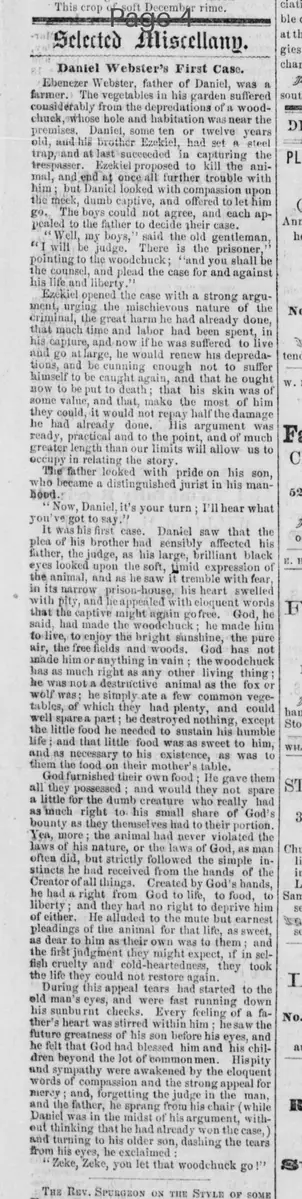
Selected Miscellany.
Daniel Webster's First Case.
Ebenezer Webster, father of Daniel, was a farmer. The vegetables in his garden suffered considerably from the depredations of a woodchuck, whose hole and habitation was near the premises. Daniel, some ten or twelve years old, and his brother Ezekiel, had set a steel trap, and at last succeeded in capturing the trespasser. Ezekiel proposed to kill the animal, and end at once all further trouble with him; but Daniel looked with compassion upon the meek, dumb captive, and offered to let him go. The boys could not agree, and each appealed to the father to decide their case.
"Well, my boys," said the old gentleman, "I will be judge. There is the prisoner, pointing to the woodchuck; and you shall be the counsel, and plead the case for and against his life and liberty."
Ezekiel opened the case with a strong argument, urging the mischievous nature of the criminal, the great harm he had already done, that much time and labor had been spent in his capture, and now if he was suffered to live and go at large, he would renew his depredations, and be cunning enough not to suffer himself to be caught again, and that he ought now to be put to death; that his skin was of some value, and that, make the most of him they could, it would not repay half the damage he had already done. His argument was ready, practical and to the point, and of much greater length than our limits will allow us to occupy in relating the story.
The father looked with pride on his son, who became a distinguished jurist in his manhood.
"Now, Daniel, it's your turn; I'll hear what you've got to say."
It was his first case. Daniel saw that the plea of his brother had sensibly affected his father, the judge, as his large, brilliant black eyes looked upon the soft, timid expression of the animal, and as he saw it tremble with fear in its narrow prison-house, his heart swelled with pity, and he appealed with eloquent words that the captive might again go free. God, he said, had made the woodchuck; he made him to live, to enjoy the bright sunshine, the pure air, the free fields and woods. God has not made him or anything in vain; the woodchuck has as much right as any other living thing; he was not a destructive animal as the fox or wolf was; he simply ate a few common vegetables, of which they had plenty, and could well spare a part; he destroyed nothing, except the little food he needed to sustain his humble life; and that little food was as sweet to him and as necessary to his existence, as was to them the food on their mother's table. God furnished their own food; He gave them all they possessed; and would they not spare a little for the dumb creature who really had as much right to his small share of God's bounty as they themselves had to their portion. Yea, more; the animal had never violated the laws of his nature, or the laws of God, as man often did, but strictly followed the simple instincts he had received from the hands of the Creator of all things. Created by God's hands, he had a right from God to life, to food, to liberty: and they had no right to deprive him of either. He alluded to the mute but earnest pleadings of the animal for that life, as sweet, as dear to him as their own was to them; and the first judgment they might expect, if in selfish cruelty and cold-heartedness, they took the life they could not restore again.
During this appeal tears had started to the old man's eyes, and were fast running down his sunburnt cheeks. Every feeling of a father's heart was stirred within him; he saw the future greatness of his son before his eyes, and he felt that God had blessed him and his children beyond the lot of common men. His pity and sympathy were awakened by the eloquent words of compassion and the strong appeal for mercy; and, forgetting the judge in the man, and the father, he sprang from his chair (while Daniel was in the midst of his argument, without thinking that he had already won the case), and turning to his older son, dashing the tears from his eyes, he exclaimed:
"Zeke, Zeke, you let that woodchuck go!"
Daniel Webster's First Case.
Ebenezer Webster, father of Daniel, was a farmer. The vegetables in his garden suffered considerably from the depredations of a woodchuck, whose hole and habitation was near the premises. Daniel, some ten or twelve years old, and his brother Ezekiel, had set a steel trap, and at last succeeded in capturing the trespasser. Ezekiel proposed to kill the animal, and end at once all further trouble with him; but Daniel looked with compassion upon the meek, dumb captive, and offered to let him go. The boys could not agree, and each appealed to the father to decide their case.
"Well, my boys," said the old gentleman, "I will be judge. There is the prisoner, pointing to the woodchuck; and you shall be the counsel, and plead the case for and against his life and liberty."
Ezekiel opened the case with a strong argument, urging the mischievous nature of the criminal, the great harm he had already done, that much time and labor had been spent in his capture, and now if he was suffered to live and go at large, he would renew his depredations, and be cunning enough not to suffer himself to be caught again, and that he ought now to be put to death; that his skin was of some value, and that, make the most of him they could, it would not repay half the damage he had already done. His argument was ready, practical and to the point, and of much greater length than our limits will allow us to occupy in relating the story.
The father looked with pride on his son, who became a distinguished jurist in his manhood.
"Now, Daniel, it's your turn; I'll hear what you've got to say."
It was his first case. Daniel saw that the plea of his brother had sensibly affected his father, the judge, as his large, brilliant black eyes looked upon the soft, timid expression of the animal, and as he saw it tremble with fear in its narrow prison-house, his heart swelled with pity, and he appealed with eloquent words that the captive might again go free. God, he said, had made the woodchuck; he made him to live, to enjoy the bright sunshine, the pure air, the free fields and woods. God has not made him or anything in vain; the woodchuck has as much right as any other living thing; he was not a destructive animal as the fox or wolf was; he simply ate a few common vegetables, of which they had plenty, and could well spare a part; he destroyed nothing, except the little food he needed to sustain his humble life; and that little food was as sweet to him and as necessary to his existence, as was to them the food on their mother's table. God furnished their own food; He gave them all they possessed; and would they not spare a little for the dumb creature who really had as much right to his small share of God's bounty as they themselves had to their portion. Yea, more; the animal had never violated the laws of his nature, or the laws of God, as man often did, but strictly followed the simple instincts he had received from the hands of the Creator of all things. Created by God's hands, he had a right from God to life, to food, to liberty: and they had no right to deprive him of either. He alluded to the mute but earnest pleadings of the animal for that life, as sweet, as dear to him as their own was to them; and the first judgment they might expect, if in selfish cruelty and cold-heartedness, they took the life they could not restore again.
During this appeal tears had started to the old man's eyes, and were fast running down his sunburnt cheeks. Every feeling of a father's heart was stirred within him; he saw the future greatness of his son before his eyes, and he felt that God had blessed him and his children beyond the lot of common men. His pity and sympathy were awakened by the eloquent words of compassion and the strong appeal for mercy; and, forgetting the judge in the man, and the father, he sprang from his chair (while Daniel was in the midst of his argument, without thinking that he had already won the case), and turning to his older son, dashing the tears from his eyes, he exclaimed:
"Zeke, Zeke, you let that woodchuck go!"
What sub-type of article is it?
Biography
Prodigy
What themes does it cover?
Moral Virtue
What keywords are associated?
Daniel Webster
Woodchuck
Mock Trial
Childhood Eloquence
Animal Mercy
Family Anecdote
What entities or persons were involved?
Daniel Webster
Ebenezer Webster
Ezekiel Webster
Woodchuck
Where did it happen?
Family Farm
Story Details
Key Persons
Daniel Webster
Ebenezer Webster
Ezekiel Webster
Woodchuck
Location
Family Farm
Event Date
Daniel Some Ten Or Twelve Years Old
Story Details
Young Daniel and brother Ezekiel capture a woodchuck damaging their father's garden; in a mock trial, Ezekiel argues for its death, but Daniel eloquently pleads for mercy based on God's creation and the animal's rights, moving their father to release it.