Thank you for visiting SNEWPapers!
Sign up free
The Kentucky Gazette
Lexington, Fayette County, Kentucky
What is this article about?
An anonymous lawyer critiques Judge Addison's charge defending the Sedition Act, arguing that common law does not apply to the federal government of the United States, thus the Act exceeds Congress's constitutional authority and infringes on press liberty. Continued from previous issue.
Merged-components note: These two components form a single continuous editorial piece, with the page 4 component explicitly continuing from the page 1 component.
Clippings
1 of 2
OCR Quality
Full Text
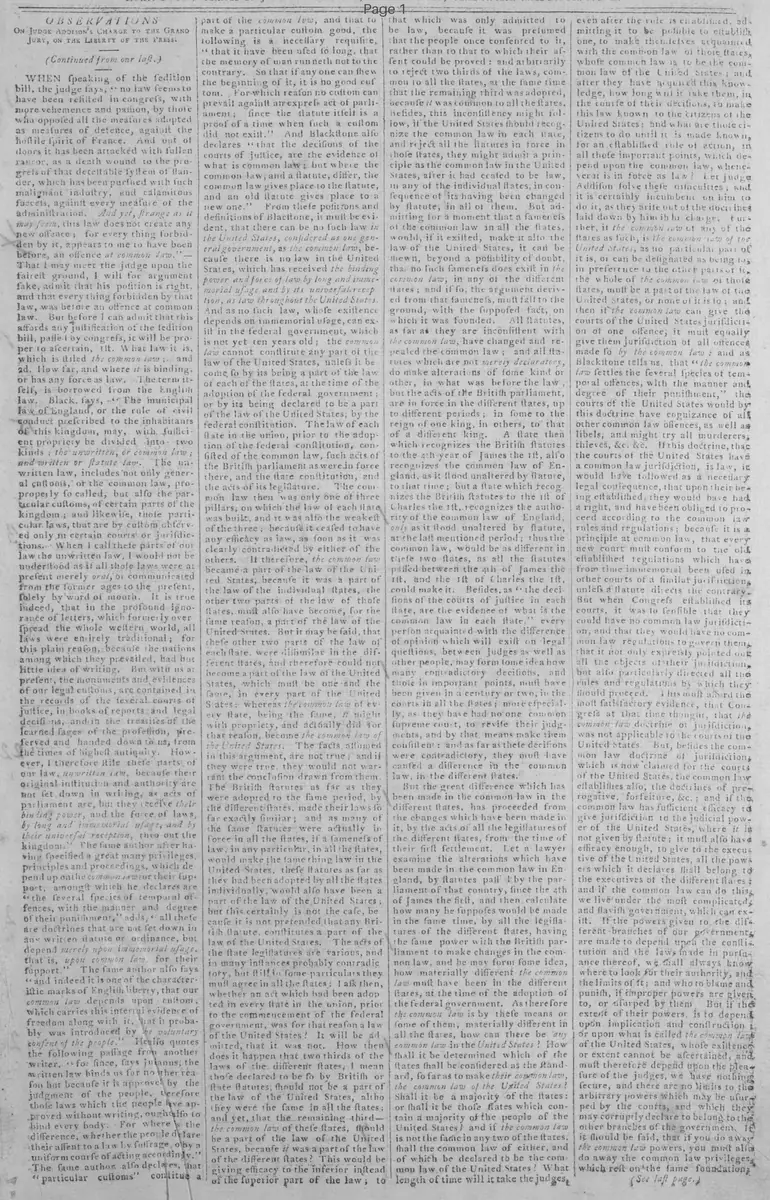
On Judge Addison's Charge TO The Grand Jury, on The Liberty of The Press.
(Continued from our last.)
WHEN speaking of the sedition bill, the judge says, "no law seems to have been resisted in congress, with more vehemence and passion, by those who opposed all the measures adopted as measures of defence, against the hostile spirit of France. And out of doors it has been attacked with sullen rancor, as a death wound to the principles of that detestable system of slander, which has been pursued with such malignant industry, and calamitous success, against every measure of the administration. And yet, strange as it may seem, this law does not create any new offence; for every thing forbidden by it, appears to me to have been before, an offence at common law."—
That I may meet the judge upon the fairest ground, I will for argument sake, admit that his position is right. and that every thing forbidden by that law, was before an offence at common law. But before I can admit that this affords any justification of the sedition bill, passed by congress, it will be proper to ascertain, 1st. What law it is. which is titled the common law; and 2d. How far, and where it is binding, or has any force as law. The term itself, is borrowed from the English law. Black. says—"The municipal law of England, or the rule of civil conduct prescribed to the inhabitants of this kingdom, may, with sufficient propriety be divided into two kinds; the unwritten, or common law; and written or statute law. The unwritten law, includes not only general customs, or the common law, properly so called, but also the particular customs, of certain parts of the kingdom; and likewise. those particular laws, that are by custom observed only in certain courts or jurisdictions. When I call these parts of our law the unwritten law. I would not be understood as if all those laws were at present merely oral, or communicated from the former ages to the present. solely by word of mouth. It is true indeed, that in the profound ignorance of letters, which formerly over spread the whole western world, all laws were entirely traditional; for this plain reason, because the nations among which they prevailed, had but little idea of writing. But with us at present, the monuments and evidences of our legal customs, are contained in the records of the several courts of justice, in books of reports and legal decisions. and in the treatises of the learned ages of the profession, preserved and handed down to us, from the times of highest antiquity. However, I therefore stile these parts of our law, unwritten law, because their original institution and authority are not set down in writing, as acts of parliament are, but they receive their binding power, and the force of laws. by long and immemorial usage, and by their universal reception, thro out the kingdom." The same author after having specified a great many privileges. principles and proceedings, which depend upon the common law for their support, amongst which he declares are "the several species of temporal offences, with the manner and degree of their punishment." adds, all these are doctrines that are not set down in any written statute or ordinance, but depend merely upon immemorial usage. that is, upon common law for their support." The same author also says "and indeed it is one of the characteristic marks of English liberty, that our common law depends upon custom; which carries this intrinsic evidence of freedom along with it. that it probably was introduced by the voluntary consent of the people." He also quotes the following passage from another writer, "for since, says Justinian, the written law binds us for no other reason but because it is approved by the judgment of the people. therefore those laws which the people have approved without writing, ought also to bind every body. For where's the difference, whether the people declare their assent to a law by suffrage, or by a uniform course of acting accordingly."
The same author also declares, that "particular customs" constitute a part of the common law, and that to make a particular custom good, the following is a necessary requisite, "that it have been used so long. that the memory of man runneth not to the contrary. So that if any one can shew the beginning of it, it is no good custom. For which reason no custom can prevail against an express act of parliament; since the statute itself is a proof of a time when such a custom did not exist." And Blackstone also declares "that the decisions of the courts of justice, are the evidence of what is common law; but where the common law, and a statute, differ, the common law gives place to the statute, and an old statute gives place to a new one." From these positions and definitions of Blackstone, it must be evident. that there can be no such law in the United States, considered as one general government, as the common law. because there is no law in the United States, which has received the binding power and force of law by long and immemorial usage and by its universal reception as law throughout the United States. And as no such law, whose existence depends on immemorial usage, can exist in the federal government. which is not yet ten years old; the common law cannot constitute any part of the law of the United States, unless it be come so by its being a part of the law of each of the states, at the time of the adoption of the federal government; or by its being declared to be a part of the law of the United States. by the federal constitution. The law of each state in the union, prior to the adoption of the federal constitution, consisted of the common law, such acts of the British parliament as were in force there, and the state constitution, and the acts of its legislature. The common law then was only one of three pillars, on which the law of each state was built, and it was also the weakest of the three; because it ceased to have any efficacy as law, as soon as it was clearly contradicted by either of the others. If therefore, the common law became a part of the law of the United States, because it was a part of the law of the individual states, the other two parts of the law of those states, must also have become, for the same reason, a part of the law of the United States. But it may be said, that these other two parts of the law of each state. were dissimilar in the different states. and therefore could not become a part of the law of the United States, which must be one and the same, in every part of the United States; whereas the common law of every state, being the same, might with propriety, and actually did for that reason, become the common law of the United States. The facts assumed in this argument, are not true; and if they were true, they would not warrant the conclusion drawn from them. The British statutes as far as they were adopted to the same period, by the different states, made their laws so far exactly similar; and as many of the same statutes were actually in force in all the states, if a sameness of law, in any particular, in all the states, would make the same thing law in the United States. these statutes as far as they had been adopted by all the states individually, would also have been a part of the law of the United States; but this certainly is not the case. because it is not pretended that any British statute, constitutes a part of the law of the United States. The acts of the state legislatures are various, and in many instances probably contradictory, but still. some particulars they must agree in all the states: I ask then, whether an act which had been adopted in every state in the union, prior to the commencement of the federal government, was for that reason a law of the United States? It will be admitted, that it was not. How then does it happen that two thirds of the laws of the different states, I mean those declared to be so by British or state statutes, should not be a part of the law of the United States, although they were the same in all the states; and yet, that the remaining third— the common law of these states, should be a part of the law of the United States, because it was a part of the law of the different states? This would be giving efficacy to the inferior instead of the Superior part of the law : to that which was only admitted to be law, because it was presumed that the people once consented to it, rather than to that to which their assent could be proved : and arbitrarily to reject two thirds of the laws, common to all the states, at the same time that the remaining third was adopted, because it was common to all the states. Besides, this inconsistency might follow, if the United States should recognize the common law in each state, and reject all the statutes in force in those states, they might admit a principle as the common law in the United States, after it had ceased to be law, in any of the individual states, in consequence of its having been changed by statute, in all of them. But admitting for a moment that a sameness of the common law in all the states, would, if it existed, make it also the law of the United States, it can be shewn, beyond a possibility of doubt. that no such sameness does exist in the common law, in any of the different states; and if so, the argument derived from that sameness. must fall to the ground, with the supposed fact, on which it was founded. All statutes, as far as they are inconsistent with the common law, have changed and repealed the common law; and all statutes which are not merely declaratory, do make alterations of some kind or other, in what was before the law but the acts of the British parliament, are in force in the different states, up to different periods; in some to the reign of one king, in others, to that of a different king. A state then which recognizes the British statutes to the 4th year of James the 1st, also recognizes the common law of England, as it stood unaltered by statute, to that time; but a state which recognizes the British statutes to the 1st of Charles the 1st, recognizes the authority of the common law of England. only as it stood unaltered by statute. at the last mentioned period; thus the common law, would be as different in these two states, as all the statutes passed between the 4th of James the 1st. and the 1st of Charles the 1st. could make it. Besides, as "the decisions of the courts of justice in each state, are the evidence of what is the common law in each state," every person acquainted with the difference of opinion which will exist on legal questions, between judges as well as other people, may form some idea how many contradictory decisions, and those in important points, must have been given in a century or two, in the courts in all the states; more especially, as they have had no one common supreme court, to revise their judgments, and by that means make them consistent : and as far as these decisions were contradictory, they must have caused a difference in the common law, in the different states. But the great difference which has been made in the common law in the different states, has proceeded from the changes which have been made in it, by the acts of all the legislatures of the different states, from the time of their first settlement. Let a lawyer examine the alterations which have been made in the common law in England, by statutes passed by the parliament of that country, since the 4th of James the first, and then calculate how many he supposes would be made in the same time. by all the legislatures of the different states, having the same power with the British parliament to make changes in the common law, and he may form some idea, how materially different the common law must have been in the different states, at the time of the adoption of the federal government. As therefore the common law is by these means or some of them, materially different in all the states, how can there be any common law in the United States ? How shall it be determined which of the states shall be considered as the standard, so far as to make their common law, the common law of the United States? Shall it be a majority of the states: or shall it be those states which contain a majority of the people of the United States and if the common law is not the same in any two of the states. Shall the common law of either, and of which be declared to be the common law of the United States ? What length of time will it take the judges, even after the test is established. admitting it to be possible to establish one, to make themselves acquainted with the common law of those states, whose common law is to be the common law of the United States ; and after they have acquired this knowledge, how long will it take them, in the course of their decisions, to make this law known to the citizens of the United States; and what are the citizens to do until it is made known, for an established rule of action, in all those important points, which depend upon the common law, whenever it is in force as law! Let judge Addison solve these difficulties; and it is certainly incumbent on him to do it, as they arise out of the doctrines laid down by him in his charge. Further, if the common law of any of the states as such, is the common law of the United States, as no particular part of it is, or can be designated as being to be in preference to the other parts of it, the whole of the common law of those states, must be a part of the law of the United States, or none of it is to : and then if the common law can give the courts of the United States jurisdiction of one offence, it must equally give them jurisdiction of all offences made so by the common law : and as Blackstone tells us. that "the common law settles the several species of temporal offences, with the manner and degree of their punishment," the courts of the United States would by this doctrine have cognizance of all other common law offences, as well as libels, and might try all murderers; thieves, &c. &c. If this doctrine, that the courts of the United States have a common law jurisdiction, is law, it would have followed as a necessary legal consequence, that upon their being established, they would have had a right, and have been obliged to proceed according to the common law rules and regulations; because it is a principle at common law, that every new court must conform to the old established regulations which have from time immemorial been used in other courts of a similar jurisdiction unless a statute directs the contrary. But when Congress established its courts, it was so sensible that they could have no common law jurisdiction, and that they would have no common law regulations to govern them that it not only expressly pointed out all the objects of their jurisdiction— but also particularly directed all the rules and regulations by which they should proceed. This must afford the most satisfactory evidence, that Congress at that time thought, that the common law doctrine of jurisdiction was not applicable to the courts of the United States But, besides the common law doctrine of jurisdiction; which is now claimed for the courts of the United States, the common law establishes also, the doctrines of prerogative, forfeiture, &c.; and if the common law has sufficient efficacy to give jurisdiction to the judicial power of the United States, where it is not given by statute; it must also have efficacy enough, to give to the executive of the United States, all the powers which it declares shall belong to the executives of the different states : and if the common law can do this we live under the most complicated; and slavish government, which can exist. If the powers given to the different branches of our government are made to depend upon the constitution and the laws made in pursuance thereof, we shall always know where to look for their authority, and the limits of it; and who to blame and punish, if improper powers are given to, or usurped by them But if the extent of their powers, is to depend upon implication and construction : Or upon what is called the common law of the United States, whose existence or extent cannot be ascertained, and. must therefore depend upon the pleasure of the judges, we have nothing secure, and there are no limits to the arbitrary powers which may be usurped by the courts, and which they may corruptly declare to belong to the other branches of the government If it should be said, that if you do away the common law powers, you must also do away the common law privileges which rest on the same foundation
(See last
(Continued from the first page.)
I deny the position: because, independent of the express declaration on this subject contained in the federal constitution, it follows as a necessary consequence from the nature of that government, that although no power was given but, unless it was expressly given; that every privilege was retained by it, which was not expressly parted with. But that clause in the constitution which expressly "reserves to the people the powers not delegated to the United States," renders all reasoning upon this subject unnecessary; for that clause would be totally nugatory, if the United States, or any persons acting under their authority, had common law powers, over and above those delegated to them by the constitution; because the constitution would then by no means fix and ascertain the boundaries of their powers, so as to show what were delegated to them, and what were reserved to the states or the people.
It remains, therefore, only to enquire, whether the common law has been declared to be a part of the law of the United States, by the federal constitution.
Nothing can be more self-evident, than that the people of the United States, had a right to declare, by what laws they would be governed; and it is equally clear that they can have made no declaration on this subject, unless it is to be found in the federal constitution. That constitution declares, that "this constitution and the laws of the United States which shall be made in pursuance thereof, and all treaties made or which shall be made, under the authority of the United States, shall be the supreme law of the land." Here we find a clear, certain and accurate description of every kind of law which was to be binding on the people of the United States; a description which includes in it, not only those things then in being which should be considered as law but also, all those acts which might afterwards become law; and yet this enumeration does not contain one word of the laws of any of the states, much less of the common law, which is only a part of the law of any one of the states, and which is different in every state. A judicious writer expresses himself thus on this subject: "Felony is a term of loose signification, even in the common law of England; and of various import in the statute law of that kingdom. But neither the common nor the statute law of that. or of any other nation, ought to be a standard for the proceedings of this, unless previously made its own by legislative adoption. The meaning of the term as defined in the codes of the several states, would be as impracticable, as the former would be a dishonorable and illegitimate guide. It is not precisely the same in any two of the states: and varies in each with every revision of its criminal laws." It is also remarkable, that although the common law of England, at least in part, was in force in all the present states of America when they were colonies, yet, upon the declaration of independence, it was judged necessary to declare in each state, either by its constitution or by an act of its legislature, that that common law. should constitute a part of the law of the State.
Upon the whole, I consider myself as being well warranted in asserting, that the common law, as such, makes no part of the law of the United States; and therefore, that if all the offences enumerated in the Sedition Bill, before the passage of that bill, were offences in the different states at common law, that this did not justify Congress in passing this bill, by which they are declared to be offences against the United States, and are made cognizable by, and punishable under the sentence of the courts of the United States; because this is not one of the cases specified. in which Congress has power to legislate; because it is not one of the offences which they have authority given them to pass laws for the punishment of; because it is not one of those cases of which the constitution authorizes them to give their courts cognizance; and because the constitution expressly forbids their passing any law on the subject.
ALAWYER.
Who does not wish to be a Judge.
(To be continued.)
What sub-type of article is it?
What keywords are associated?
What entities or persons were involved?
Editorial Details
Primary Topic
Critique Of Sedition Bill Via Common Law Inapplicability To Federal Government
Stance / Tone
Strongly Oppositional To Sedition Act And Federal Common Law Jurisdiction
Key Figures
Key Arguments