Thank you for visiting SNEWPapers!
Sign up free
Editorial
January 23, 1931
The Producers News
Plentywood, Sheridan County, Montana
What is this article about?
Editorial reproduces Dan Whetstone's critique of subservient country editors loyal to local merchants, praises Charley Taylor's bold exposure of high local prices vs. mail order benefits for farmers with low wheat prices, and asserts the paper's own independence despite potential patronage loss.
Clipping
OCR Quality
98%
Excellent
Full Text
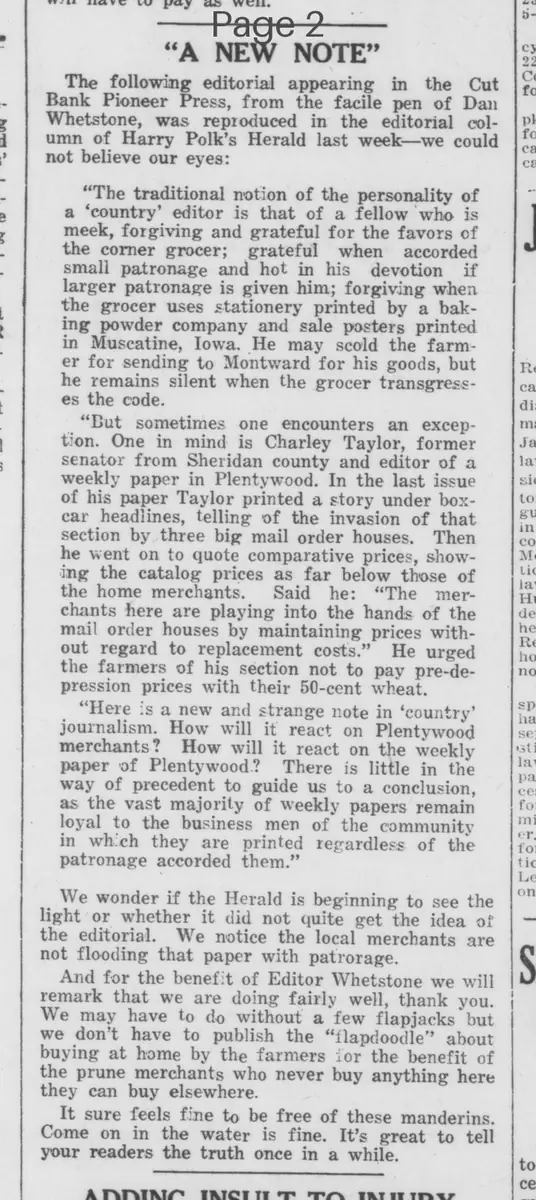
"ANEW NOTE"
The following editorial appearing in the Cut Bank Pioneer Press from the facile pen of Dan Whetstone, was reproduced in the editorial column of Harry Polk's Herald last week-we could not believe our eyes:
"The traditional notion of the personality of a 'country' editor is that of a fellow who is meek, forgiving and grateful for the favors of the corner grocer; grateful when accorded small patronage and hot in his devotion if larger patronage is given him; forgiving when the grocer uses stationery printed by a baking powder company and sale posters printed in Muscatine, Iowa. He may scold the farmer for sending to Montward for his goods, but he remains silent when the grocer transgresses the code.
But sometimes one encounters an exception. One in mind is Charley Taylor, former senator from Sheridan county and editor of a weekly paper in Plentywood. In the last issue of his paper Taylor printed a story under boxcar headlines, telling of the invasion of that section by three big mail order houses. Then he went on to quote comparative prices, showing the catalog prices as far below those of the home merchants. Said he: "The merchants here are playing into the hands of the mail order houses by maintaining prices without regard to replacement costs." He urged the farmers of his section not to pay pre-depression prices with their 50-cent wheat.
Here is a new and strange note in 'country journalism.' How will it react on Plentywood merchants? How will it react on the weekly paper of Plentywood? There is little in the way of precedent to guide us to a conclusion, as the vast majority of weekly papers remain loyal to the business men of the community in which they are printed regardless of the patronage accorded them."
We wonder if the Herald is beginning to see the light or whether it did not quite get the idea of the editorial. We notice the local merchants are not flooding that paper with patronage.
And for the benefit of Editor Whetstone we will remark that we are doing fairly well, thank you. We may have to do without a few flapjacks but we don't have to publish the "flapdoodle" about buying at home by the farmers for the benefit of the prune merchants who never buy anything here they can buy elsewhere.
It sure feels fine to be free of these mandarins. Come on in the water is fine. It's great to tell your readers the truth once in a while.
The following editorial appearing in the Cut Bank Pioneer Press from the facile pen of Dan Whetstone, was reproduced in the editorial column of Harry Polk's Herald last week-we could not believe our eyes:
"The traditional notion of the personality of a 'country' editor is that of a fellow who is meek, forgiving and grateful for the favors of the corner grocer; grateful when accorded small patronage and hot in his devotion if larger patronage is given him; forgiving when the grocer uses stationery printed by a baking powder company and sale posters printed in Muscatine, Iowa. He may scold the farmer for sending to Montward for his goods, but he remains silent when the grocer transgresses the code.
But sometimes one encounters an exception. One in mind is Charley Taylor, former senator from Sheridan county and editor of a weekly paper in Plentywood. In the last issue of his paper Taylor printed a story under boxcar headlines, telling of the invasion of that section by three big mail order houses. Then he went on to quote comparative prices, showing the catalog prices as far below those of the home merchants. Said he: "The merchants here are playing into the hands of the mail order houses by maintaining prices without regard to replacement costs." He urged the farmers of his section not to pay pre-depression prices with their 50-cent wheat.
Here is a new and strange note in 'country journalism.' How will it react on Plentywood merchants? How will it react on the weekly paper of Plentywood? There is little in the way of precedent to guide us to a conclusion, as the vast majority of weekly papers remain loyal to the business men of the community in which they are printed regardless of the patronage accorded them."
We wonder if the Herald is beginning to see the light or whether it did not quite get the idea of the editorial. We notice the local merchants are not flooding that paper with patronage.
And for the benefit of Editor Whetstone we will remark that we are doing fairly well, thank you. We may have to do without a few flapjacks but we don't have to publish the "flapdoodle" about buying at home by the farmers for the benefit of the prune merchants who never buy anything here they can buy elsewhere.
It sure feels fine to be free of these mandarins. Come on in the water is fine. It's great to tell your readers the truth once in a while.
What sub-type of article is it?
Press Freedom
Trade Or Commerce
What keywords are associated?
Country Journalism
Mail Order Houses
Local Merchants
Truthful Reporting
Farmers Prices
Editorial Independence
What entities or persons were involved?
Dan Whetstone
Charley Taylor
Harry Polk's Herald
Cut Bank Pioneer Press
Plentywood Merchants
Editorial Details
Primary Topic
Independence Of Country Journalism From Local Merchant Influence
Stance / Tone
Defending Truthful Reporting Over Loyalty To Merchants
Key Figures
Dan Whetstone
Charley Taylor
Harry Polk's Herald
Cut Bank Pioneer Press
Plentywood Merchants
Key Arguments
Traditional Country Editors Are Meek And Loyal To Local Merchants Regardless Of Patronage
Charley Taylor's Editorial Exposed Mail Order Houses' Lower Prices Compared To Local Merchants
Local Merchants Maintain High Prices Without Regard To Costs, Aiding Mail Order Competition
Farmers Should Not Pay Pre Depression Prices With Low Wheat Yields
Country Papers Usually Remain Loyal To Community Businessmen
The Reproduced Editorial Questions The Impact On Plentywood Merchants And Taylor's Paper
Local Paper Affirms Its Own Financial Stability And Freedom From Merchant Pressure
Rejects Publishing 'Flapdoodle' To Benefit Merchants Who Shop Elsewhere