Thank you for visiting SNEWPapers!
Sign up free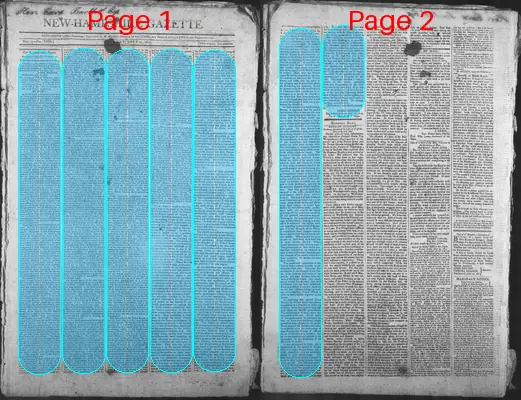
The New Hampshire Gazette
Portsmouth, Rockingham County, New Hampshire
What is this article about?
President James Madison transmits to Congress a July 12, 1813, report from Secretary of State James Monroe detailing the late notification of France's April 28, 1811, decree repealing the Berlin and Milan decrees, its diplomatic handling, implications for British Orders in Council, and the US declaration of war on Britain.
Merged-components note: The component on page 2 is a direct continuation of the article on US relations with France from page 1, as indicated by the sequential reading order and text flow starting mid-sentence. Merged into a single foreign_news component.
Clippings
1 of 2
OCR Quality
Full Text
President's Message to Congress.
To the House of Representatives of the United States:
I transmit to the House of Representatives a report of the Secretary of State, containing the information requested by their resolutions of the 21st of June last.
JAMES MADISON
Washington, July 12, 1813.
The Secretary of State, to whom was referred several resolutions of the House of Representatives of the 2d ult. requesting information on certain points relating to the French decree of the 28th of April, 1811, has the honor to make to the President the following REPORT:
In furnishing the information required by the House of Representatives, the Secretary of State presumes, that it might be deemed sufficient for him to state what is now demanded, what part thereof has been heretofore communicated, and to supply the deficiency. He considers it however more conformable to the views of the House, to meet at this time, without regarding what has been already communicated, every inquiry, and to give a direct answer to each with the proper explanation relating to it.
The House of Representatives has requested information, when, by whom, and in what manner, the first intelligence was given to this government of the decree of the government of France, bearing date on the 28th of April, 1811, and purporting to be a definitive repeal of the decrees of Berlin and Milan; whether Mr. Russell, late charge d'affaires of the United States to the government of France, ever admitted or denied to his government the correctness of the declaration of the Duke of Bassano, to Mr. Barlow, as stated in Mr. Barlow's letter of the 12th May 1812, to the Secretary of State, that the said decree had been communicated to his, Mr. Barlow's predecessor, for there, and to lay before the House any correspondence with Mr. Russell on that subject, which it may not be improper to communicate, and also any correspondence between Mr. Barlow and Mr. Russell, in possession of this Department of State; whether the Minister of France to the U. States ever informed this government of the existence of the said decree, and to lay before the House any correspondence with the said Minister relative thereto not improper to be communicated; with any other information in possession of the Executive which he may not deem it injurious to the public interest to disclose, relative to the said decree, tending to show at what time, by whom, and in what manner, it was first made known to this government or to any of its representatives or agents; and lastly, to inform the House whether the government of the U. States hath ever received from that of France any explanation of the reasons of that decree being concealed from this government, and its Minister, for so long a time after its date; and if such explanation has been asked by this government, and has been omitted to be given by that of France, whether this government has made any remonstrance, or expressed any dissatisfaction to the government of France at such concealment.
These inquiries embrace two distinct objects. The first relates to the conduct of the government of France, in regard to this decree. The second, to that of the government of the U. States. In satisfying the call of the House, on this latter point, it seems to be proper to meet it in a two fold view; as it relates to the conduct of this government in this transaction; secondly, as it relates to its conduct towards both belligerents in some important circumstances connected with it. The resolutions do not call especially for a report of such extent but as the measures of the Executive, and the acts of Congress, founded on communications from the Executive, which relate to one of the belligerents have by necessary consequence an immediate relation to the other, such a report seems to be obviously comprised within their scope. On this principle the report is prepared in this expectation that the more full the information given on every branch of the subject, the more satisfactory will it be to the House.
The Secretary of State has the honor to report in reply to the inquiries, that the first intelligence which this government received of the French decree of 28th April, 1811, was communicated by Mr. Barlow, in a letter bearing date on the 12th May 1812, which was received by this department on the 13th July following; that the first intimation to Mr. Barlow, of the existence of that decree, as appears by his communications, was given by the Duke of Bassano, in an informal conference on some day between the 1st and 10th of May, 1812, and the official communication of it to Mr. Barlow was made on the 10th of that month, at his request; that Mr. Barlow transmitted a copy of that decree, and of the Duke of Bassano's letter announcing it to Mr. Russell, in a letter of May 11th, in which he also informed Mr. Russell that the Duke of Bassano had stated that the decree had been duly communicated to him; that Mr. Russell replied, in a letter to Mr. Barlow of the 29th May, that his first knowledge of the decree was derived from his letter, and that he has repeatedly stated the same since to this government. The paper marked A, is a copy of an extract of Mr. Barlow's letter to the Department of State of May 12, 1812. B, of the Duke of Bassano's letter to Mr. Barlow, of the 10th of the same month, C. of an extract of Barlow's letter to Mr. Russell of May 11th D, of an extract of Mr. Russell's answer of the 29th May -and E, of Mr. Russell's letter to the Department of State of the 30th.
The Secretary of State reports also that no communication of the Decree of the 28th April, 1811, was ever made to this government by the minister of France or other person, than as is above stated, and that no explanation of the cause of its not having been communicated to this government and published at the time of its date, was ever made to this government or so far as it is informed to the representatives or agents of the U. S, in Europe.
The minister of France has been asked to explain the cause of a proceeding apparently so extraordinary and exceptionable, who replied that his first intelligence of that decree was received by the Wasp in a letter from the Duke of Bassano of May 20th, 1812, in which he expressed his surprise, excited by Mr. Barlow's communication, that a prior letter of May 1811, in which he had transmitted a copy of the decree for the information of this government, had not been received-further explanations were expected from Mr. Barlow, but none were given. The light in which this was viewed by this government was noticed by the President in his message to Congress, and communicated also to Mr. Barlow in a letter of the 19th July, 1812, with a view to the requisite explanation from the French government.
On the 9th day of May 1812, the emperor left Paris for the North and in two days thereafter the Duke of Bassano followed him. A negotiation for the adjustment of injuries, and the arrangement of our commerce with the government of France, long depending and said to have been brought nearly to a conclusion at the time of Mr. Barlow's death, was suspended -by that event. His successor, lately appointed is authorized to resume the negotiation and to conclude it. He is instructed to demand redress of the French government for every injury, and an explanation of its motive for withholding from this government acknowledgment of the decree for so long a time after its adoption.
It appears by the documents referred to, that Mr. Barlow lost no time, after having obtained knowledge of the existence of the French decree of the 28th April, 1811 in demanding a copy of it, and transmitting it to Mr. Russell who immediately laid it before the British government urging on the ground of this new proof of the repeal of the French decrees, that the British orders in council should be repealed. Mr. Russell's note to Lord Castlereagh bears date on the 20th of May, Lord Castlereagh's reply on the 23d, in which he promised to submit the decree to the consideration of the Prince Regent. It appears however, that no encouragement was given at that time to hope that the orders in council would be repealed in consequence of that decree, and that although it was afterwards made the ground of their repeal, the repeal was nevertheless to be ascribed to other causes. Their repeal did not take effect until the 23d of June, more than a month after the French decree had been laid before the British government, a delay indicating, in itself, at a period so momentous & critical not merely neglect but disregard of the French decree.
That the repeal of the British orders in council was not produced by the French decree, other proofs might be adduced. I will state one which in addition to the evidence contained in Mr. Russell's letters which were communicated marked G, is deemed conclusive. In the communication of Mr. Baker to Mr. Graham on the 9th of August 1812 which was founded on instructions from his government, of as late date as the 19th June in which he stated, that an official declaration would be sent to this country, proposing a conditional repeal of the orders in council so far as they affected the United States. no notice whatever was taken of the French decree. One of the conditions then contemplated was that the orders in council should be revived at the end of 8 months, unless the conduct of the French government and the result of the communications with the government of the U S should be such as in the opinion of the British government to render their revival unnecessary, a condition which proves incontestibly that the French decree was not considered by the British government a sufficient ground on which to repeal the orders in council. It proves also that on that day the British government had resolved not to repeal the orders on the basis of that decree since the proposed repeal was to depend not on what the French government had already done, but on what it might do, and on arrangement to be entered into with the U. S. unconnected with the French repeal.
The French decree of the 28th April 1811, was transmitted to the United States by the Wasp, a public vessel, which had been long awaiting, at the ports of Great Britain and France despatches from our ministers relating to these very important concerns with both governments. It was received at the Department of State on the 13th July, 1812, nearly a month after the declaration of war against G Britain. Intelligence of the repeal of the orders in council was not received until about the middle of the following month. It was impossible, therefore, that either of those acts, in whatever light they might be viewed, should have been taken into consideration, or have had any influence in deciding on that important event.
Had the British government been disposed to repeal its orders in council, in conformity with the principle on which it professed to have issued them, and on the condition which it had itself prescribed there was no reason to delay the repeal until such a decree as that of the 28th April, 1811 should be produced. The declaration of the French government of August 5, 1810, had fully satisfied every claim of the British government according to its own principles on that point, By it the decrees of Berlin and Milan were declared to be repealed, the repeal to take effect on 1st November following, on which day it did take effect. The only conditions attached to it, was either that Great Britain should follow the example, and repeal her orders in council or that the United States should carry into effect against her their non importation act. This condition was in its nature subsequent, not precedent reserving a right in France to revive her decrees in case neither alternative was performed. By this declaration it was put completely in the power of Great Britain to terminate the controversy in manner the most honorable to herself - France had yielded to her the ground on a condition with which she had declared her willingness to comply Had she complied, the non importation act would not have been carried into effect. nor could the French decrees have been revived By refusing to comply, she has made herself responsible for all that has since followed.
By the decree of the 28th April, 1811 the decrees of Berlin Milan were said to be definitively repealed ; & the execution of the non importation act against G Britain was declared to be the ground of that repeal. The repeal announced by the declaration of the 5th Augt, 1810 was absolute and final except as to the condition subsequent attached to it. This latter decree acknowledges that that condition had been performed, and disclaims the right to revive it. in consequence of that performance and extending back to the first of November, confirms in every circumstance the preceding repeal. The latter act, therefore as to the repeal is nothing more than a confirmation of the former. It. in this sense that those two acts are to be understood in France It is in the same sense that they are to be regarded by other powers.
In repealing the orders in council on the pretext of the French decree of the 28th April 1811, the British government has conceded that it ought to have repealed them on the declaration of the 5th August, 1810. It is impossible to discriminate between the two acts or to separate them from each other, so as to justify on sound and consistent principles, the repeal of the orders in council on the ground of one act, and the refusal to repeal them on that of the other. The second act makes the repeal definitive, but for what reason ? Because the non importation act had been put in force against Great Britain, in compliance with the condition subsequent attached to the former repeal, and her refusal to perform it That act being thus in force. and the decree of the 28th April, 1811, being expressly founded on it. Great Britain repeals her orders in council on the basis of this latter decree-The conclusion is, therefore, irresistible. that by this repeal, under all the circumstances attending it. the British government has acknowledged the justice of the claim of the United States to a repeal on the former occasion. By accepting the latter repeal, it has sanctioned the preceding one--it has sanctioned also the conduct of this government in carrying into effect the non importation act against Great, Britain, founded on the preceding repeal.
Other important consequences result from this repeal of the British government. By fair and obvious construction the acceptance of the decree of the 28th April. 1811, as the ground of the repeal of the orders in council, ought to be construed to extend back to the 1st of November 1810, the day on which the preceding repeal took effect The secretary of state has full confidence. that if the question could be submitted to the judgment of an impartial judicial tribunal, such would be its decision He has equal confidence that such will be the judgment pronounced on it by the enlightened and impartial world If. however these two acts could be separated from each other. or so as that the latter might be made the basis of the repeal of the orders in council; distinct from the former. it follows that bearing date on the 28th April, 1811, the repeal ought to have relation to that date. In legal construction, between nations as well as individuals, acts are to be respected from the time they begin to operate , and, where they impose a moral or political obligation on another party, that obligation commences with the commencement of the act. But it has been urged that the French decree was not. promulgated or made known to the British government until a year after its date, This objection has no force. By accepting an act bearing date a year before it was promulgated it is admitted that in the interval nothing was done repugnant to it. It cannot be presumed that any government would accept from another, as the basis on which it was to found an important measure an act of anterior and remote date, pledging itself to a certain course of conduct which that government had in the interval departed from and violated. If any government had violated an act the injunctions of which it was bound to observe by an anterior one in relation to a third party. and which it professed to have observed, before its acceptance by the other, it could not be presumed that it would cease to violate it after the acceptance. The conclusion is irresistible, that if the other government did accept such act with a knowledge of its antecedent violation, as the foundation of any measure on its own part. that such act must have been the ostensible only, and not the real motive of such measure.
The declaration of the Prince Regent of the 21st April 1811 is in full confirmation of these remarks By this act of the British government it is formally announced, on the authority of a report of the Secretary of Foreign Affairs to the Conservative Senate of France, that the French decrees were still in force, and that the orders in council should not be repealed. It cannot fail to excite considerable surprise-that the British government should immediately afterwards that. is on the 23d June repeal its orders in council. on the ground of the French decree of the 28th April 1811. By this proceeding the British government has involved itself in manifest inconsistency It has maintained by one act, that the French decrees were all in full force and by another that they were repealed during the same space of time. It admits also, that by no act of the French government or its cruizers. had any violation of the repeal announced by the declaration of the French government of the 5th August, 1810, been committed, or at least, that such violation had not had sufficient weight to prevent the repeal of the orders in council.
It was objected that the declaration of the French government of the 5th of August 1810, was not such an act as the British government ought to have regarded. The Secretary of State is thoroughly satisfied that this objection is altogether unfounded. It Was communicated by the Emperor through the highest official organ the Secretary of Foreign Affairs, to the minister plenipotentiary of the United States at Paris. It is impossible to conceive an act more formal, authentic or obligatory on the French government, than. that alluded to. Does one government ever ask or expect from another to secure the performance of any duty. however important, more than its official pledge, fairly and fully expressed ? Can better security be given for its performance Had there been any. doubt on this subject the conduct of Great Britain herself in similar cases would have completely removed it. The whole history of her diplomatic intercourse with other powers, on the subject of blockade is in accord with this proceeding of the French government. We know that when her government institutes a blockade. the Secretary of Foreign Affairs announces it to the ministers of other powers at London ; and that the same form is observed when they are revoked. Nor was the authenticity of either act thus announced ever questioned.
Had a Similar declaration been made by the minister of France in the U. S to this government by the order of his own; would it not have been entitled to respect, and been respected ? By the usage of nations such respect could not have been withheld. The arrangement made with Mr. Erskine is a last proof of the good faith of this government and of its impartiality in its transactions with both the belligerents. It was made with that minister on the ground of his public character, and the confidence due to it ; on which basis the non intercourse was removed as to England, and left in full, force against France. The failure of that arrangement was imputable to the British government alone. who in rejecting it. took on itself a high responsibility. not only, in regard to the consequences attending it but in disavowing and annulling the act of its minister, without showing that he had exceeded his authority. In accepting the declaration of the French minister of foreign affairs, in proof, of the French repeal, the U. S. gave no proof of improper credence to the government of France, On a comparison of both transactions, it will appear that if a marked confidence and respect was shown to either government, it was to that of G. Britain. In accepting the declaration of the government of France in the presence of the Emperor, the U. S. stood on a more secure ground than in accepting that of a British minister in this country.
To the demand made by the United States of the repeal of the British orders in council founded on the basis of the French repeal of August 5, 1810 the British government replied, by demanding a copy of the orders issued by the French government for carrying into effect that repeal; a demand without example in the intercourse between nations By this demand it ceased to be a question whether the French repeal was of. sufficient extent, or was founded on justifiable conditions. The pledge of the French government was doubted; a scrutiny was to be instituted as to the manner in which it was to be discharged, and, its faith preserved. not by the subsequent conduct of. its cruizers towards vessels of the United States, but by a copy of the orders. given to its cruisers. Where would this end ? If the French government intended a fraud, by, its declaration of repeal, announced to the minister of the United States, and afterwards to, this government, might it not likewise commit a fraud in any other communication which it might make? If credit was refused by the British government to the act of the French government, thus formally announced is it probable that it would have been given by it, to any document of inferior character. directed to its own people ? Although it was the policy and might be the interest of the British government to engage the U. States in such a controversy with the French government, it was far from comporting with their interest to do it. They. considered it their duty to accept the repeal already made by the French government, of its decrees, and to look to its conduct and to that of its cruizers, sanctioned by the government, for the faithful performance or violation of it. The United States having been injured by both powers, were unwilling, in their exertions to obtain justice of either, to become the instrument of the other. They were the less inclined to it in the present instance, from the consideration, that the party making the pressure on them maintained in full force its unlawful edicts against -the -American commerce while it could not deny. that a considerable advance, at least, had been made by the other towards a complete accommodation, it being manifest to the world, not only that the faith of the French government stood pledged for the repeal of its decrees. but that the repeal did take effect on the 1st of November, 1810. in regard to the United States : that several American vessels taken under them had been delivered up, and judicial decisions suspended on all, by its order, and that it also continued to give the most positive assurances that the repeal should be faithfully observed.
It has also been urged that the French repeal was conditional and for that reason could not be accepted. This objection has already been fully answered. It merits attention, however, that the acts of the British government relating. to this subject. particularly, the declaration of the 21st April, 1812, and the repeal of the 23d June of the same year, are equally and in like manner conditional. It is not a little surprising, that the British government should have objected to a measure in another government, to which it has itself given sanction by its own acts. It is proper, however, to remark, that this objection has been completely waived and given up by the acceptance of the decree of the 28th April, 1811.
The British government has urged also, that it could not consider in the faithful performance by the French government of any engagement it might enter into relative to the repeal of its decrees. This objection would be equally applicable to any other compact to be entered into with France. While maintained it would be a bar to any treaty, even to a treaty of peace, between them. But it also has been admitted to be unfounded by the acceptance of the decree of the 28th of April, 1811.
The Secretary of State presumes that these facts and explanations, supported as they are by authentic documents, prove, first, that the repeal of the British orders in council was not to be ascribed to the French decree bearing date on the 28th April, 1811, and secondly, that in making that decree the basis of their repeal, the British government conceded that it ought to have repealed them on the ground of the declaration of the French government of 5th August, 1810, so as to take effect on the 1st November following. To what cause the. repeal of the British orders in council was justly attributable, cannot now remain a doubt, with any, who. have marked with a just discernment the course of events. It must afford great consolation to the good people of these states, to know that they have not submitted to privations in vain.
The discussion of other wrongs, particularly that relating to impressment, had been closed some time before the period alluded to. It was unworthy of the character of the United States to pursue the discussion on that difference, when it was evident that no advantage could be derived from it. The right was reserved, to be brought forward and urged again, when it might be done with effect. In the mean time the practice of impressment was persevered in with vigour.
At the time when war was declared against Great Britain, no satisfactory arrangement was offered, or likely to be obtained respecting impressment, and nothing was more remote from the expectation of this government, than the repeal of the orders in council. Every circumstance which had occurred tended to illustrate the policy and views of the British government rendered such an event altogether improbable. From the commencement of that system of hostility, which Great Britain had adopted against the United States, her pretensions had gradually increased, or at least become more fully unfolded, according to circumstances; until at the moment when war was declared they had assumed a character which dispelled all prospect of accommodation. The orders in council were said to have been adopted on a principle of retaliation on France, although at the time when the order of. May 1806 was issued, no measure of France had occurred on which it could be retaliatory, and at the date of the new order January, 1807, was hardly possible that this government should have even heard of the decree of Berlin to which it related. It was stated at the time of their adoption and for some time afterwards, that they should be revoked as soon as France revoked her decrees, & that the British government would proceed with the government of France pari passu in the revocation. After the declaration, however, of the French government of
The 5th August 1810, by which the Berlin and Milan decrees were declared to be repealed, the British government changed its tone, and continued to resist its demands, to the moment that war was declared. It objected first that the French repeal was conditional, and not absolute: although the only condition attached to it, was, that G. Britain should follow the example, or the United States fulfill their pledge by executing the non-importation act against her. It was then demanded that France should repeal her internal regulations, as a condition of the repeal of the British orders in council. Next, that the French repeal should be extended to all neutral nations, as well as to the United States. And lastly, that the ports of her enemies, and all ports from which the British flag was excluded, should be opened to the British manufactures in American vessels; conditions so extravagant as to satisfy all dispassionate minds that they were demanded, not in the expectation that they would or could be complied with, but to terminate the discussion.
On full consideration of all circumstances, it appeared that the period had arrived, when it became the duty of the United States to take that attitude with G. Britain, which was due to their violated rights, to the security of their most important interests, and to their character as an independent nation. To have shrunk from the crisis would have been to abandon everything valuable to a free people. The surrender of our seamen to British impressment, with the destruction of our navigation and commerce, would not have been its only evils. The desolation of property, however great and widely spread, affects an interest which admits of repair. The wound is incurable only, which fixes a stigma on the national honor.
While the spirit of the people is unsubdued, there will always be found in their virtue a resource equal to the greatest dangers and most trying emergencies. It is in the nature of free government, to inspire in the body of the people generous and noble sentiments, and it is the duty of the constituted authorities to cherish and appeal to those sentiments, and rely on the patriotic support of their constituents. Had they proved themselves unequal to the crisis, the most fatal consequences would have resulted from it. The proof of their weakness would have been recorded; but not on them alone would its baneful effects have been visited. It would have shaken the foundation of the government itself, and even of the sacred principles of the revolution, on which all our political institutions depend.
Yielding to the pretensions of a foreign power, without making a manly effort in defence of our rights, without appealing to the virtue of the people, or to the strength of our Union, it would have been charged and believed that in these sources lay the hidden defects. Where would the good people of these states have been able to make another stand? Where would have been their rallying point? The government of their choice having been dishonored, its weakness & that of their institutions demonstrated, the triumph of the enemy would have been complete. It would also have been durable.
The constituted authorities of the United States neither dreaded or anticipated these evils. They had full confidence in the strength of the Union, in the firmness and virtue of the people, and were satisfied, when the appeal should be made, that ample proof would be afforded, that their confidence had not been misplaced. Foreign pressure, it was not doubted, would soon dissipate foreign partialities and prejudices, if such existed, & unite us more closely together as one people.
In declaring war against Great Britain the United States have placed themselves in a situation to retort the hostility, which they had so long suffered from the British government. The maintenance of their rights was the object of the war. Of the desire of this government to terminate the war on honorable conditions, ample proof has been afforded by the propositions made to the British government immediately after the declaration of war, through the Charge d'Affaires of the United States at London, and by the promptitude and manner of the acceptance of the Mediation of the Emperor of Russia.
It was anticipated by some, that a declaration of war against G. Britain would force the United States into a close connection with her adversary, much to their disadvantage. The Secretary of State thinks it proper to remark, that nothing is more remote from the fact. The discrimination in favor of France, according to law, in consequence of her acceptance of the proposition made equally to both powers, produced a difference between them in that special case, but in that only. The war with England was declared, without any concert or communication with the French government: it has produced no connexion between the United States and France, or any understanding as to its prosecution, continuance, or termination. The ostensible relation between the two countries, is the true and only one.
The United States have just claims on France for spoliations on their commerce on the high seas, and in the ports of France, and their late Minister was, and their present Minister is, instructed, to demand reparation for these injuries, and to press it with the energy due to the justice of their claim and to the character of the U. States. The result of the negotiation will be communicated to Congress in due time. The papers marked I contain copies of two letters, addressed from this Department to Mr. Barlow, one of the 16th June, 1812, just before the declaration of war, the other of the 14th July following, which show distinctly the relation existing between the United States and France at that interesting period. No change has since occurred in it.
All of which is respectfully submitted.
JAMES MONROE
Department of State, July 12, 1813
To the President of the U. States.
What sub-type of article is it?
What keywords are associated?
What entities or persons were involved?
Where did it happen?
Foreign News Details
Primary Location
France
Event Date
July 12, 1813
Key Persons
Outcome
repeal of british orders in council on june 23, 1812; us declaration of war against great britain on june 18, 1812; no casualties mentioned; diplomatic concessions acknowledging french repeal of berlin and milan decrees effective november 1, 1810.
Event Details
Secretary of State James Monroe reports to President Madison on the French decree of April 28, 1811, repealing the Berlin and Milan decrees, its delayed communication to the US until May 1812 via Mr. Barlow, lack of prior notification from France, implications for British Orders in Council repeal, US impartiality toward belligerents, and justification for war declaration against Britain due to unresolved trade and impressment issues.