Thank you for visiting SNEWPapers!
Sign up free
Story
November 4, 1872
The Daily Dispatch
Richmond, Virginia
What is this article about?
A massive political demonstration for Andrew Johnson in Nashville on October 26, 1872, featured a two-mile procession with bands, torchlights, industry displays, and 30,000 attendees, highlighting strong support amid the election campaign.
Clipping
OCR Quality
88%
Good
Full Text
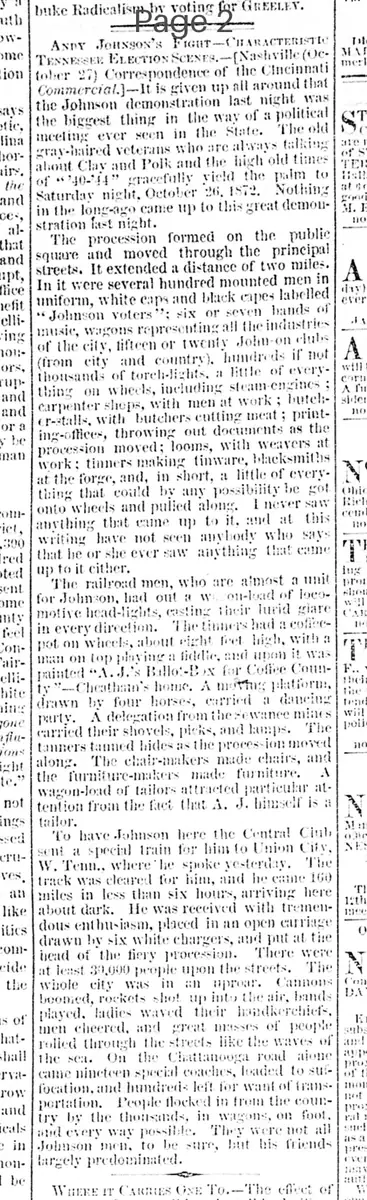
Andy Johnson's Fight—Characteristic Tennessee Election Scenes.—(Nashville, October 27) Correspondence of the Cincinnati Commercial.—It is given up all around that the Johnson demonstration last night was the biggest thing in the way of a political meeting ever seen in the State. The old gray-haired veterans who are always talking about Clay and Polk and the high old times of '44 gracefully yield the palm to Saturday night, October 26, 1872. Nothing in the long-ago came up to this great demonstration last night.
The procession formed on the public square and moved through the principal streets. It extended a distance of two miles. In it were several hundred mounted men in uniform, white caps and black capes labelled 'Johnson voters'; six or seven bands of music, wagons representing all the industries of the city, different or twenty Johnson clubs (iron city and country), hundreds if not thousands of torch-lights, a little of everything on wheels, including steam engine, carpenter shops, with men at work; butcher stalls, with butchers cutting meat; printing-offices, throwing out documents as the procession moved; looms, with weavers at work; tinners making tinware, blacksmiths at the forge, and, in short, a little of everything that could by any possibility be got onto wheels and hauled along. I never saw anything that came up to it, and at this writing have not seen anybody who says that he or she ever saw anything that came up to it either.
The railroad men, who are almost a unit for Johnson, had out a whole train of locomotive head-lights, casting their lurid glare in every direction. The cars had a cone-pot on wheel, about eight feet high, with a man on top playing a fiddle, and it was entitled 'A.J. Bullock for Congress'—Bullock's home. A mining shaft for, drawn by four horses, carried a dining party. A delegation from the Swansea mines carried their shovel, picks, and lamp. The tanners turned hides as the procession moved along. The chair-makers made chairs, and the furniture-makers made furniture. A wagon-load of tailors attracted particular attention from the fact that A. J. Bullock is a tailor.
To have Johnson here the Central Club sent a special train for him to Union City, W. Tenn., where he spoke yesterday. The track was cleared for him, and he came 160 miles in less than six hours, arriving here about dark. He was received with tremendous enthusiasm, placed in an open carriage drawn by six white chargers, and put at the head of the fiery procession. There were at least 30,000 people upon the streets. The whole city was in an uproar. Cannons boomed, rockets shot up into the air, bands played, ladies waved their handkerchiefs, men cheered, and great masses of people rolled through the streets like the waves of the sea. On the Chattanooga road alone came nineteen special coaches, loaded to suffocation, and hundreds left for want of transportation. People flocked in from the country by the thousands, in wagons, on foot, and every way possible. They were not all Johnson men, to be sure, but his friends largely predominated.
The procession formed on the public square and moved through the principal streets. It extended a distance of two miles. In it were several hundred mounted men in uniform, white caps and black capes labelled 'Johnson voters'; six or seven bands of music, wagons representing all the industries of the city, different or twenty Johnson clubs (iron city and country), hundreds if not thousands of torch-lights, a little of everything on wheels, including steam engine, carpenter shops, with men at work; butcher stalls, with butchers cutting meat; printing-offices, throwing out documents as the procession moved; looms, with weavers at work; tinners making tinware, blacksmiths at the forge, and, in short, a little of everything that could by any possibility be got onto wheels and hauled along. I never saw anything that came up to it, and at this writing have not seen anybody who says that he or she ever saw anything that came up to it either.
The railroad men, who are almost a unit for Johnson, had out a whole train of locomotive head-lights, casting their lurid glare in every direction. The cars had a cone-pot on wheel, about eight feet high, with a man on top playing a fiddle, and it was entitled 'A.J. Bullock for Congress'—Bullock's home. A mining shaft for, drawn by four horses, carried a dining party. A delegation from the Swansea mines carried their shovel, picks, and lamp. The tanners turned hides as the procession moved along. The chair-makers made chairs, and the furniture-makers made furniture. A wagon-load of tailors attracted particular attention from the fact that A. J. Bullock is a tailor.
To have Johnson here the Central Club sent a special train for him to Union City, W. Tenn., where he spoke yesterday. The track was cleared for him, and he came 160 miles in less than six hours, arriving here about dark. He was received with tremendous enthusiasm, placed in an open carriage drawn by six white chargers, and put at the head of the fiery procession. There were at least 30,000 people upon the streets. The whole city was in an uproar. Cannons boomed, rockets shot up into the air, bands played, ladies waved their handkerchiefs, men cheered, and great masses of people rolled through the streets like the waves of the sea. On the Chattanooga road alone came nineteen special coaches, loaded to suffocation, and hundreds left for want of transportation. People flocked in from the country by the thousands, in wagons, on foot, and every way possible. They were not all Johnson men, to be sure, but his friends largely predominated.
What sub-type of article is it?
Historical Event
Personal Triumph
What themes does it cover?
Triumph
Social Manners
What keywords are associated?
Johnson Demonstration
Political Procession
Nashville Rally
Election Scenes
Andrew Johnson
Tennessee Politics
What entities or persons were involved?
Andy Johnson
A.J. Bullock
Where did it happen?
Nashville, Tennessee
Story Details
Key Persons
Andy Johnson
A.J. Bullock
Location
Nashville, Tennessee
Event Date
October 26, 1872
Story Details
A grand procession and rally in support of Andrew Johnson featured industry-themed wagons, torchlights, bands, and thousands of attendees, culminating in Johnson's arrival by special train and leading the event amid widespread enthusiasm.