Thank you for visiting SNEWPapers!
Sign up free
The Kentucky Gazette
Lexington, Fayette County, Kentucky
What is this article about?
A treatise on equality recently published in France critiques democratic principles arguing that political society is artificial contrary to nature and founded on hereditary inequality allowing social mobility.
Clipping
OCR Quality
Full Text
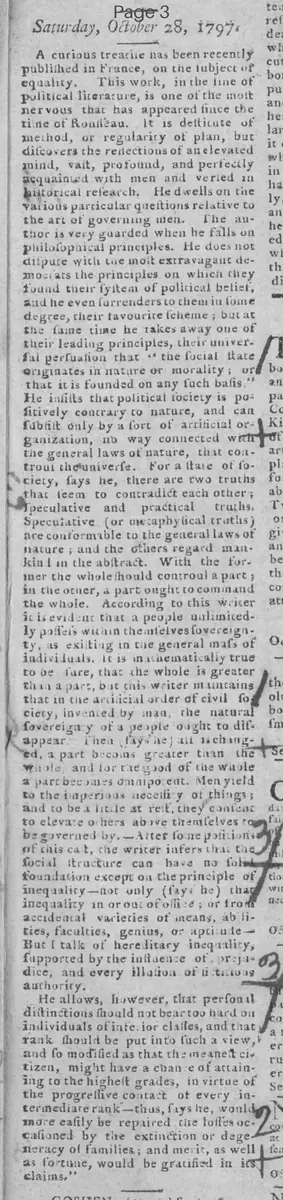
A curious treatise has been recently published in France, on the subject of equality. This work, in the line of political literature, is one of the most nervous that has appeared since the time of Rouleau. It is destitute of method, or regularity of plan, but discovers the reflections of an elevated mind, vast, profound, and perfectly acquainted with men and varied in historical research. He dwells on the various particular questions relative to the art of governing men. The author is very guarded when he falls on philosophical principles. He does not dispute with the most extravagant democrats the principles on which chiefly found their system of political belief; and he even surrenders to them some degree, their favourite scheme; but at the same time he takes away one of their leading principles, their universal persuasion that the social state originates in nature or morality; or that it is founded on any such basis. He insists that political society is positively contrary to nature, and can subsist only by a sort of artificial organization, no way connected with the general laws of nature, that control the universe. For a state of society, says he, there are two truths that seem to contradict each other: speculative and practical truths. Speculative, (or metaphysical truths) are conformable to the general laws of nature; and the others regard man kind in the abstract. With the former the whole should control a part; in the other, a part ought to command the whole. According to this writer it is evident that a people unlimitedly possesses within themselves sovereignty, as existing in the general mass of individuals. It is mathematically true to be true, that the whole is greater than a part. But this writer maintains that in the artificial order of civil society, invented by man: the natural sovereignty of a people ought to disappear. Then (says he) all natured, a part becomes greater than the whole, and for the good of the whole a part becomes omnipotent. Men yield to the imperious necessity of things; and to be a little at rest, they consent to elevate others above themselves to be governed by. After some positions of this cast, the writer infers that the social structure can have no solid foundation except on the principle of inequality—not only (says he) clear inequality in or out of allied; or from accidental varieties of means, abilities, faculties, genius, or aptitude. But I talk of hereditary inequality, supported by the influence of prejudice, and every illusion of longstanding authority. He allows, however, that personal distinctions should not bear too hard on individuals of inferior classes, and that rank should be put into such a view, and so modified as that the meanest citizen, might have a chance of attaining to the highest grades, in virtue of the progressive contact of every intermediate rank—thus, says he, would more easily be repaired the losses occasioned by the extinction or degeneracy of families; and merit, as well as fortune, would be gratified in its claims.
What sub-type of article is it?
What keywords are associated?
What entities or persons were involved?
Where did it happen?
Foreign News Details
Primary Location
France
Event Date
Recently
Key Persons
Event Details
A curious treatise has been recently published in France on the subject of equality. This work in political literature is one of the most nervous that has appeared since the time of Rouleau. It is destitute of method or regularity of plan but discovers the reflections of an elevated mind vast profound and perfectly acquainted with men and varied in historical research. The author dwells on various particular questions relative to the art of governing men. He is very guarded when he falls on philosophical principles. He does not dispute with the most extravagant democrats the principles on which they chiefly found their system of political belief and he even surrenders to them some degree their favourite scheme but at the same time he takes away one of their leading principles their universal persuasion that the social state originates in nature or morality or that it is founded on any such basis. He insists that political society is positively contrary to nature and can subsist only by a sort of artificial organization no way connected with the general laws of nature that control the universe. For a state of society says he there are two truths that seem to contradict each other speculative and practical truths. Speculative or metaphysical truths are conformable to the general laws of nature and the others regard mankind in the abstract. With the former the whole should control a part in the other a part ought to command the whole. According to this writer it is evident that a people unlimitedly possesses within themselves sovereignty as existing in the general mass of individuals. It is mathematically true that the whole is greater than a part. But this writer maintains that in the artificial order of civil society invented by man the natural sovereignty of a people ought to disappear. Then says he in nature a part becomes greater than the whole and for the good of the whole a part becomes omnipotent. Men yield to the imperious necessity of things and to be a little at rest they consent to elevate others above themselves to be governed by. After some positions of this cast the writer infers that the social structure can have no solid foundation except on the principle of inequality not only says he clear inequality in or out of allied or from accidental varieties of means abilities faculties genius or aptitude. But I talk of hereditary inequality supported by the influence of prejudice and every illusion of longstanding authority. He allows however that personal distinctions should not bear too hard on individuals of inferior classes and that rank should be put into such a view and so modified as that the meanest citizen might have a chance of attaining to the highest grades in virtue of the progressive contact of every intermediate rank thus says he would more easily be repaired the losses occasioned by the extinction or degeneracy of families and merit as well as fortune would be gratified in its claims.