Thank you for visiting SNEWPapers!
Sign up free
Alexandria Gazette, Commercial And Political
Alexandria, Virginia
What is this article about?
A Fairfax County freeholder criticizes Virginia's 1800 electoral law requiring statewide slates of presidential electors, arguing it violates free elections and the Bill of Rights by forcing votes for unknown non-residents, and calls for repeal to restore the 1793 district system.
Merged-components note: Continuation of the same letter to the editor ('A FREEHOLDER---No. I.') across columns on page 2 and into page 3; relabeled the page 3 portion from 'editorial' to 'letter_to_editor' as it is part of the ongoing letter.
Clippings
1 of 2
OCR Quality
Full Text
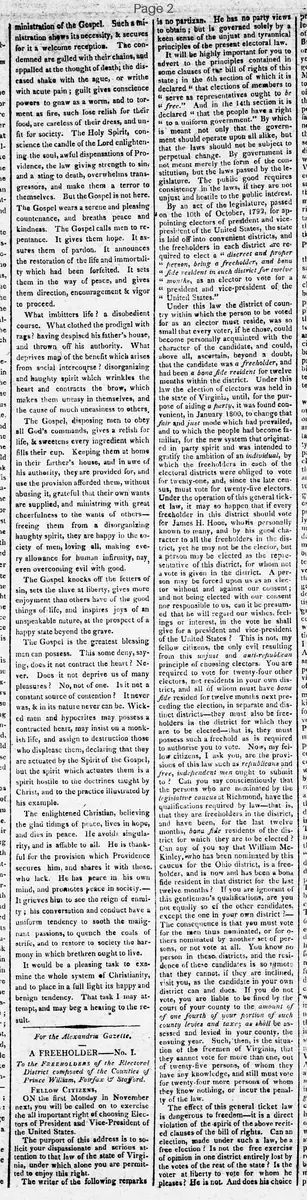
A FREEHOLDER---No. I.
To the FREEHOLDERS of the Electoral
District composed of the Counties of
Prince William, Fairfax & Stafford.
Fellow Citizens,
ON the first Monday in November
next, you will be called on to exercise
the all important right of choosing Electors of President and Vice-President of
the United States.
The purport of this address is to solicit your dispassionate and serious attention to that law of the state of Virginia, under which alone you are permitted to enjoy this right.
The writer of the following remarks
to obtain; but is governed solely by a
keen sense of the unjust and tyrannical
principles of the present electoral law.
It will be highly important for you to
advert to the principles contained in
some clauses of the bill of rights of this
state; in the 6th section of which it is
declared "that elections of members to
"serve as representatives ought to be
"free." And in the 14th section it is
declared "that the people have a right
"to a uniform government." By which
is meant not only that the government
should operate upon all alike, but
that the laws should not be subject to
perpetual change. By government is
not meant merely the form of the constitution, but the laws passed by the legislature. The public good requires
consistency in the laws, if they are not
unjust and hostile to the public interest.
By an act of the legislature, passed
on the 10th of October, 1793, for appointing electors of president and vice.
president of the United States, the state
is laid off into convenient districts, and
the freeholders in each district are required to elect a "discreet and proper
"person, being a freeholder, and bona
"fide resident in such district for twelve
"months, as an elector to vote for a
"president and vice-president of the
"United States."
Under this law the district of country within which the person to be voted
for as an elector must reside, was so
small that every voter, if he chose, could
become personally acquainted with the
character of the candidate, and could,
above all, ascertain, beyond a doubt
that the candidate was a freeholder, and
had been a bona fide resident for twelve
months within the district. Under this
law the election of electors was held in
the state of Virginia, until, for the purpose of aiding a party, it was found convenient, in January 1800, to change that
fair and just mode which had prevailed,
and to which the people had become familiar, for the new system that originated in party spirit and was intended to
gratify the ambition of an individual, by
which the freeholders in each of the
electoral districts were obliged to vote
for twenty-one, and, since the late census, must vote for twenty-five electors.
Under the operation of this general ticket law, it may so happen that if every
freeholder in this district should vote
for James H. Hooe, who is personally
known to many, and by his good character to all the freeholders in the district, yet he may not be the elector, but
a person may be elected as the representative of this district, for whom not
a vote is given in the district. A person may be forced upon us as an elector without and against our consent;
and not being elected with our consent
nor responsible to us, can it be presumed that he will regard our wishes, feelings or interest, in the vote he shall
give for a president and vice-president
of the United States? This is not, my
fellow citizens, the only evil resulting
from this unjust and anti-republican
principle of choosing electors. You are
required to vote for twenty-four other
electors, not residents in your own district, and all of whom must have bona
fide resided for twelve months next preceding the election, in separate and distinct districts--they must also be freeholders in the district for which they
are to be elected-that is, they must
possess such a freehold as is required
to authorise you to vote. Now, my fellow citizens, I ask you, are the provisions of this law such as republicans and
free, independent men ought to submit
to? Can you say conscientiously that
the persons who are nominated by the
legislative caucus at Richmond, have the
qualifications required by law--that is,
that they are freeholders in the district,
and have been, for the last twelve
months, bona fide residents of the district for which they are to be elected?
Can any of you say that William McKinley, who has been nominated by this
caucus for the Ohio district, is a freeholder, and is now and has been a bona
fide resident in that district for the last
twelve months? If you are ignorant of
this gentleman's qualifications, are you
not equally so of the other candidates,
except the one in your own district?-
The consequence is that you must vote
for the men thus nominated, or for others nominated by another set of persons, or not vote at all. You know no
person in these districts, and the residence of these candidates is so remote
that they cannot, if they are inclined,
visit you, as the candidate in your own
district can and does. If you do not
vote, you are liable to be fined by the
court of your county to the amount of
one fourth of your portion of such
county levies and taxes as shall be assessed and levied in your county, the
ensuing year. Such, then, is the situation of the freemen of Virginia, that
they cannot vote for more than one, out
of twenty-five persons, of whom they
have any knowledge, and still must vote
for twenty-four more persons of whom
they know nothing, or incur the penalty of the law.
The effect of this general ticket law
is dangerous to freedom-it is a direct
violation of the spirit of the above recited clauses of the bill of rights. Can an
election, made under such a law, be a
free election? Is not the free exercise
of opinion in one district entirely lost by
the votes of the rest of the state? Is the
voter at liberty to vote for whom he
pleases? He is not. And does his choice
extend to the election of more than one elector? No. The voter is compelled to vote for a ticket nominated by party leaders, often unknown to him. Do you call yourselves real friends to your country? Do you love her more than you do a party? Will you adopt the sentiments contained in your bill of rights, "that no free government, or the blessing of liberty, can be preserved to any people but by a firm adherence to justice, moderation, temperance, frugality, and virtue and by a frequent recurrence to fundamental principles." Then consider this subject with temperance—recur to the fundamental principles of our government, which was to secure the political rights of each member of the community, and not those of a party and to do equal justice to all. If these principles govern, you will discard from your confidence men who have imposed upon you a law so fundamentally ruinous to your rights as the General Ticket law is.— Adopt the old principles of election, which were formed by our revolutionary patriots, and carried us through that contest, and under which we lived happily, until party spirit, in the year 1800, destroyed them. Let not party men use you as the means of climbing into power, under cover of this abominable law, a law not fitted for the views of honest men; but well calculated as a nursery for despotism. It is worthy of remark that some of the persons, who are nominated by the legislative caucus, voted for this law. Being a plain man, I have submitted in a plain manner, these few remarks to my fellow citizens, with the hope that they will be received by them with the same candor with which they are offered. My motive is not that arising from party-spirit, but a sincere wish to induce my fellow-citizens to examine and reflect seriously and dispassionately upon the subject. I trust they will discard party views and unite to obtain, in a constitutional manner, a repeal of this law, so unjust in its operation, and dangerous to the rights of the people.
A Freeholder in Fairfax County.
What sub-type of article is it?
What themes does it cover?
What keywords are associated?
What entities or persons were involved?
Letter to Editor Details
Author
A Freeholder In Fairfax County
Recipient
To The Freeholders Of The Electoral District Composed Of The Counties Of Prince William, Fairfax & Stafford
Main Argument
the 1800 virginia electoral law's general ticket system forces voters to select unknown non-resident electors nominated by party caucuses, violating free elections and the bill of rights; it urges repeal and return to the 1793 district-based system for accountable, informed voting.
Notable Details