Thank you for visiting SNEWPapers!
Sign up free
Virginia Argus
Richmond, Virginia
What is this article about?
James Madison transmits to Congress correspondence between Secretary Monroe and Minister Barlow regarding US claims against France for commercial injuries, revocation of French decrees, and demands for indemnity and fair trade reciprocity amid tensions with Britain in 1812.
Merged-components note: Continuation across pages of the President's message and diplomatic correspondence regarding relations with France.
Clippings
1 of 2
OCR Quality
Full Text
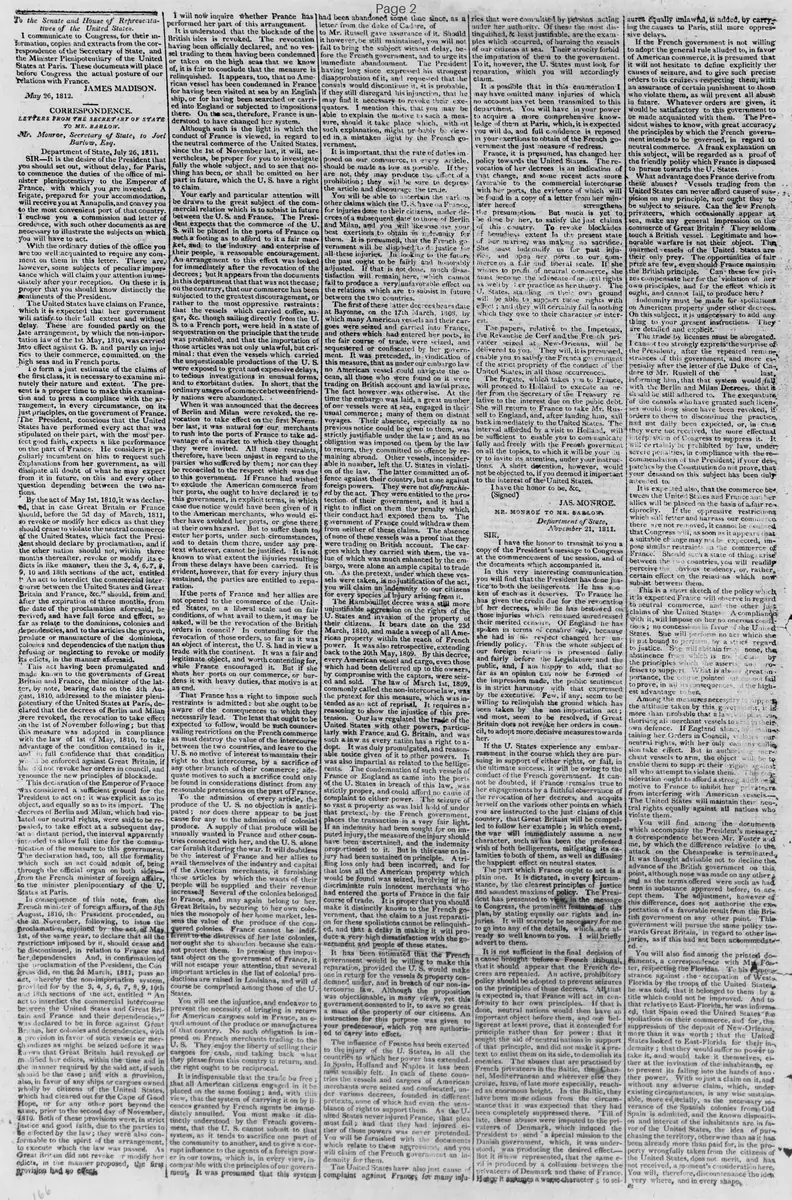
I communicate to Congress, for their information, copies and extracts from the correspondence of the Secretary of State, and the Minister Plenipotentiary of the United States at Paris. These documents will place before Congress the actual posture of our relations with France.
JAMES MADISON.
May 26, 1812.
CORRESPONDENCE.
LETTERS FROM THE SECRETARY OF STATE TO MR. BARLOW.
Mr. Monroe, Secretary of State, to Joel Barlow, Esq.
Department of State, July 26, 1811.
SIR,—It is the desire of the President that you should set out, without delay, for Paris, to commence the duties of the office of minister plenipotentiary to the Emperor of France, with which you are invested. A frigate, prepared for your accommodation, will receive you at Annapolis, and convey you to the most convenient port of that country.
I enclose you a commission and letter of credence, with such other documents as are necessary to illustrate the subjects on which you will have to act.
With the ordinary duties of the office you are too well acquainted to require any comment on them in this letter. There are, however, some subjects of peculiar importance which will claim your attention immediately after your reception. On these it is proper that you should know distinctly the sentiments of the President.
The United States have claims on France, which it is expected that her government will satisfy to their full extent and without delay. These are founded partly on the late arrangement, by which the non-importation law of the 1st May, 1810, was carried into effect against G. B. and partly on injuries to their commerce, committed on the high seas and in French ports.
To form a just estimate of the claims of the first class, it is necessary to examine minutely their nature and extent. The present is a proper time to make this examination and to press a compliance with the arrangement, in every circumstance, on its just principles, on the government of France.
The President, conscious that the United States have performed every act that was stipulated on their part, with the most perfect good faith, expects a like performance on the part of France. He considers it peculiarly incumbent on him to request such explanations from her government, as will dissipate all doubt of what he may expect from it in future, on this and every other question depending between the two nations.
By the act of May 1st, 1810, it was declared, that in case Great Britain or France should, before the 3d day of March, 1811, so revoke or modify her edicts as that they should cease to violate the neutral commerce of the United States, which fact the President should declare by proclamation, and if the other nation should not, within three months thereafter, revoke or modify its edicts in like manner, then the 3, 4, 6, 7, 8, 9, 10 and 18th sections of the act, entitled "An act to interdict the commercial intercourse between the United States and Great Britain and France, &c." should, from and after the expiration of three months, from the date of the proclamation aforesaid, be revived, and have full force and effect, so far as relate to the dominions, colonies and dependencies, and to the articles the growth, produce or manufacture of the dominions, colonies and dependencies of the nation thus refusing or neglecting to revoke or modify its edicts, in the manner aforesaid.
This act having been promulgated and made known to the governments of Great Britain and France, the minister of the latter, by note, bearing date on the 5th August, 1810, addressed to the minister plenipotentiary of the United States at Paris, declared that the decrees of Berlin and Milan were revoked, the revocation to take effect on the 1st of November following; but that this measure was adopted in compliance with the law of 1st of May, 1810, to take advantage of the condition contained in it, and in full confidence that that condition would be enforced against Great Britain, if she did not revoke her orders in council, and renounce the new principles of blockade.
This declaration of the Emperor of France was considered a sufficient ground for the President to act on: it was explicit as to its object, and equally so as to its import. The decrees of Berlin and Milan, which had violated our neutral rights, were said to be repealed, to take effect at a subsequent day, at no distant period, the interval apparently intended to allow full time for the communication of the measure to this government.
The declaration had, too, all the formality which such an act could admit of, being through the official organ on both sides—from the French minister of foreign affairs, to the minister plenipotentiary of the U. States at Paris.
In consequence of this note, from the French minister of foreign affairs, of the 5th August, 1810, the President proceeded, on the 2d November, following, to issue the proclamation, enjoined by the act of May 1st, of the same year, to declare that all the restrictions imposed by it, should cease and be discontinued, in relation to France and her dependencies. And, in confirmation of the proclamation of the President, the Congress did, on the 2d March, 1811, pass an act, whereby the non-importation system, provided for by the 3, 4, 5, 6, 7, 8, 9, 10th and 18th sections of the act, entitled "An act to interdict the commercial intercourse between the United States and Great Britain and France and their dependencies," was declared to be in force against Great Britain, her colonies and dependencies, with a provision in favor of such vessels or merchandizes as might be seized before it was known that Great Britain had revoked or modified her edicts, within the time and in the manner required by the said act, if such should be the case; and with a provision, also, in favor of any ships or cargoes owned wholly by citizens of the United States, which had cleared out for the Cape of Good Hope, or for any other port beyond the same, prior to the second day of November, 1810. Both of these provisions were, in strict justice and good faith, due to the parties to be affected by the law; they were also conformable to the spirit of the arrangement, to execute which the law was passed. As Great Britain did not revoke or modify her edicts, in the manner proposed, the first provision had no effect.
I will now inquire whether France has fulfilled her part of this arrangement.
It is understood that the blockade of the British isles is revoked. The revocation having been officially declared, and no vessel trading to them having been condemned or taken on the high seas that we know of, it is fair to conclude that the measure is relinquished. It appears, too, that no American vessel has been condemned in France for having been visited at sea by an English ship, or for having been searched or carried into England or subjected to impositions there. On the sea, therefore, France is understood to have changed her system.
Although such is the light in which the conduct of France is viewed, in regard to the neutral commerce of the United States, since the 1st of November last, it will, nevertheless, be proper for you to investigate fully the whole subject, and to see that nothing has been, or shall be omitted on her part in future, which the U. S. have a right to claim.
Your early and particular attention will be drawn to the great subject of the commercial relation which is to subsist in future between the U.S. and France. The President expects that the commerce of the U. S. will be placed in the ports of France on such a footing as to afford to it a fair market, and to the industry and enterprise of their people, a reasonable encouragement.
An arrangement to this effect was looked for immediately after the revocation of the decrees; but it appears from the documents in this department that that was not the case; on the contrary, that our commerce has been subjected to the greatest discouragement, or rather to the most oppressive restraints: that the vessels which carried coffee, sugar, &c. though sailing directly from the U. S. to a French port, were held in a state of sequestration on the principle that the trade was prohibited, and that the importation of those articles was not only unlawful, but criminal: that even the vessels which carried the unquestionable productions of the U. S. were exposed to great and expensive delays, to tedious investigations in unusual forms, and to exorbitant duties. In short, that the ordinary usages of commerce between friendly nations were abandoned.
When it was announced that the decrees of Berlin and Milan were revoked, the revocation to take effect on the first November last, it was natural for our merchants to rush into the ports of France to take advantage of a market to which they thought they were invited. All these restraints, therefore, have been unjust in regard to the parties who suffered by them; nor can they be reconciled to the respect which was due to this government. If France had wished to exclude the American commerce from her ports, she ought to have declared it to this government, in explicit terms, in which case due notice would have been given of it to the American merchants, who would either have avoided her ports, or gone there at their own hazard. But to suffer them to enter her ports, under such circumstances, and to detain them there, under any pretext whatever, cannot be justified. It is not known to what extent the injuries resulting from these delays have been carried. It is evident, however, that for every injury thus sustained, the parties are entitled to reparation.
If the ports of France and her allies are not opened to the commerce of the United States, on a liberal scale and on fair conditions, of what avail to them, it may be asked, will be the revocation of the British orders in council? In contending for the revocation of those orders, so far as it was an object of interest, the U. S. had in view a trade with the continent. It was a fair and legitimate object, and worth contending for, while France encouraged it. But if she shuts her ports on our commerce, or burdens it with heavy duties, that motive is at an end.
That France has a right to impose such restraints is admitted: but she ought to be aware of the consequences to which they necessarily lead. The least that ought to be expected to follow, would be such countervailing restrictions on the French commerce as must destroy the value of the intercourse between the two countries, and leave to the U. S. no motive of interest to maintain their right to that intercourse, by a sacrifice of any other branch of their commerce; adequate motives to such a sacrifice could only be found in considerations distinct from any reasonable pretensions on the part of France.
To the admission of every article, the produce of the U. S. no objection is anticipated; nor does there appear to be just cause for any to the admission of colonial produce. A supply of that produce will be annually wanted in France and other countries connected with her, and the U. S. alone can furnish it during the war. It will doubtless be the interest of France and her allies to avail themselves of the industry and capital of the American merchants, it furnishing those articles by which the wants of their people will be supplied and their revenue increased. Several of the colonies belonged to France, and may again belong to her. Great Britain, by securing to her own colonies the monopoly of her home market, lessens the value of the produce of the conquered colonies. France cannot be indifferent to the distresses of her late colonies, nor ought she to abandon because she cannot protect them. In pressing this important object on the government of France, it will not escape your attention, that several important articles in the list of colonial productions are raised in Louisiana, and will of course be comprised among those of the U. States.
You will see the injustice, and endeavor to prevent the necessity of bringing in return for American cargoes sold in France, an equal amount of the produce or manufactures of that country. No such obligation is imposed on French merchants trading to the U. S. They enjoy the liberty of selling their cargoes for cash, and taking back what they please from this country in return, and the right ought to be reciprocal.
It is indispensable that the trade be free; that all American citizens engaged in it be placed on the same footing; and, with this view, that the system of carrying it on by licenses granted by French agents be immediately annulled. You must make it distinctly understood by the French government, that the U. S. cannot submit to that system, as it tends to sacrifice one part of the community to another, and to give a corrupt influence to the agents of a foreign power in our towns, which is, in every view, incompatible with the principles of our government. It was presumed that this system had been abandoned some time since, as a letter from the duke of Cadore, of to Mr. Russell gave assurance of it. Should it however, be still maintained, you will not fail to bring the subject without delay, before the French government, and to urge its immediate abandonment. The President having long since expressed his strongest disapprobation of it, and requested that the consuls would discontinue it, it is probable, if they still disregard his injunction, that he may find it necessary to revoke their exequaturs. I mention this, that you may be able to explain the motive to such a measure, should it take place which, without such explanation, might probably be viewed in a mistaken light by the French government.
It is important, that the rate of duties imposed on our commerce, in every article, should be made as low as possible. If they are not, they may produce the effect of a prohibition; they will be sure to depress the article and discourage the trade.
You will be able to ascertain the various other claims which the U.S. have on France, for injuries done to their citizens, under decrees of a subsequent date to those of Berlin and Milan, and you will likewise use your best exertions to obtain an indemnity for them. It is presumed, that the French government will be disposed to do justice for all these injuries. In looking to the future the past ought to be fairly and honorably adjusted. If that is not done, much dissatisfaction will remain here, which cannot fail to produce a very unfavorable effect on the relations which are to subsist in future between the two countries.
The first of these latter decrees bears date at Bayonne, on the 17th March, 1808, by which many American vessels and their cargoes were seized and carried into France, and others which had entered her ports, in the fair course of trade, were seized, and sequestered or confiscated by her government. It was pretended, in vindication of this measure, that as under our embargo law no American vessel could navigate the ocean, all those who were found on it were trading on British account and lawful prize.
The fact however was otherwise. At the time the embargo was laid, a great number of our vessels were at sea, engaged in their usual commerce; many of them on distant voyages. Their absence, especially as no previous notice could be given to them, was strictly justifiable under the law; and as no obligation was imposed on them by the law to return, they committed no offence by remaining abroad. Other vessels, inconsiderable in number, left the U. States in violation of the law. The latter committed an offence against their country, but none against foreign powers. They were not disfranchised by the act. They were entitled to the protection of their government, and it had a right to inflict on them the penalty which their conduct had exposed them to. The government of France could withdraw them from neither of these claims. The absence of none of these vessels was a proof that they were trading on British account. The cargoes which they carried with them, the value of which was much enhanced by the embargo, were alone an ample capital to trade on. As the pretext, under which these vessels were taken, is no justification of the act, you will claim an indemnity to our citizens for every species of injury arising from it.
The Rambouillet decree was a still more unjustifiable aggression on the rights of the U. States and invasion of the property of their citizens. It bears date on the 23d March, 1810, and made a sweep of all American property within the reach of French power. It was also retrospective, extending back to the 20th May, 1809. By this decree, every American vessel and cargo, even those which had been delivered up to the owners, by compromise with the captors, were seized and sold. The law of March 1st, 1809, commonly called the non-intercourse law, was the pretext for this measure, which was intended as an act of reprisal. It requires no reasoning to show the injustice of this pretension. Our law regulated the trade of the United States with other powers, particularly with France and G. Britain, and was such a law as every nation has a right to adopt. It was duly promulgated, and reasonable notice given of it to other powers. It was also impartial as related to the belligerents. The condemnation of such vessels of France or England as came into the ports of the U. States in breach of this law, was strictly proper, and could afford no cause of complaint to either power. The seizure of so vast a property as was laid hold of under that pretext, by the French government, places the transaction in a very fair light.
If an indemnity had been sought for on imputed injury, the measure of the injury should have been ascertained, and the indemnity proportioned to it. But in this case no injury had been sustained on principle. A trifling loss only had been incurred, and for that loss all the American property which would be found was seized, involving indiscriminate ruin innocent merchants who had entered the ports of France in the fair course of trade. It is proper that you should make it distinctly known to the French government, that the claim to a just reparation for these spoliations cannot be relinquished, and that a delay in making it will produce a very high dissatisfaction with the government and people of these states.
It has been intimated that the French government would be willing to make this reparation, provided the U. S. would make one in return for the vessels & property condemned under, and in breach of our non-intercourse law. Although the proposition was objectionable, in many views, yet this government consented to it, to save so great a mass of the property of our citizens. An instruction for this purpose was given to your predecessor, which you are authorised to carry into effect.
The influence of France has been exerted to the injury of the U. States, in all the countries to which her power has extended. In Spain, Holland and Naples it has been most sensibly felt. In each of these countries the vessels and cargoes of American merchants were seized and confiscated, under various decrees, founded in different pretexts, none of which had even the semblance of right to support them. As the United States never injured France, that plea must fail; and that they had injured either of those powers was never pretended.
You will be furnished with the documents which relate to these aggressions, and you will claim of the French government an indemnity for them.
The United States have also just cause of complaint against France for many injuries that were committed by persons acting under her authority. Of these the most distinguished, & least justifiable, are the examples which occurred, of burning the vessels of our citizens at sea. Their atrocity forbid the imputation of them to the government. To it, however, the U. States must look for reparation, which you will accordingly claim.
It is possible that in this enumeration I may have omitted many injuries of which no account has yet been transmitted to this department. You will have in your power to acquire a more comprehensive knowledge of them at Paris, which, it is expected you will do, and full confidence is reposed in your exertions to obtain of the French government the just measure of redress.
France, it is presumed, has changed her policy towards the United States. The revocation of her decrees is an indication of that change, and some recent acts more favorable to the commercial intercourse with her ports, the evidence of which will be found in a copy of a letter from her minister here strengthens the presumption. But much is yet to be done by her, to satisfy the just claims of this country. To revoke blockades of boundless extent in the present state of her marine, was making no sacrifice. She must indemnify us for past injuries, and open her ports, to our commerce on a fair and liberal scale. If she wishes to profit of neutral commerce, she must become the advocate of neutral rights as well by her practice as her theory. The U. States, standing on their own ground will be able to support those rights with effect; and they will certainly fail in nothing which they owe to their character or interest.
The papers, relative to the Impeteux, the Revanche de Corf and the French privateer seized at New Orleans, will be delivered to you. They will, it is presumed, enable you to satisfy the French government of the strict propriety of the conduct of the United States, in all those occurrences.
The frigate, which takes you to France, will proceed to Holland to execute an order from the Secretary of the Treasury relative to the interest due on the public debt. She will return to France to take Mr. Russell to England, and, after landing him, sail back immediately to the United States. The interval afforded by a visit to Holland, will be sufficient to enable you to communicate fully and freely with the French government on all the topics, to which it will be your duty to invite its attention, under your instructions. A short detention, however, would not be objected to, if you deemed it important to the interest of the United States.
I have the honor to be, &c.
(Signed) JAS. MONROE.
MR. MONROE TO MR. BARLOW
Department of State,
November 21, 1811.
SIR,
I have the honor to transmit to you a copy of the President's message to Congress at the commencement of the session, and of the documents which accompanied it.
In this very interesting communication you will find that the President has done justice to both the belligerents. He has spoken of each as it deserves. To France he has given the credit due for the revocation of her decrees, while he has bestowed on those injuries which remained unredressed their merited censure. Of England he has spoken in terms of censure only, because she had in no respect changed her unfriendly policy. As the whole subject of our foreign relations is presented fully and fairly before the Legislature and the public, and, I am happy to add, that so far as an opinion can now be formed of the impression made, the public sentiment is in strict harmony with that expressed by the executive. Few, if any, seem to be willing to relinquish the ground which has been taken by the non importation act; and most, seem to be resolved, if Great Britain does not revoke her orders in council, to adopt more decisive measures towards her.
If the U. States experience any embarrassment in the course which they are pursuing in support of their rights, or fail, in the ultimate success, it will be owing to the conduct of the French government. It cannot be doubted, if France remains true to her engagements by a faithful observance of the revocation of her decrees, and acquits herself on the various other points on which you are instructed to the just claims of this country, that Great Britain will be compelled to follow her example; in which event, the war will immediately assume a new character, such as has been the professed wish of both belligerents, mitigating its calamities to both of them, as well as diffusing the happiest effect on neutral states.
The part which France ought to act is a plain one. It is dictated, in every circumstance, by the clearest principles of justice and soundest maxims of policy. The President has presented to view, in the message to Congress, the prominent features of this plan, by stating equally our rights and injuries. It will scarcely be necessary for me to go into any of the details, which are already so well known to you. I will briefly advert to them.
It is not sufficient in the final decision of a cause brought before a French tribunal, that it should appear that the French decrees are repealed. An active, prohibitory policy should be adopted to prevent seizures on the principles of those decrees. All that is expected is, that France will act in conformity to her own principles. If that is done, neutral nations would then have an important object before them, and one belligerent at least prove, that it contended for principle rather than for power: that it sought the aid of neutral nations in support of that principle, and did not make it a pretext to enlist them on its side, to demolish its enemies. The abuses that are practised by French privateers in the Baltic, the Channel, Mediterranean and wherever else they cruize, have, of late more especially, reached an enormous height. In the Baltic, they have been more odious from the circumstance that it was expected that they had been completely suppressed there. Till of late, these abuses were imputed to the privateers of Denmark, which induced the President to send a special mission to the Danish government, which, it was understood, was producing the desired effect.— But it is now represented, that the same evil is produced by a collusion between the privateers of Denmark and those of France. Hence it assumes a worse character; to seizures equally unlawful, is added, by carrying the causes to Paris, still more oppressive delays.
If the French government is not willing to adopt the general rule alluded to, in favor of American commerce, it is presumed that it will not hesitate to define explicitly the causes of seizure, and to give such precise orders to its cruizers respecting them, with an assurance of certain punishment to those who violate them, as will prevent all abuse in future. Whatever orders are given, it would be satisfactory to this government to be made acquainted with them. The President wishes to know, with great accuracy the principles by which the French government intends to be governed, in regard to neutral commerce. A frank explanation on this subject, will be regarded as a proof of the friendly policy which France is disposed to pursue towards the U. States.
What advantage does France derive from these abuses? Vessels trading from the United States can never afford cause of suspicion on any principle, nor ought they to be subject to seizure. Can the few French privateers, which occasionally appear at sea, make any general impression on the commerce of Great Britain? They seldom touch a British vessel. Legitimate and honorable warfare is not their object. The unarmed vessels of the United States are their only prey. The opportunities of fair prize are few, even should France maintain the British principle. Can these few prizes compensate her for the violation of her own principles, and for the effect which it ought, and cannot fail, to produce here?
Indemnity must be made for spoliations on American property under other decrees. On this subject, it is unnecessary to add any thing to your present instructions. They are detailed and explicit.
The trade by licenses must be abrogated. I cannot too strongly express the surprise of the President; after the repeated remonstrances of this government, and more especially after the letter of the Duke of Cadore to Mr. Russell of the last informing him, that that system would fall with the Berlin and Milan Decrees. that it should be still adhered to. The exequaturs of the consuls who have granted such licenses would long since have been revoked, if orders to them to discontinue the practice had not daily been expected, or, in case they were not received, the more effectual interposition of Congress to suppress it. It will certainly be prohibited by law, under severe penalties, in compliance with the recommendation of the President, if your despatches by the Constitution do not prove, that your demand on this subject has been duly attended to.
It is expected also, that the commerce between the United States and France and her allies will be placed on the basis of a fair reciprocity. If the oppressive restrictions which still fetter and harass our commerce there are not removed, it cannot be doubted that Congress will, as soon as it appears that a suitable change may not be expected, impose similar restraints on the commerce of France. Should such a state of things arise between the two countries, you will readily perceive the obvious tendency, or, rather, certain effect on the relations which now subsist between them.
This is a short sketch of the policy which it is expected France will observe in regard to neutral commerce, and the other just claims of the United States. A compliance with it, will impose on her no onerous conditions; no concessions in favor of the United States. She will perform no act which she is not bound to perform, by a strict regard to justice. She will abstain from none, the abstinence from which is not had by the principles which she asserts, and professes to support. What is also of great importance, the course pointed out can not fail to prove, in all its consequences, to the highest advantage to her.
Among the measures necessary to support the attitude taken by this government, it is more than probable that a law will pass authorising all merchant vessels to arm in their own defence. If England alone, by maintaining her Orders in Council, violates our neutral rights, with her only can collision take effect. But in authorising merchant vessels to arm, the object will be to enable them to support their right against all who attempt to violate them. This consideration ought to afford a strong additional motive to France to inhibit her privateers from interfering with American vessels. The United States will maintain their neutral rights equally against all nations who violate them.
You will find among the documents which accompany the President's message a correspondence between Mr. Foster and me, by which the difference relative to the attack on the Chesapeake is terminated. It was thought advisable not to decline the advance of the British government on this point, although none was made on any other; and as the terms offered were such as had been in substance approved before, to accept them. The adjustment, however of this difference, does not authorise the expectation of a favorable result from the British government on any other point. This government will pursue the same policy towards Great Britain, in regard to other injuries, as if this had not been accommodated.
You will also find among the printed documents, a correspondence with Mr. Foster, respecting the Floridas. To his remonstrance against the occupation of West Florida by the troops of the United States he was told, that it belonged to them by a title which could not be impaired. And to that relative to East Florida, he was informed, that Spain owed the United States for spoliations on their commerce, and for the suppression of the deposit of New Orleans, more than it was worth; that the United States looked to East Florida for their indemnity; that they would suffer no power to take it, and would take it themselves, either at the invitation of the inhabitants, or to prevent its falling into the hands of another power. With so just a claim on it, and without any adverse claim, which, under existing circumstances, is in any wise sustainable, more especially, as the necessary severance of the Spanish colonies from Old Spain is admitted, and the known disposition and interest of the inhabitants are in favor of the United States, the idea of purchasing the territory, otherwise than as it has been already more than paid for, in the property wrongfully taken from the citizens of the United States, does not merit, and has not received, a moment's consideration here.
You will, therefore, discountenance the idea everywhere, and in every shape.
You will be furnished with a copy of my correspondence with Mr. Serrurier, on the subject of a vessel called the Balaou, No. 5. (formerly the Exchange,) bearing a commission from the Emperor of France, lately libelled in the district court of the United States for Pennsylvania. The decision of that court was in favor of a discharge of the vessel. An appeal was taken from it to the circuit court, by which the sentence was reversed. The cause was then carried by appeal, at the instance of the government, to the supreme court of the United States where it is now depending. The whole process in favor of the French government is conducted on the part of, and at the expense of, the United States, without, however, making themselves a party to it.
This vessel was one of those that were seized under the Rambouillet decree. The French government took her into service, as appears by the documents in possession of the commandant, and sent her with despatches to some distant quarter. She came into the port of Philadelphia, as it is said, in distress; she having on board a cargo, distress may have been a pretext. As this government denies the justice of the Rambouillet decree, has remonstrated against it, and expects an indemnity for losses under it, you will be sensible of the delicacy and difficulty which it has experienced in interfering, in any respect, in the case. To take the vessel from the court, and, of course, from the owner, and restore her to the French consul or other agent, even if, under any circumstances, lawful, would have excited universal discontent. I cannot dismiss this subject without remarking, that if the government of France had not violated the rights of the U. States by the Rambouillet decree, this case would not have occurred; and that it is painful to see a question, connected with the public law, originate under such circumstances.
The public vessel which takes these despatches to you, has others for our charge d'affaires at London. After landing Mr. Biddle, who is the bearer of yours, at some port in France, she will proceed immediately to the English coast, and land Mr. Tayloe, the messenger who is charged with those for London. It is expected that she will be subject to a short delay only on the English coast, and that your despatches will be prepared for her; on her return to France. It is highly important to this government to obtain, without delay, or rather, with the greatest possible dispatch, correct information from you, and from our Charge d'Affaires at London, of the policy adopted and the measures which have been already taken on the important interests depending with each government, on which you have been respectively instructed. A short detention of the vessel, for an obvious and useful purpose, as intimated heretofore, will not be objected to; but such a delay as has, on some occasions, occurred, is utterly inadmissible.
I have the honor, &c. &c.
(Signed) JAs. MONROE.
Finding it impossible, from the length of these documents, and the late hour at which we were able to obtain a copy, to get them all into this day's paper, we have culled from the residue the three last letters of Mr Barlow to our government, which will afford a pretty good idea of the state in which the despatches by the Hornet left our affairs at Paris. The publication of the documents shall be resumed and concluded in our next.
Extract of a letter from Mr. Barlow to the Secretary of State, dated Paris, March 15, 1812.
"I have scarcely been able to get an interview with the Duke of Bassano for the last 15 days though he has appointed several. He has disappointed me in most of them, and I am sure with reluctance. Last evening I obtained a short audience, in which he declared that his great work of this continent was now finished, and he would be able after to-morrow to devote himself very much to the treaty with United States, till it should be completed.— And I left him rather with the hope than the full expectation that he will have it in his power to keep his promise."
(No. 9.)
Extract of a letter from Mr. Barlow, to the Secretary of State, dated Paris, March 16, 1812.
"Since I had the honor of writing to you yesterday, the Moniteur has come out with the Senatus Consultum of which I spoke. This I now enclose. This despatch goes by a safe hand for Bordeaux, there to be confided to some passenger to go by one of our fast sailing schooners. You will notice that the Minister in his report, says nothing particular of the United States, and nothing more precise than heretofore of the revocation of the decrees.
This furnishes an additional motive for using all efforts to get the treaty through, carrying with it an unequivocal stipulation that shall put the question to rest. Its importance is sufficient to warrant my detaining the Hornet.
The Emperor did not like the bill we have seen before Congress for 'admitting English goods contracted for before the non-importation law went into operation.'
I was questioned by the Duke of Bassano on the bill, with a good deal of point, when it first appeared, and I gave such decided explanations, as I thought at the time would remove all uneasiness. But I have since heard that the Emperor is not well satisfied. If Congress had applied its relieving hand to individuals cases only, and on personal petitions, it would have excited no suspicion:
In consequence of my repeated remonstrances in cases of condemnation of American cargoes, on frivolous or false pretences, I think the career is somewhat arrested, and they shew a disposition to revise the judgments. The Betsy, the Ploughboy, and the Ann, are ordered for revision. The Belisarius is in progress, and is likely to be liberated, as you will learn by the correspondence I now have the honor to enclose respecting the case."
Note. Mr. Barlow's of the 15th and 16th of March, are both marked No. 9 by him.
(No. 10.)
Extracts of a letter from Mr. Barlow to Mr. Monroe.
Paris, 22d April, 1812.
"I am obliged at last to dismiss the Hornet without the expected treaty, which I should have regretted more than I do if your despatches, which I have had the honor to receive by the Wasp, had not somewhat abated my zeal in that work."
"It really appeared to me, that the advantages of such a treaty as I have sketched would be very great, and especially if it could be concluded soon."
"It is true, that our claims of indemnity for past spoliation should be heard, examined and satisfied; which operation should precede the new treaty or go hand in hand with it. This is dull work, hard to begin, and difficult to pursue."
"I urged it a long time, without the effect even of an oral answer. But lately they have consented to give it a discussion, and the minister assures me that something shall be done to silence the complaints, and on principles that he says ought to be satisfactory."
"I shall not venture to detain the Wasp more than two or three weeks. And I hope by that time to have something decisive to forward by her."
"From some expressions in your letters, I am in hopes of receiving soon some more precise instructions on these subjects."
"My communication with England by Morlaix is almost entirely cut off. It is not so easy to send to London, unless by one of our own public ships, as it is to the United States. I now send your despatches and my own to Mr. Russel, by a messenger in the Hornet, whom I shall desire captain Lawrence to put on shore or into a pilot-boat on the coast of England."
"This messenger with Mr Biddle, will leave Paris this night for Cherbourg, where the Hornet is ready to receive them."
What sub-type of article is it?
What keywords are associated?
What entities or persons were involved?
Where did it happen?
Foreign News Details
Primary Location
Paris, France
Event Date
May 26, 1812
Key Persons
Outcome
france revoked berlin and milan decrees effective november 1, 1810; us demands indemnity for spoliations under subsequent decrees like rambouillet; ongoing negotiations for fair commercial reciprocity and cessation of license system; no treaty concluded by april 1812.
Event Details
Madison communicates diplomatic correspondence to Congress detailing instructions to Barlow for negotiating with France on US claims from French decrees violating neutral commerce, seeking indemnity for seized vessels and cargoes, revocation confirmations, fair trade access without oppressive duties or licenses, and addressing spoliations in allied territories; Barlow reports delays in negotiations due to French priorities but progress on revisions of condemnations and indemnity discussions.