Thank you for visiting SNEWPapers!
Sign up free
Literary
September 12, 1840
The New England Weekly Review
Hartford, Hartford County, Connecticut
What is this article about?
Joseph Cooper provides detailed instructions on proper cider manufacture, criticizing common errors like gathering wet apples and poor pressing, and outlining his successful method for producing high-quality cider for domestic use and export, including fermentation control, cask cleaning, racking, and refining with isinglass.
Clipping
OCR Quality
95%
Excellent
Full Text
THE FARMER.
From the Farmer's Cabinet
Manufacture of Cider.
(From the papers of the late Joseph Cooper, Esq.)
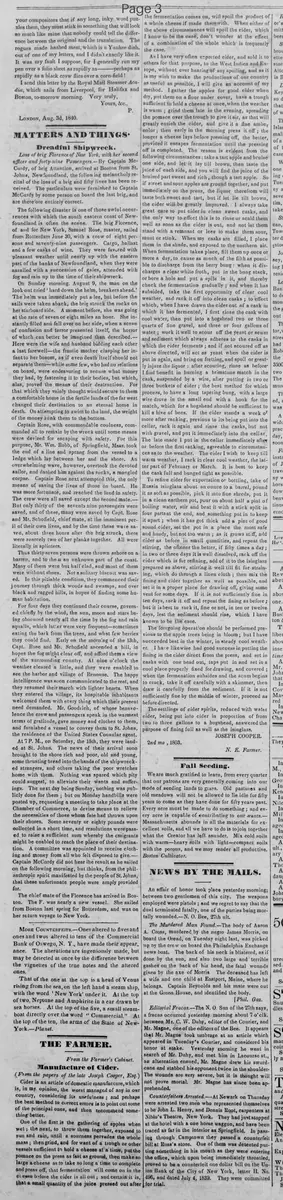
Cider is an article of domestic manufacture, which is, in my opinion, the worst managed of any in our country, considering its usefulness; and perhaps the best method to correct errors is to point out some of the principal ones, and then recommend something better.
One of the first is the gathering of apples when wet ; the next, to throw them together, exposed to sun and rain, until a sourness pervades the whole mass; then grind, and for want of a trough or other vessels sufficient to hold a cheese at a time, put the pomace on the press as fast as ground, then make so large a cheese as to take so long a time to complete and press off, that fermentation will come on in the cheese before the cider is all out; and certain it is, that a small quantity of the juice pressed out after the fermentation comes on, will spoil the product of a whole cheese if made therewith, When either of the above circumstances will spoil the cider. which I know to be the case, don't wonder at the effect of a combination of the whole which is frequently the case.
As I have very often exported cider. and sold it to others for that purpose, to the West Indies and Europe, without ever hearing of any spoiling, and as it is my wish to make the productions of our country as useful as possible, I will give an account of my method. I gather the apples for good cider when dry, put them on a floor under cover, have a trough sufficient to hold a cheese at once,when the weather is warm ; grind them late in the evening, spreading the pomace over the trough to give it air, as that will greatly enrich the cider, and give it a fine amber color; then early in the morning press it off; the longer a cheese lays before pressing off, the better, provided it escapes fermentation until the pressing off is completed. The reason is evident from the following circumstances: take a tart apple and bruise one side, and let it lay till brown, then taste the juice of each side, and you will find the juice of the bruised part sweet and rich, though a tart apple. So if sweet and sour apples are ground together, and put immediately on the press, the liquor therefrom will taste both sweet and tart, but if let lie till brown, the cider will be greatly improved. I always take great care to put cider in clean sweet casks, and the only way to effect this is to rinse or scald them well as soon as the cider is out, and not let them stand with a remnant or lees to make them sour, must or stink. When my casks are filled, I place them in the shade, and exposed to the northern air. When fermentation takes place, fill them up once or more a day, to cause as much of the filth as possible to discharge from the berry bung: when it discharges a clear white froth, put in the bung stick, or bore a hole and put a spile in it, and thereby check the fermentation gradually ; and when it has subsided, take the first opportunity of clear cool weather, and rack it off into clean casks : to effect which, when I have drawn the cider out of a cask in which it has fermented, I first rinse the cask with cool water. then put into a hogshead two or three quarts of fine gravel, and three or four gallons of water ; work it well to scour off the yeast or scum and sediment which always adheres to the casks in which the cider ferments ; and if not scoured off as above directed, will act as yeast when the cider is put in again. and bring on fretting, and spoil or greatly injure the liquor : after scouring, rinse as before I find benefit in burning a brimstone match in the cask, suspended by a wire, after putting in two or three buckets of cider ; the best method for which process, to have a long tapering bung, with a large wire drove in the small end with a hook for the match, which for a hogshead should be sufficient to kill a hive of bees. If the cider stands a week or more after racking, previous to its being put into the cellar, rack it again and rinse the casks, but not with gravel, and put it immediately into the cellar The late made I put in the cellar immediately after or before the first racking, agreeable to circumstances as to the weather. The cider I wish to keep till warm weather, I rack in clear cool weather, the latter part of February or March. It is best to keep the cask full and bunged tight as possible.
To refine cider for exportation or bottling, take of Russia isinglass about an ounce to a barrel, pound it as soft as possible, pick it into fine shreds, put it in a clean earthen pot, pour on about half a pint of boiling water, stir and beat it with a stick split in four parts at the end, and something put in to keep it apart ; when it has got thick add a pint of good sound cider, set the pot in a place the most safe and handy, but not too warm ; as it grows stiff, add cider as before in small quantities, and repeat the stirring, the oftener the better, if fifty times a day; in two or three days it is well dissolved, rack off the cider which is for refining, add of it to the isinglass prepared as above, stirring it well till fit for straining, which do through a linen cloth ; then mix the fining and cider together as well as possible, and set it in a proper place for drawing off, giving some vent for some days. If it is not sufficiently fine in ten days, rack it off and repeat the fining as before; but it is best to rack it, fine or not, in ten or twelve days, lest the sediment should rise, which I have known to be the case.
The foregoing operation should be performed previous to the apple trees being in bloom: but I have succeeded best in the winter, in steady cool weather. I have likewise had good success in putting the fining in the cider direct from the press, and set in casks with one head out, taps put in and set in a cool place properly fixed for drawing, and covered; when the fermentation subsides and the scum begins to crack, take it off carefully with a skimmer, then draw it carefully from the sediment. If it is not sufficiently fine by the middle of winter, proceed as before directed.
The settlings of cider spirits. reduced with water cider, being put into cider in proportion of from two to three gallons to a hogshead, answered the purpose of fining full as well as the isinglass.
JOSEPH COOPER.
2nd mo , 1803.
From the Farmer's Cabinet
Manufacture of Cider.
(From the papers of the late Joseph Cooper, Esq.)
Cider is an article of domestic manufacture, which is, in my opinion, the worst managed of any in our country, considering its usefulness; and perhaps the best method to correct errors is to point out some of the principal ones, and then recommend something better.
One of the first is the gathering of apples when wet ; the next, to throw them together, exposed to sun and rain, until a sourness pervades the whole mass; then grind, and for want of a trough or other vessels sufficient to hold a cheese at a time, put the pomace on the press as fast as ground, then make so large a cheese as to take so long a time to complete and press off, that fermentation will come on in the cheese before the cider is all out; and certain it is, that a small quantity of the juice pressed out after the fermentation comes on, will spoil the product of a whole cheese if made therewith, When either of the above circumstances will spoil the cider. which I know to be the case, don't wonder at the effect of a combination of the whole which is frequently the case.
As I have very often exported cider. and sold it to others for that purpose, to the West Indies and Europe, without ever hearing of any spoiling, and as it is my wish to make the productions of our country as useful as possible, I will give an account of my method. I gather the apples for good cider when dry, put them on a floor under cover, have a trough sufficient to hold a cheese at once,when the weather is warm ; grind them late in the evening, spreading the pomace over the trough to give it air, as that will greatly enrich the cider, and give it a fine amber color; then early in the morning press it off; the longer a cheese lays before pressing off, the better, provided it escapes fermentation until the pressing off is completed. The reason is evident from the following circumstances: take a tart apple and bruise one side, and let it lay till brown, then taste the juice of each side, and you will find the juice of the bruised part sweet and rich, though a tart apple. So if sweet and sour apples are ground together, and put immediately on the press, the liquor therefrom will taste both sweet and tart, but if let lie till brown, the cider will be greatly improved. I always take great care to put cider in clean sweet casks, and the only way to effect this is to rinse or scald them well as soon as the cider is out, and not let them stand with a remnant or lees to make them sour, must or stink. When my casks are filled, I place them in the shade, and exposed to the northern air. When fermentation takes place, fill them up once or more a day, to cause as much of the filth as possible to discharge from the berry bung: when it discharges a clear white froth, put in the bung stick, or bore a hole and put a spile in it, and thereby check the fermentation gradually ; and when it has subsided, take the first opportunity of clear cool weather, and rack it off into clean casks : to effect which, when I have drawn the cider out of a cask in which it has fermented, I first rinse the cask with cool water. then put into a hogshead two or three quarts of fine gravel, and three or four gallons of water ; work it well to scour off the yeast or scum and sediment which always adheres to the casks in which the cider ferments ; and if not scoured off as above directed, will act as yeast when the cider is put in again. and bring on fretting, and spoil or greatly injure the liquor : after scouring, rinse as before I find benefit in burning a brimstone match in the cask, suspended by a wire, after putting in two or three buckets of cider ; the best method for which process, to have a long tapering bung, with a large wire drove in the small end with a hook for the match, which for a hogshead should be sufficient to kill a hive of bees. If the cider stands a week or more after racking, previous to its being put into the cellar, rack it again and rinse the casks, but not with gravel, and put it immediately into the cellar The late made I put in the cellar immediately after or before the first racking, agreeable to circumstances as to the weather. The cider I wish to keep till warm weather, I rack in clear cool weather, the latter part of February or March. It is best to keep the cask full and bunged tight as possible.
To refine cider for exportation or bottling, take of Russia isinglass about an ounce to a barrel, pound it as soft as possible, pick it into fine shreds, put it in a clean earthen pot, pour on about half a pint of boiling water, stir and beat it with a stick split in four parts at the end, and something put in to keep it apart ; when it has got thick add a pint of good sound cider, set the pot in a place the most safe and handy, but not too warm ; as it grows stiff, add cider as before in small quantities, and repeat the stirring, the oftener the better, if fifty times a day; in two or three days it is well dissolved, rack off the cider which is for refining, add of it to the isinglass prepared as above, stirring it well till fit for straining, which do through a linen cloth ; then mix the fining and cider together as well as possible, and set it in a proper place for drawing off, giving some vent for some days. If it is not sufficiently fine in ten days, rack it off and repeat the fining as before; but it is best to rack it, fine or not, in ten or twelve days, lest the sediment should rise, which I have known to be the case.
The foregoing operation should be performed previous to the apple trees being in bloom: but I have succeeded best in the winter, in steady cool weather. I have likewise had good success in putting the fining in the cider direct from the press, and set in casks with one head out, taps put in and set in a cool place properly fixed for drawing, and covered; when the fermentation subsides and the scum begins to crack, take it off carefully with a skimmer, then draw it carefully from the sediment. If it is not sufficiently fine by the middle of winter, proceed as before directed.
The settlings of cider spirits. reduced with water cider, being put into cider in proportion of from two to three gallons to a hogshead, answered the purpose of fining full as well as the isinglass.
JOSEPH COOPER.
2nd mo , 1803.
What sub-type of article is it?
Essay
What themes does it cover?
Agriculture Rural
What keywords are associated?
Cider Manufacture
Apple Gathering
Fermentation Control
Cask Cleaning
Isinglass Fining
What entities or persons were involved?
Joseph Cooper, Esq.
Literary Details
Title
Manufacture Of Cider.
Author
Joseph Cooper, Esq.
Subject
Instructions For Improving Cider Production
Key Lines
Cider Is An Article Of Domestic Manufacture, Which Is, In My Opinion, The Worst Managed Of Any In Our Country, Considering Its Usefulness; And Perhaps The Best Method To Correct Errors Is To Point Out Some Of The Principal Ones, And Then Recommend Something Better.
As I Have Very Often Exported Cider. And Sold It To Others For That Purpose, To The West Indies And Europe, Without Ever Hearing Of Any Spoiling, And As It Is My Wish To Make The Productions Of Our Country As Useful As Possible, I Will Give An Account Of My Method.
I Always Take Great Care To Put Cider In Clean Sweet Casks, And The Only Way To Effect This Is To Rinse Or Scald Them Well As Soon As The Cider Is Out, And Not Let Them Stand With A Remnant Or Lees To Make Them Sour, Must Or Stink.