Thank you for visiting SNEWPapers!
Sign up free
Daily National Intelligencer
Washington, District Of Columbia
What is this article about?
In the U.S. House of Representatives, Mr. Williams of North Carolina delivers a speech advocating repeal of internal taxes due to surplus revenue exceeding estimates and post-war promises, while proposing army reduction from 10,000 to 6,000 men, citing dangers of standing armies and economic prudence.
Merged-components note: This is a single continuous congressional speech by Mr. Williams on repealing internal taxes and reducing the army, spanning pages 2 and 3 with sequential reading orders.
Clippings
1 of 2
OCR Quality
Full Text
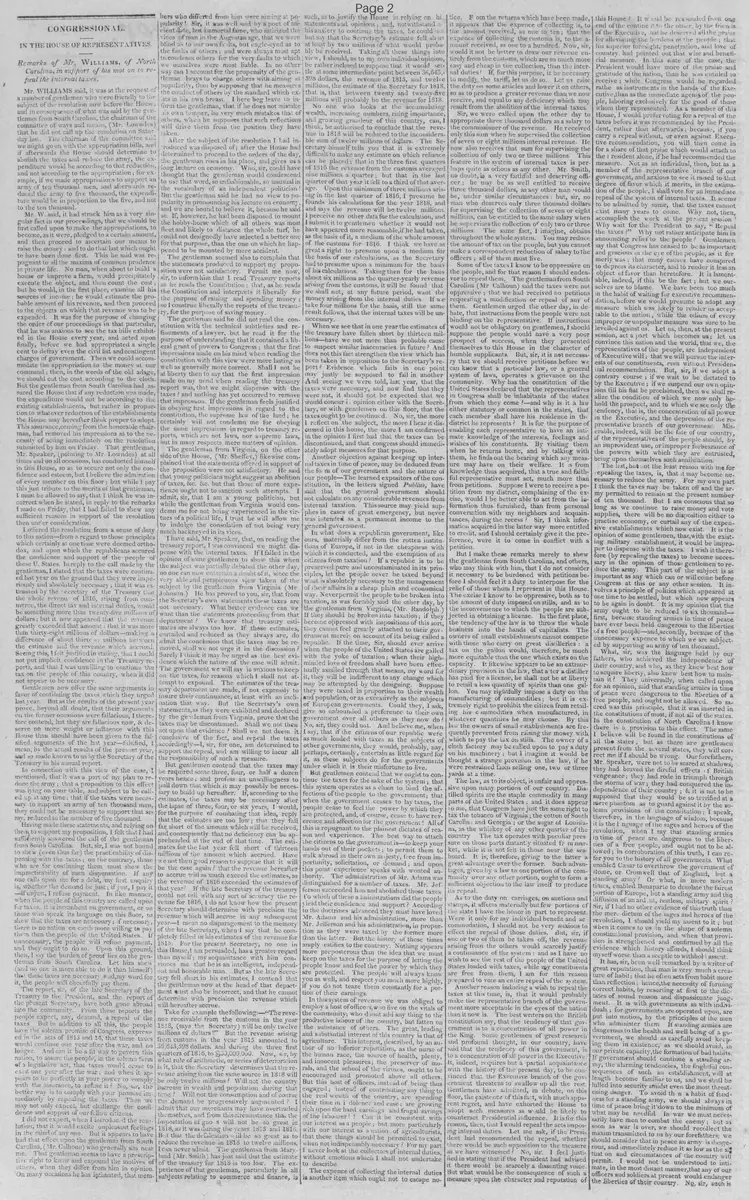
IN THE HOUSE OF REPRESENTATIVES.
Remarks of Mr. WILLIAMS, of North Carolina, in support of his motion to repeal the internal taxes.
Mr. WILLIAMS said, it was at the request of a number of gentlemen who were friendly to the subject of the resolution now before the House, and in consequence of what was said by the gentleman from South Carolina, the chairman of the committee of ways and means, (Mr. Lowndes), that he did not call up the resolution on Saturday last. The chairman of the committee said we might go on with the appropriation bills, and if afterwards the House should determine to abolish the taxes and reduce the army, the expenditure would be according to that reduction, and not according to the appropriation; for example, if we made appropriations to support an army of ten thousand men, and afterwards reduced the army to five thousand, the expenditure would be in proportion to the five, and not to the ten thousand.
Mr. W. said, it had struck him as a very singular fact in our proceedings, that we should be first called upon to make the appropriations, to become, as it were, pledged to a certain amount, and then proceed to ascertain our means to raise the money: and to do that last which ought to have been done first. This he said was repugnant to all the maxims of common prudence in private life. No man, when about to build a house or improve a farm, would precipitately execute the object, and then count the cost; but he would, in the first place, examine all his sources of income; he would estimate the probable amount of his revenue, and then proceed to the objects on which that revenue was to be expended. It was for the purpose of changing the order of our proceedings in that particular, that he was anxious to see the tax bills exhibited in the House every year, and acted upon finally, before we had appropriated a single cent to defray even the civil list and contingent charges of government. Then we could accommodate the appropriation to the money at our command; then, in the words of the old adage, we should cut the coat according to the cloth.
But the gentleman from South Carolina had assured the House that if any reduction was made, the expenditure would not be according to the existing establishments, but rather in proportion to whatever reduction of the establishments the House may hereafter think proper to adopt. This assurance, coming from the honorable chairman, had removed his impressions as to the necessity of acting immediately on the resolution submitted by him on Friday. That gentleman, Mr. Speaker, (pointing to Mr. Lowndes) at all times and on all occasions, has conducted himself in this House, so as to secure not only the confidence and esteem, but I believe the admiration of every member on this floor; but while I pay this just tribute to the merits of that gentleman, I must be allowed to say, that I think he was incorrect when he stated, in reply to the remarks I made on Friday, that I had failed to show any sufficient reasons in support of the resolution then under consideration.
I offered the resolution from a sense of duty to this nation—from a regard to those principles which certainly at one time were deemed orthodox, and upon which the republicans secured the confidence and support of the people of these U. States. In reply to the call made by the gentleman, I stated that the taxes were continued last year on the ground that they were imperiously and absolutely necessary; that it was estimated by the Secretary of the Treasury that the whole revenue of 1816, arising from commerce, the direct tax and internal duties, would be something more than twenty-five millions of dollars; but it now appeared that the revenue greatly exceeded that amount: that it was more than thirty-eight millions of dollars—making a difference of about thirteen millions between the estimate and the revenue which accrued. Seeing this, I felt justified in stating, that I could not put implicit confidence in the Treasury reports, and that I was unwilling to continue the tax on the people of this country, when it did not appear to be necessary.
Gentlemen now offer the same arguments in favor of continuing the taxes which they urged last year. But as the results of the present year prove, beyond all doubt, that their arguments on the former occasions were fallacious, I therefore contend, that they are fallacious now, & deserve no more weight or influence with this House than should have been given to the falsified arguments of the last year—falsified, I mean, by the actual results of the present year, and so made known to us by the Secretary of the Treasury in his annual report.
In connection with this view of the case, I mentioned, that it was a part of my plan to reduce the army; that a proposition to this effect was lying on your table, and subject to be called up at any time; that if the taxes were necessary to support an army of ten thousand men, they could not be necessary to support that army, reduced to the number of five thousand.
Having made these statements, and relying on them to support my proposition, I felt that I had sufficiently answered the call of the gentleman from South Carolina. But, sir, I was not bound to show (even thus far) the practicability of dispensing with the taxes; on the contrary, those who are for continuing them must show the impracticability of such dispensation. If any one calls upon me for a debt, my first enquiry is, whether the demand be just; if just, I pay it—if unjust, I refuse payment. In like manner, when the people of this country are called upon for taxes, it is incumbent on government, or on those who speak its language on this floor, to show that the taxes are necessary; if necessary, there is no nation on earth more willing to pay them than the people of the United States. If unnecessary, the people will refuse payment, and they ought to do so. Upon this ground, then, I say the burden of proof lies on the gentleman from South Carolina. Let him show (and no one is more able to do it than himself) that these taxes are necessary, and, my word for it, the people will cheerfully pay them.
The report, sir, of the late Secretary of the Treasury to the President, and the report of the present Secretary, have both gone abroad into the community. From these reports the people expect, nay, demand, a repeal of the taxes. But in addition to all this, the people have the solemn promise of Congress, expressed in the acts of 1813 and 14, that these taxes would continue one year after the war, and no longer. And can it be a fit way to govern this nation, to assure the people, in the solemn form of a legislative act, that taxes would cease to exist one year after the war; and when it appears to be perfectly in your power to comply with the assurance, to refuse it? No, sir, the better way is to comply with your promise immediately by repealing the taxes. Then we may not only expect, but challenge the confidence and support of our fellow citizens.
I did not expect, when I introduced the resolution, that it would excite unpleasant feelings in the mind of any one. But it appears to have had that effect upon the gentleman from South Carolina, (Mr. Calhoun) who generally sits near me. That gentleman seems to have a prescriptive right to know and expound the motives of others, when they differ from him in opinion. On many occasions he has intimated, that members who differed from him were aiming at popularity! Sir, it was well said by a poet of ancient date, but immortal fame, who satirized the vices of man in the Augustan age, that we were blind as to our own faults, but eagle-eyed as to the faults of others: and were always most apt to condemn others for the very faults to which we ourselves were most liable. In no other way can I account for the propensity of the gentleman always to charge others with aiming at popularity, than by supposing that he measures the conduct of others by the standard which exists in his own breast. I here beg leave to inform the gentleman, that if he does not mistake his own temper, he very much mistakes that of others, when he supposes that such reflections will drive them from the position they have taken.
After the subject of the resolution I had introduced was disposed of: after the House had determined to proceed to the orders of the day, the gentleman rises in his place, and gives us a long lecture on economy. Who, sir, could have thought that the gentleman would condescend to use that word, so unfashionable, so unusual in the vocabulary of an independent politician? But the gentleman said he had no view to popularity in pronouncing his lecture on economy, and we are bound to believe it, because he said so. If, however, he had been disposed to mount the hobby-horse which of all others was most fleet and likely to distance the whole turf, he could not designedly have selected a better one for that purpose, than the one on which he happened to be mounted by mere accident.
The gentleman seemed also to complain that the statements produced to support my proposition were not satisfactory. Permit me now, sir, to inform him that I read Treasury reports as he reads the Constitution; that, as he reads the Constitution and interprets it liberally for the purpose of raising and spending money; so I construe liberally the reports of the treasury, for the purpose of saving money.
The gentleman said he did not read the constitution with the technical subtleties and refinements of a lawyer, but he read it for the purpose of understanding that it contained a liberal grant of powers to Congress: that the first impressions made on his mind when reading the constitution with this view were more lasting as well as generally more correct. Shall I not be at liberty then to say that the first impression made on my mind when reading the treasury report was, that we might dispense with the taxes? and nothing has yet occurred to remove that impression. If the gentleman feels justified in obeying first impressions in regard to the constitution, the supreme law of the land; he certainly will not condemn me for obeying the same impressions in regard to treasury reports, which are not laws, nor supreme laws, but in many respects mere matters of opinion.
The gentleman from Virginia, on the other side of the House, (Mr. Sheffey,) likewise complained that the statements offered in support of the proposition were not satisfactory. He said that young politicians might suggest an abolition of taxes, &c. &c. but that those of more experience ought not to sanction such attempts. I admit, sir, that I am a young politician, but while the gentleman from Virginia would condemn me for not being experienced in the virtues of a political life, I trust he will allow me to indulge the consolation of not being very much hackneyed in its vices.
I have said, Mr. Speaker, that, on reading the treasury report, I was convinced we might dispense with the internal taxes. If I failed in the opinion of some gentlemen to show this when the subject was partially debated the other day, no one can now entertain a doubt of it, since the very able and perspicuous view taken of the subject by the gentleman from Virginia (Mr. Johnson.) He has proved to you, sir, that from the Secretary's own statements these taxes are not necessary. What better evidence can we want than the statements proceeding from that department? We know that treasury estimates are always too low. If those estimates, curtailed and reduced as they always are, do admit the conclusion that the taxes may be removed, shall we not urge it in the discussion? Surely I think it may be urged as the best evidence which the nature of the case will admit.
The government we will say is anxious to keep on the taxes, for reasons which I shall not attempt to expound. The estimates of the treasury department are made, if not expressly to insure their continuance, at least with an inclination that way. But the Secretary's own statements, as they were exhibited and declared by the gentleman from Virginia, prove that the taxes may be discontinued. Shall we not then act upon that evidence? Shall we not deem it conclusive of the fact, and repeal the taxes accordingly—I, sir, for one, am determined to support the repeal, and am willing to incur all the responsibility of such a measure.
But gentlemen contend that the taxes may be required some three, four, or half a dozen years hence; and profess an unwillingness to pull down that which it may possibly be necessary to build up hereafter. If, according to the estimates, the taxes may be necessary after the lapse of three, four, or six years, I would, for the purpose of combating that idea, reply that the estimates are too low; that they fall far short of the amount which will be received, and consequently that no deficiency can be apprehended at the end of that time. The estimates for the last year fell short of thirteen millions of the amount which accrued. Have we not then good reason to suppose that it will be the case again? that the revenue hereafter to accrue will as much exceed the estimates, as the revenue of 1816 exceeded the estimates of that year? If the late Secretary of the treasury could not tell with any sort of accuracy the revenue for 1816, I do not know how the present Secretary should determine with precision the revenue which will accrue in any subsequent year—I mean no disparagement to the memory of the late Secretary, when I say that he completely failed in his estimates of the revenue for 1816. For the present Secretary, no one in this House, I am persuaded, has a greater regard than myself; my acquaintance with him convinces me that he is an intelligent, independent and honorable man. But as the late Secretary fell short in his estimates, I contend that the gentleman now at the head of that department must also be incorrect, and that he cannot determine with precision the revenue which will hereafter accrue.
Take for example the following: "The revenue receivable from the customs in the year 1818, (says the Secretary) will be only twelve millions of dollars!" But the revenue arising from customs in the year 1815 amounted to 36,643,598 dollars, and during the three first quarters of 1816, to $30,000,000. Now, sir, by what rule of arithmetic, or series of deterioration is it, that the Secretary determines that the revenue arising from the same source in 1818 will be only twelve millions? Will not the country increase in wealth and population during that time? Will not the consumption and of course the demand be progressively augmented? I admit that our merchants may have overtraded themselves, and from this circumstance that the importation of goods will not be so great in 1818, as it was during the years 1815 and 1816. But that the defalcation will be so great as to reduce the revenue in 1818 to twelve millions, I can never admit. The gentleman from Maryland (Mr. Smith) has just said that the estimate of the treasury for 1818 is too low. The experience of that gentleman, particularly in all subjects relating to commerce and finance, is such, as to justify the House in relying on his statements and opinions; and, notwithstanding his anxiety to continue the taxes, he could not but say that the Secretary's estimate fell short at least by two millions of what would probably be received. Taking all these things into view, I should, as to my own individual opinion, be rather inclined to suppose that it would settle at some intermediate point between 36,643,598 dollars, the revenue of 1815, and twelve millions, the estimate of the Secretary for 1818, that is, that between twenty and twenty-five millions will probably be the revenue for 1818.
No one who looks at the accumulating wealth, increasing numbers, rising importance, and growing grandeur of this country, can, I think, be authorised to conclude that the revenue in 1818 will be reduced to the inconsiderable sum of twelve millions of dollars. The Secretary himself tells you that it is extremely difficult to make any estimate on which reliance can be placed: that in the three first quarters of 1816 the revenue from the customs averaged nine millions a quarter; but that in the last quarter of that year it fell to a third of that average. Upon this minimum of three millions arising in the last quarter of 1816, I presume he founds his calculations for the year 1818, and says the revenue will be twelve millions. I perceive no other data for the calculation, and I submit it to gentlemen whether it would not have appeared more reasonable, if he had taken, as the basis of it, a medium of the whole amount of the customs for 1816. I think we have as great a right to presume upon a medium for the basis of our calculations, as the Secretary had to presume upon a minimum for the basis of his calculations. Taking then for the basis about six millions as the quarter-yearly revenue arising from the customs, it will be found that we shall not, at any future period, want the money arising from the internal duties. If we take four millions for the basis, still the same result follows, that the internal taxes will be unnecessary.
When we see that in one year the estimates of the treasury have fallen short by thirteen millions—have we not more than probable cause to suspect similar inaccuracies in future? And does not this fact strengthen the view which has been taken in opposition to the Secretary's report? Evidence which fails in one point may justly be supposed to fail in another. And seeing we were told, last year, that the taxes were necessary, and now find that they were not, it should not be expected that we would concur in opinion either with the Secretary, or with gentlemen on this floor, that the taxes ought to be continued. No, sir, the more I reflect on the subject, the more I hear it discussed in this house, the more I am confirmed in the opinion I first had that the taxes can be discontinued, and that congress should immediately adopt measures for that purpose.
Another objection against keeping up internal taxes in time of peace, may be deduced from the form of our government and the nature of our people. The learned expositors of the constitution, in the letters signed Publius, have said that the general government should not calculate on any considerable revenues from internal taxation. This source may yield supplies in cases of great emergency, but never was intended as a permanent income to the general government.
In what does a republican government, like ours, materially differ from the rotten institutions of Europe, if not in the cheapness with which it is conducted, and the exemption of its citizens from taxation? If a republic is to be preserved pure and uncontaminated in its principles, let the people never be taxed beyond what is absolutely necessary to the management of their affairs in a cheap plain and economical way. Never permit the people to be broken into taxation, as was forcibly said the other day, by the gentleman from Virginia, (Mr. Randolph.) If they should be broken into taxation; if they become oppressed with impositions of this sort they cannot feel greatly attached to their government merely on account of its being called a republic. If the time, Sir, should ever arrive when the people of the United States are galled with the yoke of taxation; when their high-minded love of freedom shall have been effectually assailed through that means, my word for it, they will be indifferent to any change which may be attempted by the designing. Suppose they were taxed in proportion to their wealth and population, or as excessively as the subjects of European governments. Could they, I ask, give so unbounded a preference to their own government over all others as they now do? No, sir, they could not. And believe me, when I say, that if the citizens of our republic were as much loaded with taxes as the subjects of other governments, they would, probably, nay, perhaps, certainly, entertain as little regard for it, as these subjects do for the governments under which it is their misfortune to live.
But gentlemen contend that we ought to continue the taxes for the sake of the system; that this system operates as a chain to bind the affections of the people to the government; that when the government ceases to lay taxes, the people cease to feel the power by which they are protected, and, of course, cease to have reverence and affection for the government! All of this is repugnant to the plainest dictates of reason and experience. The best way to attach the citizens to the government is—to keep your hands out of their pockets; to permit them to walk abroad in their own majesty, free from importunity, solicitation, or demand; and upon this point experience speaks with wonted authority. The administration of Mr. Adams was distinguished for a number of taxes. Mr. Jefferson succeeded him and abolished those taxes. To which of these administrations did the people yield their confidence and support? According to the doctrines advanced they must have loved Mr. Adams and his administration, more than Mr. Jefferson and his administration, in proportion as they were taxed by the former more than the latter. But the history of those times amply testifies to the contrary. Nothing appears more preposterous than the idea that we must keep on the taxes for the purpose of letting the people know and feel the power by which they are protected. The people will always know you as well, and respect you much more highly, if you do not tease them constantly for a portion of their earnings.
In this system of revenue we was obliged to employ a host of officers who live on the vitals of the community; who do not add any thing to the productive labour of the country, but fatten on the substance of others. The great, leading and substantial interest of this country is that of agriculture. This interest, described, by an author of no inferior reputation, as the nurse of the human race, the source of health, plenty, and innocent pleasures; the preserver of morals, and the school of the virtues, ought to be encouraged and promoted above all others. But this host of officers, instead of being thus engaged; instead of contributing any thing to the real wealth of the country, are spending their time in idleness and ease; are growing rich upon the hard earnings and frugal savings of the labourer!! Can it be consistent with our interest as a people; but more particularly with our interest as a nation of agriculturists, that these things should be permitted to exist, when not indispensably necessary? For my part I never look at the collectors of internal duties, without emotions which I shall not undertake to describe.
The expence of collecting the internal duties is another item which ought not to escape notice. From the returns which have been made it appears that the expence of collecting is, to the amount received, as one to ten: that the expence of collecting the customs is, to the amount received, as one to a hundred. Now, sir, would it not be better to draw our revenue entirely from the customs, which are so much more easy and cheap in the collection, than the internal duties? If, for this purpose, it be necessary to modify the tariff, let us do so. Let us raise the duty on some articles and lower it on others, so as to produce a greater revenue than we now receive, and equal to any deficiency which may result from the abolition of the internal taxes.
Sir, we were called upon the other day to appropriate three thousand dollars as a salary to the commissioner of the revenue. He received only this sum when he supervised the collection of seven or eight millions internal revenue. He now also receives that sum for supervising the collection of only two or three millions. This feature in the system of internal taxes is perhaps quite as odious as any other. Mr. Smith, no doubt, is a very faithful and deserving officer; he may be as well entitled to receive three thousand dollars, as any other man would be, under similar circumstances: but, sir, no man who deserves only three thousand dollars for supervising the collection of seven or eight millions, can be entitled to the same salary when he supervises the collection of only two or three millions. The same fact, I imagine, obtains throughout the whole system. You may reduce the amount of tax on the people, but you cannot make a correspondent reduction of salary to the officers: all of them must live.
Some of the taxes I know to be oppressive on the people, and for that reason I should endeavor to repeal them. The gentleman from South Carolina (Mr. Calhoun) said the taxes were not oppressive; that we had received no petitions requesting a modification or repeal of any of them. Gentlemen urged the other day, in debate, that instructions from the people were not binding on the representative. If instructions would not be obligatory on gentlemen, I should suppose the people would have a very poor prospect of success, when they presented themselves to this House in the character of humble supplicants. But, sir, it is not necessary that we should receive petitions before we can know that a particular law, or a general system of laws, operates a grievance on the community. Why has the constitution of the United States declared that the representatives in Congress shall be inhabitants of the states from which they come?—and why is it a law either statutory or common in the states, that each member shall have his residence in the district he represents? It is for the purpose of enabling each representative to have an intimate knowledge of the interests, feelings and wishes of his constituents. By visiting them when he returns home, and by talking with them, he finds out the bearing which any measure may have on their welfare. It is from knowledge thus acquired, that a true and faithful representative must act, much more than from petitions. Suppose I were to receive a petition from my district, complaining of the excise, would I be better able to act from the information thus furnished, than from personal conversation with my neighbors and acquaintances, during the recess? Sir, I think information acquired in the latter way more entitled to credit, and I should certainly give it the preference, were it to come in conflict with a petition.
But I make these remarks merely to show the gentleman from South Carolina, and others, who may think with him, that I do not consider it necessary to be burdened with petitions before I should feel it a duty to interpose for the relief of those whom I represent in this House. The excise I know to be oppressive, both as to the amount of duty imposed on stills, and as to the inconvenience to which the people are subjected in obtaining a license. In the first place, the tendency of the law is to throw the whole business into the hands of capitalists. The owners of small establishments cannot compete with those who carry on great distilleries: a tax on the gallon would, therefore, be much more equitable than the one which exists on the capacity. It likewise appears to be an extraordinary provision in the law, that after a distiller has paid for a license, he shall not be at liberty to retail a less quantity of spirits than one gallon. You may rightfully impose a duty on the manufacturing of commodities; but it is extremely rigid to prohibit the citizen from retailing his commodities when manufactured, in whatever quantities he may choose. By this law the owners of small establishments are frequently prevented from raising the money with which to pay the tax on stills. The owner of a cloth factory may be called upon to pay a duty on his machinery; but I imagine it would be thought a strange provision in the law, if he were restrained from selling one, two or three yards at a time.
The law, as to its object, is unfair and oppressive upon many portions of our country. Distilled spirits are the staple commodity in many parts of the United States; and it does appear to me, that Congress have just the same right to tax the tobacco of Virginia; the cotton of South Carolina and Georgia; or the sugar of Louisiana, as the whiskey of any other quarter of the country. The tax operates with peculiar pressure on those parts distantly situated from market, while it is not felt in those near the sea board. It is, therefore, giving to the latter a great advantage over the former. Such advantages, given by a law to one portion of the community over any other portion, ought to form a sufficient objection to the law itself to produce its repeal.
As to the duty on carriages, on auctions and stamps, it affects materially but few portions of the state I have the honor in part to represent. Were it only for my individual benefit and accommodation, I should not be very anxious to effect the repeal of those duties. But, sir, if one or two of them be taken off, the revenue arising from the others would scarcely justify a continuance of the system: and as I have no wish to see the rest of the people of the United States loaded with taxes, while my constituents are free from them, I am for this reason prepared to vote an entire repeal of the system.
Another reason inducing a wish to repeal the taxes at this time, is, that it would probably make the representative branch of the government more acceptable in the eyes of the nation than it now is. The best writers on the British constitution say, that the tendency of that government is to a concentration of all power in the King. Some gentlemen of great research and profound thought, in our country, have said that the tendency of this government, is to a concentration of all power in the Executive. It, indeed, requires but a partial acquaintance with the history of the present day, to be convinced that the Executive branch of the government threatens to swallow up all the rest. Gentlemen have admitted, in debate, on this floor, the existence of this fact, with much apparent regret, and have exhorted the House to adopt such measures as would be likely to counteract Presidential influence. It is for this reason, then, that I would repeal the acts imposing internal duties. Let me ask, if the President had recommended the repeal, whether there would be such opposition to the measure as we have witnessed? No, sir. I feel justified in stating that if the President had advised it there would be scarcely a dissenting voice. But what would be the consequence of such a measure upon the character and reputation of this House? It would be resounded from one end of the continent to the other, by the friends of the Executive, that he deserved all the praise for allevating the burdens of the people; that his superior foresight, penetration, and love of country, had pointed out that wise and beneficial measure. In this state of the case, the President would have more of the praise and gratitude of the nation, than he was entitled to receive; while Congress would be regarded rather as instruments in the hands of the Executive, than as the immediate agents of the people, laboring exclusively for the good of those whom they represented. As a member of this House, I would prefer voting for a repeal of the taxes before it was recommended by the President, rather than afterwards; because, if you carry a repeal without, or even against Executive recommendation, you will then come in for a share of that praise which would attach to the President alone, if he had recommended the measure. Not as an individual, then, but as a member of the representative branch of our government, and anxious to see it raised to that degree of favor which it merits, in the estimation of the people, I shall vote for an immediate repeal of the system of internal taxes. It seems to be admitted by some, that the taxes cannot exist many years to come. Why not, then, accomplish the work at the present session? Why wait for the President to say, "Repeal the taxes?" Why not rather anticipate him in announcing relief to the people? Gentlemen say that Congress has ceased to be as important and gracious in the eye of the people, as it formerly was; that many causes have conspired to depress its character, and to render it less an object of favor than heretofore. It is lamentable, indeed, if this be the fact; but we ourselves are to blame. We have been too much in the habit of waiting for executive recommendation, before we would presume to adopt any measure which was likely to render us acceptable to the nation; while the odium of every improper or unpopular measure was sure to be levelled against us. Let us, then, at the present session, act a part which becomes us; let us convince this nation and the world, that we, the representatives of the people, are independent of Executive will; that we will pursue the interests of our constituents, even without Presidential recommendation. But, sir, if we adopt a contrary course; if we wait to be dictated to by the Executive; if we suspend our own opinions till his fiat be proclaimed, then we shall realize the condition of which we now only behold the prospect, and to which we see only the tendency, that is, the concentration of all power in the Executive, and the depression of the representative branch of our government. Miserable, indeed, will be the fate of our country, if the representatives of the people should, by an improvident use, or improper forbearance of the powers with which they are entrusted, bring upon themselves such annihilation.
The last, but not the least reason with me for repealing the taxes, is, that it may become necessary to reduce the army. For my own part I think the taxes may be taken off and the army permitted to remain at the present number of ten thousand. But I am conscious that so long as we continue to raise money and vote supplies, there will be no disposition either to practise economy, or curtail any of the expensive establishments which now exist. It is the opinion of some gentlemen, that, with the existing military establishment, it would be improper to dispense with the taxes. I wish it therefore (by repealing the taxes) to become necessary in the opinion of those gentlemen to reduce the army. This part of the subject is as important as any which can or will come before Congress at this or any other session. It involves a principle of politics which appeared at one time to be settled, but which now appears to be again in doubt. It is my opinion that the army ought to be reduced to six thousand—first, because standing armies in time of peace have ever been held dangerous to the liberties of a free people—and, secondly, because of the unnecessary expence to which we are subjected by supporting an army of ten thousand.
What, sir, was the language held by our fathers, who achieved the independence of their country, and who, as they knew best how to acquire liberty, also knew best how to maintain it? They universally, when called upon for an opinion, said that standing armies in time of peace were dangerous to the liberties of a free people, and ought not be allowed. So sacred was this principle, that it was inserted in the constitutions of most, if not all of the states. In the constitution of North Carolina I know there is a provision to this effect. The same I believe will be found in the constitutions of all the states; but as there are gentlemen present from the several states, they will correct me if I should be wrong. Our forefathers, Mr. Speaker, were not to be scared at shadows; they had braved the direful effects of British vengeance; they had rode in triumph through the storms of war; they had conquered the independence of their country; & it is not to be supposed that they would be so terrified at a mere phantom as to guard against it by the solemn provisions of the constitution; I speak, therefore, in the language of wisdom, because it is the language of the sages and heroes of the revolution, when I say that standing armies in time of peace are dangerous to the liberties of a free people, and ought not to be allowed; in corroboration of this truth, I can refer you to the history of all governments. What enabled Caesar to overthrow the government of Rome, or Cromwell that of England, but a standing army? Or what, in more modern times, enabled Bonaparte to desolate the fairest portion of Europe, but a standing army and the diffusion of an ardent, restless, military spirit?
Sir, if I had no other evidence of this truth than the mere dictum of the sages and heroes of the revolution, I should yield my assent to it; but when it comes to us in the shape of a solemn constitutional provision, and when that provision is strengthened and confirmed by all the evidence which history affords, I should think myself worse than a sceptic to withhold assent.
It has, sir, been well remarked by a writer of great reputation, that man is very much a creature of habit; that he often acts from habit more than reflection; hence, the necessity of forming correct habits, by resorting at first to the dictates of sound reason and dispassionate judgment. It is with governments as with individuals; for governments are operated upon, are put into motion, by the principles of the men who administer them. If standing armies are dangerous to the health and well being of a government, we should as carefully avoid keeping them in existence, as we should avoid, in our private capacity, the formation of bad habits. If government should continue a standing army, the alarming tendencies, the frightful consequences of such an establishment, will at length become familiar to us, and we shall be lulled into security amidst even the most threatening danger. To avoid then a habit of fondness for a standing army, we should always in time of peace bring it down to the minimum of what may be needful. In war we must necessarily have men to combat the enemy; but as soon as war is over, we should recollect the maxim transmitted to us by our forefathers; we should consider that in peace an army is dangerous, and immediately reduce it as low as the situation and circumstances of the country will permit. I would not be understood to intimate, in the most distant manner, that any of our officers and soldiers at present would endanger the liberties of their country. No, sir, such is
not my meaning, and I beg the House not to believe me as conveying the most distant idea of the kind. The present army has neither the numbers nor the disposition to engage in so unhallowed a work. All I contend for is this, that the government and people of the United States should not, in opposition to the advice of our forefathers, acquire a habit of fondness for, and dependence upon a standing army; that, to avoid this habit, it should be a settled rule in time of peace to reduce the army as low as the situation of the country will permit; that the question should not be "how many men can we retain in the service," but how many can we dispense with; that we should not keep in service as many as possible, but as few as possible.
Now, sir, I ask whether it is necessary to continue in service an army of ten thousand men? In my judgment it is not; we want just so many men as will garrison our posts and fortifications. I hold in my hand a statement, from which it will appear, that a little upwards of six thousand men will be amply sufficient for this purpose, any greater number involving a risk of contracting that dangerous habit of fondness for a standing army, to which I have alluded.
The indulgence of the House will, I trust, be extended to me while I read the statement—it was furnished by one in whose military knowledge I have the utmost confidence. If gentlemen are not equally disposed to confide in it, they have only to produce other statements, and the candor and intelligence of the House will determine between us.*
The statement exhibited to the House had gone very much into detail, and Mr. Williams said, he must apologize for having so long occupied the attention of the gentlemen. It appeared to him necessary that a statement of the kind should show the different positions of the garrisons, and the various uses to which they must be applied. If this were done, those not inclined to a reduction of the army could more easily point out the errors contained in any statements made to the House, and he hoped this consideration would justify him for having consumed so much time by minute details of this part of the subject. It is obvious from this statement that an army containing about six thousand two hundred men will be entirely adequate to every purpose. He must then, in the seriousness and soberness of the most heartfelt conviction, say, that the army should be reduced: that he would adopt the maxim that standing armies in time of peace were dangerous to liberty, and that no act of his should ever induce the government to form a habit different from that maxim by continuing in service a greater number than is absolutely wanted.—
This, he said, is the point to which we should
*Mr. Williams then read to the House the number, situation, and names of our forts and other public works; and the number and description of force necessary to be placed in each, as follows:
Fort Hawkins—At this fort one company of infantry is necessary to prevent the white people from intruding on the Indians, and also to preserve the factory established for the purposes of trade.
Town of Savannah—One company of artillery, to keep the fort in repair; the cannon and small arms in order, and also to aid the revenue officers, if occasion should require.
Charleston—At Charleston there are Fort Moultrie, Fort Johnson, and Castle Pinkney—At these places two companies of artillery will be necessary, for the same purposes as at Savannah.
Fort Johnson, below Wilmington, in North-Carolina—The works at this place are very unimportant, and scarcely merit the attention of a garrison; but, to swell the estimate, we will assign to that fort one company of artillery.
Norfolk—Fort Nelson and Fort Norfolk, are the only works—There may be a water battery on Craney Island, erected during the war, but it is not necessary to garrison it in time of peace. At these works two companies of artillery may be necessary to keep them in repair; to preserve the cannon, small arms, and munitions of war, and occasionally to aid the revenue officers, as at Savannah.
Baltimore—Fort McHenry; one company of artillery, for the same purposes.
Philadelphia—Mud or Sullivan's Fort; one company of artillery, for the same purposes.
New-York—Here there is a fort called Castle Williams, with two or three other forts, the names of which are not recollected, and which are not material. At these places three companies of artillery would do the ordinary garrison duties, but we will say four.
Newport, Rhode-Island—Fort Trumbull, it is believed, is the name of the works—At this place one company of artillery may be necessary.
Boston—The name of the works unknown; but, from the extent of them, as generally understood, two companies of artillery will be quite sufficient.
New-London, Connecticut—One company of artillery.
Plattsburgh—Rouse's point, near Plattsburgh, is in the neighborhood of Isle de Noix, in Lower Canada; and, lest at some unguarded moment, the enemy might possibly make a dash upon it, we will assign to this place two companies of artillery and two of infantry.
Sackett's Harbor—One company of artillery.
Niagara—One company of artillery.
Detroit & its dependencies, Mackinaw, Green-bay, and Chicago—Fort Detroit, three companies of infantry and one company of artillery; For Mackinaw three companies of infantry, and a subaltern's command of artillery—For Green-bay, two companies of infantry, and a subaltern's command of artillery—For Chicago, two companies of infantry. It is necessary there should be a larger force at Detroit than the other places, for the purpose of escorting supplies of provisions and munitions of war to Mackinaw, Greenbay, and Chicago.
St. Louis and its dependencies, fort Edwards, fort Armstrong, fort Crawford, fort Clarke, fort Osage, and a fort to be established on the Arkansas. To these places may be assigned ten companies of riflemen and one of artillery, to be disposed of as follows, viz: Fort Edwards, one company of riflemen—Fort Armstrong, two companies of riflemen, and a subaltern's command of artillery—Fort Crawford, three companies of riflemen & a subaltern's command of artillery—Fort Clarke, one company of riflemen—Fort Osage, one company of riflemen. The fort to be established on the Arkansas, one company of riflemen—The depot at St. Louis, one company of riflemen, and the residue of the artillery, to keep the stores in readiness, and to escort supplies to the outposts, when necessary.
Fort Washington, on the Potomac, one company of artillery.
New-Orleans and dependencies. fort St. Philip, fort St. Charles, fort St. John, fort Petit Coquille—Four companies of artillery will be entirely sufficient to garrison these places.
Mobile—Two companies of artillery.
Those little forts in the Creek nation, viz: Fort Jackson, fort Decatur, fort Williams, fort Crawford, &c, &c. are considered unworthy of notice, because the Indians are completely subdued; the country is fast settling, and these places will be of no use.
It may be necessary to establish a fort on the Appalachicola, at or near the Spanish line, where one company of artillery will answer every object the government can propose.
always go, and beyond which we ought never to pass, because the least extravagance in this matter involves the most dangerous consequence. But gentlemen contend that it would be improper to reduce the army in the present unsettled state of the world. Sir, I consider their fears on this head as perfectly visionary; for we cannot, I think, entertain apprehensions of another war within any short time. On the Canada frontier, Great Britain is the weaker power in relation to the United States. She cannot act with such a want of wisdom, with so much precipitation, as to commence war upon us in that quarter. The same remark applies to Spain on our South Western frontier; in addition to which the state of her South American provinces will be most ample security for her pacific dispositions. It is not likely, therefore, that hostilities will be commenced against us in any part of our territories so as to make it necessary that we should retain in service more than a peace establishment.
There is one other point of view in which this subject ought to be considered, and in which it becomes a matter of good policy if not of imperious duty to reduce the army. It is, that a reduction now will conduce hereafter to the more effectual and substantial defence of the country. I well know that it is invidious to draw comparisons, and I trust not to be understood in what I shall say as meaning the least disparagement to any description of troops during the late war; they all did their duty. But as there are three degrees of comparison, I would ask whether the officers and soldiers enlisted a long time prior to the late war, or those enlisted immediately before war & during its continuance, won the battles which have done so much honor to the country. Brown and Jackson and the officers and soldiers who fought under their banners, were not of the old military establishment. It is a rule which, I believe, will generally hold good throughout the late war, that the officers and soldiers of the new establishment contributed most to the defence of their country. The same remark applies to the troops of other nations. When troops have been enlisted just so long as to be perfectly disciplined and no longer, they fight best; after they have become enervated by all the irregularities of a camp life, they are not so much to be depended on. Taking, then, these data, it becomes both a duty and a matter of wise policy, in regard to the future defence of our country, to curtail the army. Suppose we remain at peace ten years, we have now an army of ten regiments, costing the government annually $500,000 each. If we reduce the number to five, we shall in ten years save $2,500,000; if we continue the additional five, we shall in that time expend $2,500,000. These two millions five hundred thousand dollars would keep in service fifty regiments for one year, or twenty-five regiments for two years. Then, by reducing the army, we shall at the end of ten years be able to employ fifty regiments for one year, or twenty-five regiments for two years. Now, sir, I would ask whether, by reducing the army, we shall not, at the end of ten years, be better able to defend the country with fifty regiments or with twenty-five, as the case may be, in the manner above stated, than if we do not reduce it, and at the end of ten years have only the ten old regiments, worn out and enfeebled by all the irregularities of a camp life, and in the experience of every country not so much to be relied on. I will not say that my view is exactly correct in all its details, but that the principle of it is true cannot be doubted. Were it, therefore, only for the purpose of saving two millions five hundred thousand dollars, and of being thereby better able at the end of ten years to defend the country, I should vote to reduce the army. But when, in connection with this view of the case, we reflect on the danger of a standing army unnecessarily large in time of peace, we should not, in my judgment, hesitate a moment as to the course which ought to be pursued.
But gentlemen say the army is not greater now than it was in the administration of Mr. Jefferson, and from thence argue that it ought not to be reduced. It is, sir, a very unsatisfactory mode of defending any measure, to say that something of the kind has existed in times past. Upon that principle, not only the foibles, but the enormities of almost every government might be defended. The fact, however, is not as it is alleged to be. Mr. Jefferson's peace establishment consisted only of 3000 men, and he got on very well with that number: when an aspect of war suddenly appeared in our horizon it is true that the number was increased. If in a course of years after the proposed reduction a prospect of war should again appear, we can imitate the example of Mr. Jefferson, and increase the number. A great error has arisen amongst us, from supposing that the maxims of policy in relation to standing armies in Europe are applicable to our situation; whereas, directly the contrary is the fact. In Europe, great, powerful and hostile nations border upon each other; they are always disposed to take an advantage, and often commence wars without permitting their adversaries to have any notice of such designs. But with us, although our government is composed of separate independent sovereignties, yet they are bound together in one common union of peace and friendship. We are separated from the nations of Europe, the only powers that can attack us, by an ocean of immense extent; no war can be undertaken against us without giving us reasonable time for preparation. The maxims, therefore, in favor of standing armies in Europe do not apply to the government of the United States; and the question for us now to decide is not whether the army was as great during the administration of Mr. Jefferson as it is at present, but whether it is not now greater than necessary. I have produced statements to support the affirmative of this proposition, and I call upon gentlemen to disprove them. If it can be shewn to my satisfaction that the present establishment of ten thousand is necessary to the defence of the country, I pledge you my word, sir, that I will not vote for a reduction. Prove this, and my opposition ceases from that moment: But, believing that the number now in service greatly exceeds that which is necessary, I must persevere in the course I have marked out.
I will now conclude. Mr. Speaker, with remarking to the House, that these observations have been offered not out of any respect I could entertain for the calls made upon me by different gentlemen when this subject was slightly agitated on Friday last. For those calls, sir, I could not possibly feel any respect, and my remarks at present have been submitted to the House from a sense of duty to myself and to the nation, more than from any other consideration. The time has now arrived, when, by the vote of this House we shall determine, whether the government of the United States is hereafter to conform its measures to the characteristic purity, simplicity and economy of its institutions; or whether we shall go as other nations have gone and run equally with them the race of taxation and extravagance.
What sub-type of article is it?
What themes does it cover?
What keywords are associated?
What entities or persons were involved?
Where did it happen?
Story Details
Key Persons
Location
House Of Representatives
Event Date
1817
Story Details
Mr. Williams argues for repealing internal taxes citing surplus revenue from 1816 exceeding estimates by $13 million, post-war promises in acts of 1813-14, oppressive nature of taxes like excise on stills, high collection costs, and benefits to republican economy; proposes reducing army to 6,200 men for garrisoning forts, warning against dangers of standing armies in peacetime based on founders' wisdom and history, and for future defense efficiency.