Thank you for visiting SNEWPapers!
Sign up free
Southern Telegraph
Rodney, Jefferson County, Mississippi
What is this article about?
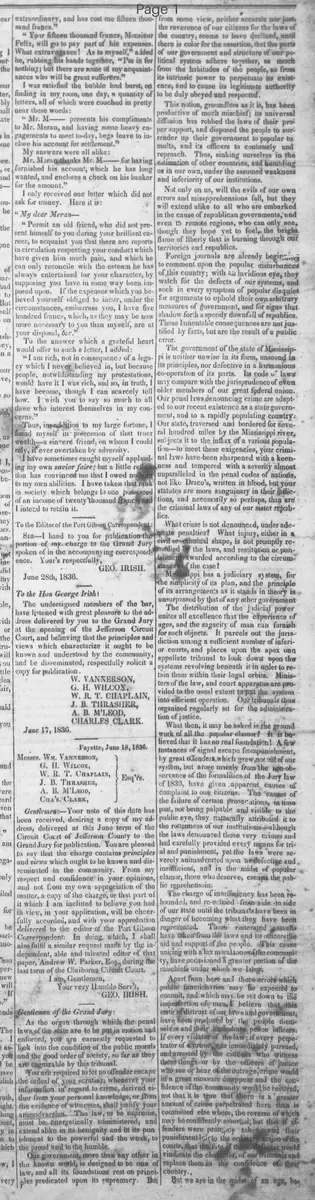
In June 1836, Judge George Irish submits his charge to the Grand Jury of Jefferson County, Mississippi, for publication in the Port Gibson Correspondent, at the request of local bar members. The charge urges vigorous enforcement of penal laws, defends Mississippi's judiciary, and attributes public disorder to moral decline and lack of community support for law.
Merged-components note: Table contains the list of signers referenced in the letter text; subsequent notice is the direct continuation of the judge's charge quoted in the letter to the editor
Clippings
1 of 2
OCR Quality
Full Text
| Messrs. WM. VANNERSON, G. H. WILCOX, W. R. T. CHAPLAIN, J. B. THRASHER, A. B. M'LEOD, CHA'S. CLARK, |
To the Editor of the Port Gibson Correspondent:
SIR—I hand to you for publication the
portion of my charge to the Grand Jury
spoken of in the accompanying correspond-
ence. Yours respectfully,
GEO. IRISH
June 28th, 1836.
To the Hon. George Irish:
The undersigned members of the bar
have listened with great pleasure to the ad-
dress delivered by you to the Grand Jury
at the opening of the Jefferson Circuit
Court, and believing that the principles and
views which characterize it ought to be
known and understood by the community,
and be disseminated, respectfully solicit a
copy for publication.
W. VANNERSON,
G. H. WILCOX,
W. R. T. CHAPLAIN,
J. B. THRASHER,
A. B. M'LEOD,
CHARLES CLARK.
June 17, 1836.
Fayette, June 18, 1836:
Gentlemen:—Your note of this date has
been received, desiring a copy of my ad-
dress, delivered at this June term of the
Circuit Court of Jefferson County to the
Grand Jury for publication. You are pleased
to say that the charge contains principles
and views which ought to be known and dis-
seminated in the community. From my
respect and confidence in your opinions,
and not from my own appreciation of the
matter, a copy of the charge, or that part of
it which I am inclined to believe you had
in view, in your application, will be cheer-
fully accorded, and with your approbation
delivered to the editor of the Port Gibson
Correspondent: In doing which, I shall
also fulfil a similar request made by the in-
dependent, able and talented editor of that
paper, Andrew W. Parker, Esq., during the
last term of the Claiborne Circuit Court.
I am, Gentlemen,
Your very Humble Serv't,
GEO. IRISH.
Gentlemen of the Grand Jury:
As the organ through which the penal
laws of the state are to be put in motion and
enforced, you are earnestly requested to
look into the condition of the public morals
and the good order of society, so far as they
are cognizable by this tribunal.
You are required to let no offender escape
the ordeal of your scrutiny; whenever your
information in regard to crime, derived ei-
ther from your personal knowledge, or from
the evidence of witnesses, shall justify your
animadversion. The law, to be supreme,
must be energetically administered; and
extend alike in its benignity and in its pun-
ishments to the powerful and the weak, to
the proud and to the humble.
Our government, more than any other in
the known world, is designed to be one of
law, and all its foundations rest on princi-
ples predicated upon its supremacy. But
from some view, neither accurate nor just,
the reverence of our citizens for the laws of
the country, seems to have declined, until
there is color for the assertion, that the parts
of our government and structure of our po-
litical system adhere together, as much
from the habitudes of the people, as from
its intrinsic power to perpetuate its exist-
ence, and to cause its legitimate authority
to be duly obeyed and respected.
This notion, groundless as it is, has been
productive of much mischief; its universal
diffusion has robbed the laws of their pro-
per support, and disposed the people to sur-
render up their government to popular tu-
mults, and its officers to contumely and
reproach. Thus, sinking ourselves in the
estimation of other countries, and humbling
us in our own, under the assumed weakness
and inferiority of our institutions.
Not only on us, will the evils of our own
errors and misapprehensions fall, but they
will extend alike to all who are embarked
in the cause of republican governments, and
even to remote regions, who can only see,
though they hope yet to feel, the bright
flame of liberty that is burning through our
territories and republics.
Foreign journals are already beginning
to comment upon the popular disturbances
of this country; with an invidious eye, they
watch for the defects of our systems, and
seek in every symptom of popular disquiet
for arguments to uphold their own arbitrary
measures of government, and for signs that
shadow forth a speedy downfall of republics.
These lamentable consequences are not jus-
tified by facts, but are the result of a public
error.
The government of the state of Mississip-
pi is neither unwise in its form, unsound in
its principles, nor defective in a harmonious
co-operation of its parts. Its code of laws
may compare with the jurisprudence of even
older members of our great federal union.
Our penal laws denouncing crime are adapt-
ed to our recent existence as a state govern-
ment, and to a rapidly populating country:
Our state, traversed and bordered for Seve-
ral hundred miles by the Mississippi river,
subjects it to the influx of a various popula-
tion—to meet these exigencies, your crimi-
nal laws have been sharpened with a keen-
ness and tempered with a severity almost
unparalleled in the penal codes of nations,
not like Draco's, written in blood, but your
statutes are more sanguinary in their inflic-
tions, and necessarily so perhaps, than are
the criminal laws of any of our sister repub-
lies.
What crime is not denounced, under ade-
quate penalties? What injury, either in a
civil or criminal shape, is not promptly re-
medied by the laws, and restitution or pun-
ishments awarded according to the circum-
stances of the case?
Mississippi has a judiciary system, for
the simplicity of its plan, and the principle
of its arrangements as it stands in theory is
unsurpassed by that of any other government
The distribution of the judicial power
unites all excellence that the experience of
ages, and the sagacity of man can furnish
for such objects. It parcels out the juris-
diction among a sufficient number of inferi-
or courts, and places upon the apex one
appellate tribunal to look down upon the
systems revolving beneath it in order to re-
tain them within their legal orbits. Minis-
ters of the law, and court apparatus are pro-
vided to the usual extent to put the system
into efficient operation. Our tribunals thus
organized regularly sit for the administra-
tion of justice.
What then, it may be asked is the ground
work of all the popular clamor? It is be-
lieved that it has no real foundation! A few
instances of signal escape from punishment,
by great offenders, which grew, not out of our
system, but arose mainly from the non-ob-
servance of the formalities of the Jury law
of 1830, have given apparent causes of
complaint to our citizens: The causes of
the failure of certain prosecutions, in time
past, not being palpable and visible to the
public eye, they naturally attributed it to
the rottenness of our institutions although
the laws denounced those very crimes and
had carefully provided every means for tri-
al and punishment, yet the laws were se-
verely animadverted upon as defective and
insufficient, and in the midst of popular
clamor, those who deserve, escape the pub-
lic reprehension.
The charge of insufficiency has been re-
bounded, and re-echoed from side to side
of our state until the tribunals have been in
danger of becoming what they have been
represented. These reiterated assaults
have taken from the laws and its officers the
aid and support of the people. This cause
uniting with a lax moral tone of the communi-
ty, have occasioned a greater portion of the
mischiefs under which we labor:
Apart from here and there errors which
public functionaries may be expected to
commit, and which may be set down to his
imperfection of man, I believe that this
state of distrust of our laws and government;
have been produced by the people them-
themselves and their immediate peace officers.
If every violator of the law; if every perpe-
trator of a crime, was immediately pursued,
and arrested by the citizens who witness
these things or by the officers of justice
who see or hear of the outrage, crime would
in a great measure disappear and the con-
fidence of the community would be restored,
not that it is true that there is a greater
amount of crime perpetrated here than is
committed elsewhere, the reverse of which
may be confidently asserted, but that if of-
fenders were promptly taken and their
punishment left to the ordinary action of the
courts, that the fact alone would
vindicate the character, of our tribunals and
replace them in the confidence of their
country.
But we are in the midst of an age, be-
Without first the efficient agency of the regular ministers of the law to institute proceedings, neither the Grand Jury nor the court can exercise their functions, however they may be considered responsible for the administration of the penal laws.
When the community shall pause from their excited and inordinate pursuit of money and shall bestow a portion of their care on their social condition, we may then expect to see officers vigilant in the discharge of their duty, we may then expect to see our public police improved, and our laws and government respected and cherished as the foundations of civil and political liberty: we may then expect to see our courts regarded as the fountains of public justice and individual security. But to achieve this the people must give the impulse, and not war against the law and its officers: unless the good, the wise and the moderate, firmly and decidedly take their stand on the side of the law and order, and oppose mobs, tumults and the irregular action of bodies of misguided citizens, all government will be brought to an end, and speedily swallowed up in licentiousness and anarchy. The functionaries of the land with the physical force against them, the sentiment against them and abandoned by the people, have no power, though they had the will, to resist the storm of popular commotion. The law itself, abstracted from the aid and support of the people, is powerless, and the officers of the government but as slender reeds. Law must have the aid of trained bands and standing armies, or be sustained by the virtue and intelligence of the community and its physical force when needed or demanded. Consequently, when the law and its officers are abandoned and neither sustained by an armed force, nor a virtuous community they must fall and be lost in the throes of popular anarchy. Let the community, then, neither through fashion nor through error, causelessly assail our laws and government nor too unsparingly though something merited, blame the servants of the country.
But let the people trace the evil under which they suffer to its proper source. They will find that it in part springs from the rapacious spirit of the times, from the root of all evil, an inordinate love of money, from a feeling of licentiousness that spurns restraint, and from the decline of public virtue.
And, armed with this conviction, let them essay to rebuild the temple of their virtue, to replace their overthrown altars, and once more rekindle the sacred flame of patriotism.
What sub-type of article is it?
What themes does it cover?
What keywords are associated?
What entities or persons were involved?
Letter to Editor Details
Author
Geo. Irish
Recipient
To The Editor Of The Port Gibson Correspondent
Main Argument
the grand jury must enforce penal laws vigorously to maintain public morals and order; mississippi's legal system is sound, but public distrust and moral laxity have undermined it, leading to disorder that harms republican ideals.
Notable Details