Thank you for visiting SNEWPapers!
Sign up free
Virginia Free Press & Farmers' Repository
Charles Town, Jefferson County, West Virginia
What is this article about?
The U.S. Supreme Court, led by Chief Justice Marshall, reversed a Georgia court's judgment in Worcester v. Georgia, declaring state laws over Cherokee lands unconstitutional and affirming federal treaties and Indian rights.
Clipping
OCR Quality
Full Text
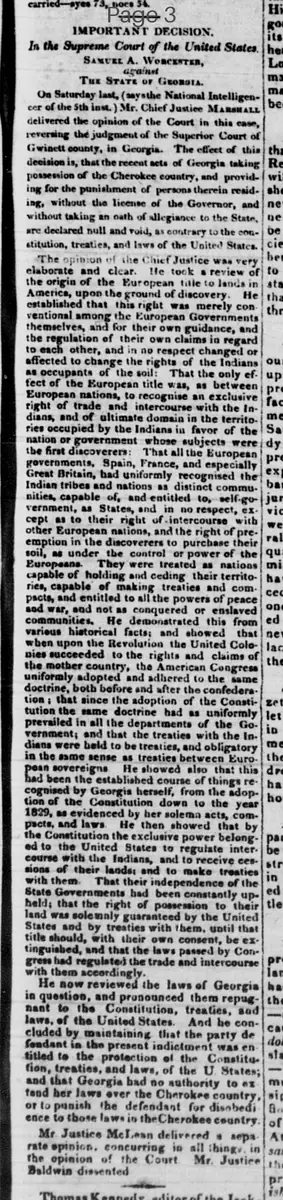
In the Supreme Court of the United States.
SAMUEL A. WORCESTER,
against
THE STATE OF GEORGIA.
On Saturday last, (says the National Intelligencer of the 5th inst.) Mr. Chief Justice Marshall delivered the opinion of the Court in this case, reversing the judgment of the Superior Court of Gwinnett county, in Georgia. The effect of this decision is, that the recent acts of Georgia taking possession of the Cherokee country, and providing for the punishment of persons therein residing, without the license of the Governor, and without taking an oath of allegiance to the State, are declared null and void, as contrary to the constitution, treaties, and laws of the United States.
The opinion of the Chief Justice was very elaborate and clear. He took a review of the origin of the European title to lands in America, upon the ground of discovery. He established that this right was merely conventional among the European Governments themselves, and for their own guidance, and the regulation of their own claims in regard to each other, and in no respect changed or affected to change the rights of the Indians as occupants of the soil: That the only effect of the European title was, as between European nations, to recognise an exclusive right of trade and intercourse with the Indians, and of ultimate domain in the territories occupied by the Indians in favor of the nation or government whose subjects were the first discoverers: That all the European governments, Spain, France, and especially Great Britain, had uniformly recognised the Indian tribes and nations as distinct communities, capable of, and entitled to, self-government, as States, and in no respect, except as to their right of intercourse with other European nations, and the right of pre-emption in the discoverers to purchase their soil, as under the control or power of the Europeans. They were treated as nations capable of holding and ceding their territories, capable of making treaties and compacts, and entitled to all the powers of peace and war, and not as conquered or enslaved communities. He demonstrated this from various historical facts: and showed that when upon the Revolution the United Colonies succeeded to the rights and claims of the mother country, the American Congress uniformly adopted and adhered to the same doctrine, both before and after the confederation; that since the adoption of the Constitution the same doctrine had as uniformly prevailed in all the departments of the Government; and that the treaties with the Indians were held to be treaties, and obligatory in the same sense as treaties between European sovereigns He showed also that this had been the established course of things recognised by Georgia herself, from the adoption of the Constitution down to the year 1829, as evidenced by her solemn acts, compacts, and laws He then showed that by the Constitution the exclusive power belonged to the United States to regulate intercourse with the Indians, and to receive cessions of their lands: and to make treaties with them. That their independence of the State Governments had been constantly upheld; that the right of possession to their land was solemnly guaranteed by the United States and by treaties with them, until that title should, with their own consent, be extinguished, and that the laws passed by Congress had regulated the trade and intercourse with them accordingly.
He now reviewed the laws of Georgia in question, and pronounced them repugnant to the Constitution, treaties, and laws of the United States. And he concluded by maintaining that the party defendant in the present indictment was entitled to the protection of the Constitution, treaties, and laws, of the U. States; and that Georgia had no authority to extend her laws over the Cherokee country, or to punish the defendant for disobedience to those laws in the Cherokee country.
Mr Justice McLean delivered a separate opinion, concurring in all things, in the opinion of the Court Mr. Justice Baldwin dissented
What sub-type of article is it?
What themes does it cover?
What keywords are associated?
What entities or persons were involved?
Where did it happen?
Story Details
Key Persons
Location
Supreme Court Of The United States, Gwinnett County, Georgia, Cherokee Country
Event Date
On Saturday Last, As Reported In The National Intelligencer Of The 5th Inst.
Story Details
The Supreme Court reversed the Georgia Superior Court's judgment, declaring Georgia's acts seizing Cherokee lands and punishing residents without state license unconstitutional, as they violated U.S. Constitution, treaties, and laws. Chief Justice Marshall's opinion reviewed historical European and U.S. recognition of Indian tribes as sovereign nations with rights to self-government and land possession until ceded by consent.