Thank you for visiting SNEWPapers!
Sign up free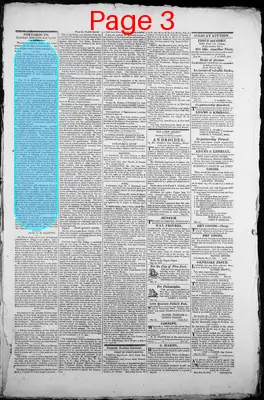
Editorial
May 24, 1825
The New Hampshire Gazette
Portsmouth, Rockingham County, New Hampshire
What is this article about?
Editorial from Portsmouth, NH, May 24, 1825, reports on shipping news from Liverpool and Campeachy, Mexico's independence recognition, and argues strongly for electing Republican candidates to fill four New Hampshire Senate vacancies, criticizing Federalists and editor Mr. Parker of the N.H. Statesman.
Clipping
OCR Quality
98%
Excellent
Full Text
PORTSMOUTH, TUESDAY MORNING, MAY 24, 1825.
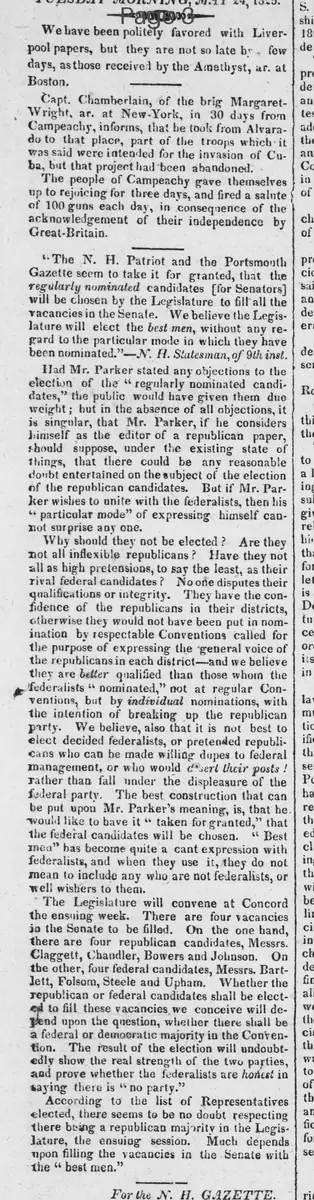
We have been politely favored with Liverpool papers, but they are not so late by a few days, as those received by the Amethyst, arr. at Boston.
Capt. Chamberlain, of the brig Margaret-Wright, arr. at New-York, in 30 days from Campeachy, informs, that he took from Alvarado to that place, part of the troops which it was said were intended for the invasion of Cuba, but that project had been abandoned.
The people of Campeachy gave themselves up to rejoicing for three days, and fired a salute of 100 guns each day, in consequence of the acknowledgement of their independence by Great-Britain.
"The N. H. Patriot and the Portsmouth Gazette seem to take it for granted, that the regularly nominated candidates [for Senators] will be chosen by the Legislature to fill all the vacancies in the Senate. We believe the Legislature will elect the best men, without any regard to the particular mode in which they have been nominated." N. H. Statesman, of 9th inst.
Had Mr. Parker stated any objections to the election of the "regularly nominated candidates," the public would have given them due weight; but in the absence of all objections, it is singular, that Mr. Parker, if he considers himself as the editor of a republican paper, should suppose, under the existing state of things, that there could be any reasonable doubt entertained on the subject of the election of the republican candidates. But if Mr. Parker wishes to unite with the federalists, then his "particular mode" of expressing himself cannot surprise any one.
Why should they not be elected? Are they not all inflexible republicans? Have they not all as high pretensions, to say the least, as their rival federal candidates? No one disputes their qualifications or integrity. They have the confidence of the republicans in their districts, otherwise they would not have been put in nomination by respectable Conventions called for the purpose of expressing the general voice of the republicans in each district—and we believe they are better qualified than those whom the federalists "nominated," not at regular Conventions, but by individual nominations, with the intention of breaking up the republican party. We believe, also that it is not best to elect decided federalists, or pretended republicans who can be made willing dupes to federal management, or who would desert their posts rather than fall under the displeasure of the federal party. The best construction that can be put upon Mr. Parker's meaning, is, that he would like to have it "taken for granted," that the federal candidates will be chosen. "Best men" has become quite a cant expression with federalists, and when they use it, they do not mean to include any who are not federalists, or well wishers to them.
The Legislature will convene at Concord the ensuing week. There are four vacancies in the Senate to be filled. On the one hand, there are four republican candidates, Messrs. Claggett, Chandler, Bowers and Johnson. On the other, four federal candidates, Messrs. Bartlett, Folsom, Steele and Upham. Whether the republican or federal candidates shall be elected to fill these vacancies we conceive will depend upon the question, whether there shall be a federal or democratic majority in the Convention. The result of the election will undoubtedly show the real strength of the two parties, and prove whether the federalists are honest in saying there is "no party."
According to the list of Representatives elected, there seems to be no doubt respecting there being a republican majority in the Legislature, the ensuing session. Much depends upon filling the vacancies in the Senate with the "best men."
We have been politely favored with Liverpool papers, but they are not so late by a few days, as those received by the Amethyst, arr. at Boston.
Capt. Chamberlain, of the brig Margaret-Wright, arr. at New-York, in 30 days from Campeachy, informs, that he took from Alvarado to that place, part of the troops which it was said were intended for the invasion of Cuba, but that project had been abandoned.
The people of Campeachy gave themselves up to rejoicing for three days, and fired a salute of 100 guns each day, in consequence of the acknowledgement of their independence by Great-Britain.
"The N. H. Patriot and the Portsmouth Gazette seem to take it for granted, that the regularly nominated candidates [for Senators] will be chosen by the Legislature to fill all the vacancies in the Senate. We believe the Legislature will elect the best men, without any regard to the particular mode in which they have been nominated." N. H. Statesman, of 9th inst.
Had Mr. Parker stated any objections to the election of the "regularly nominated candidates," the public would have given them due weight; but in the absence of all objections, it is singular, that Mr. Parker, if he considers himself as the editor of a republican paper, should suppose, under the existing state of things, that there could be any reasonable doubt entertained on the subject of the election of the republican candidates. But if Mr. Parker wishes to unite with the federalists, then his "particular mode" of expressing himself cannot surprise any one.
Why should they not be elected? Are they not all inflexible republicans? Have they not all as high pretensions, to say the least, as their rival federal candidates? No one disputes their qualifications or integrity. They have the confidence of the republicans in their districts, otherwise they would not have been put in nomination by respectable Conventions called for the purpose of expressing the general voice of the republicans in each district—and we believe they are better qualified than those whom the federalists "nominated," not at regular Conventions, but by individual nominations, with the intention of breaking up the republican party. We believe, also that it is not best to elect decided federalists, or pretended republicans who can be made willing dupes to federal management, or who would desert their posts rather than fall under the displeasure of the federal party. The best construction that can be put upon Mr. Parker's meaning, is, that he would like to have it "taken for granted," that the federal candidates will be chosen. "Best men" has become quite a cant expression with federalists, and when they use it, they do not mean to include any who are not federalists, or well wishers to them.
The Legislature will convene at Concord the ensuing week. There are four vacancies in the Senate to be filled. On the one hand, there are four republican candidates, Messrs. Claggett, Chandler, Bowers and Johnson. On the other, four federal candidates, Messrs. Bartlett, Folsom, Steele and Upham. Whether the republican or federal candidates shall be elected to fill these vacancies we conceive will depend upon the question, whether there shall be a federal or democratic majority in the Convention. The result of the election will undoubtedly show the real strength of the two parties, and prove whether the federalists are honest in saying there is "no party."
According to the list of Representatives elected, there seems to be no doubt respecting there being a republican majority in the Legislature, the ensuing session. Much depends upon filling the vacancies in the Senate with the "best men."
What sub-type of article is it?
Partisan Politics
What keywords are associated?
New Hampshire Senate
Republican Candidates
Federalist Opposition
Party Elections
Legislative Vacancies
Political Conventions
What entities or persons were involved?
Mr. Parker
N. H. Statesman
N. H. Patriot
Portsmouth Gazette
Claggett
Chandler
Bowers
Johnson
Bartlett
Folsom
Steele
Upham
New Hampshire Legislature
Editorial Details
Primary Topic
Election Of Republican Candidates To New Hampshire Senate Vacancies
Stance / Tone
Strongly Supportive Of Republican Candidates And Critical Of Federalists
Key Figures
Mr. Parker
N. H. Statesman
N. H. Patriot
Portsmouth Gazette
Claggett
Chandler
Bowers
Johnson
Bartlett
Folsom
Steele
Upham
New Hampshire Legislature
Key Arguments
Republican Candidates Are Inflexible Republicans With High Qualifications And District Confidence
Federal Nominations Aim To Break Up The Republican Party
Electing Federalists Or Pretended Republicans Would Harm Republican Interests
Legislature Likely Has Republican Majority, Outcome Depends On Party Strength
Mr. Parker's Comments Suggest Alignment With Federalists