Thank you for visiting SNEWPapers!
Sign up free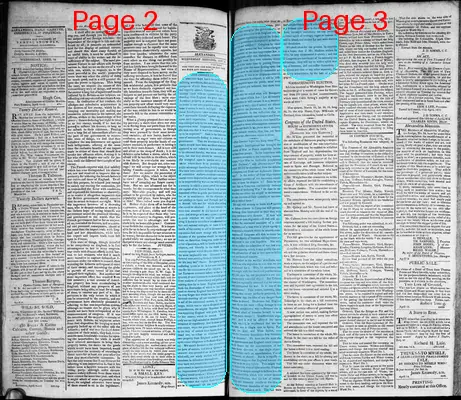
Alexandria Daily Gazette, Commercial & Political
Alexandria, Virginia
What is this article about?
This editorial laments the U.S. merchants' plight under non-importation and restrictive policies, criticizes the government's refusal to allow retrieval of American property from England amid impending war, and rebukes the National Intelligencer for imperiously demanding war declaration, asserting the nation is unprepared and Congress should act independently of President Madison.
Merged-components note: This is a continuation of the same editorial piece on non-importation and war policy across pages 2 and 3, with coherent topic flow.
Clippings

1 of 2
OCR Quality
Full Text
A transitory hope has been excited in our suffering merchants, that amidst their gloomy prospects of ruin from restrictions at home and rapacity abroad, Congress was about to indulge them with an opportunity of withdrawing from England the great amount of American property at present excluded from its home by our own repulsive edicts. This hope it seems is not to be indulged. The National Intelligencer takes occasion to caution its "mercantile friends" against any reliance upon such expectation. The hope indeed was indulged only by the most sanguine; the expression most frequently used by mercantile men was that it was "too rational a policy to be expected."
Such is the lamentable state of mercantile feeling in relation to our government. That the interests of the merchants should have been sacrificed when there appeared to our rulers to be a national good to be obtained thereby, was not so extraordinary, but that they should be wantonly, cruelly trampled upon in passion and in party rancor where there is no possibility of any public advantage therefrom, is truly appalling! We have been carried through all the devices of restrictive warfare—embargo—non-intercourse—non-importation, and again embargo, to be superceded by war—a war with England a country in which a great part of the mercantile capital of the United States, is at present deposited either in goods purchased and paid for, or in remittances for the shipments of our produce to Spain and Portugal, paid for in British bills and for which often nothing else could be obtained. A vast treasure has been thus amassed in the hands of our enemies, and strange as it may appear, a question is made whether we shall be permitted to bring it home to contribute to individual comfort—and national strength, or leave it in the hands of the enemy to add to his means of annoyance—And more strange still, that such decision of the question should be expected from an American Congress, under the impulse of passion, as will be hostile to their own citizens, and friendly in the result to that country against which they are about to wage the most implacable war. Alas such is "infuriated man, seeking through blood & slaughter his long lost" reason. Bonaparte himself unfeeling tyrant as he is has some consideration for the convenience of his subjects. The last European accounts inform us that he has granted 50 new licenses to trade with England from motives of conveniency and policy submitting thus far to favor English commerce from the destruction of which he had threatened to destroy England herself Nor should we ever forget that whilst we were with stoicism in aid of the continental system, by our embargo, which was to starve England and her dependencies, the mighty Napoleon himself was supplying England with grain in return for her money, which he wanted. But we truly are too high-minded to descend to considerations of expediency. And in those portentous times, when the great nations of Europe in the fury of contest have beaten down national law, we refuse to withdraw even our own property from England unless she will first withdraw hers from us, in violation of the laws of nations, and like a Quixotic adventurer who preceded us in the attack on wind-mill, our windy warfare will probably terminate in ridiculous discomfiture. If war must have war, would it be no advantage to our government to have its treasury replenished by the importations of goods which our money has already paid for in England would produce ? If the government is to borrow money, will it find no advantage in drawing home that capital from which loans are to be expected? Or are those vaunting declarations of war to be the signals for drawing home that capital from which loans
Who eat 0
And to loan money to the government; or fiscal calculations preparatory to a volunteer expedition against the Indians.
The government is expected in a few days to other measures, has acknowledged st England—why not, therefore, remove the impotency of the non-importation law until this measure is adopted, it will be difficult accommodation, if she is so disposed—indeed, once more to the latter or honorable action England upon the same footing open the pressure, will at the same time by putting France from their own citizens, whilst to it to impress upon the public mind what they have never yet believed, that there really will be war.
What is the reply to the repeal of this law? Let us humbly but it may be asked what will Bonaparte trust that even he will excuse it as a measure preparatory to war; but if indeed we should thereby forfeit his friendship, we shall have great consolation in the reflection that he treats his enemies with more respect and favor, than he does his friends, since even hated England enjoys a more advantageous commerce for her licensed vessels, than has yet been with him and finds in his ports more security granted to the Americans whom he loves.
* What Cannoneer begot this lusty blood? *
Yesterday's Intelligencer has brought the question of War or Peace explicitly before the American people. In the imperious style of an eastern monarch to his crouching vassals, he says, "Let War be forthwith proclaimed against England:" and afterwards,—"The subject MUST be dismissed from the debates of Congress, and from our diplomatic discussions." Is the writer of these high-handed declarations ignorant of the American constitution, or does he despise it? Does he not know that to Congress exclusively belongs the power of declaring War? Or does he believe they are either too stupid to understand the true interests of their country, or too cowardly to defend them?
We wait with anxiety to learn what course our fellow-citizens in Congress will pursue, after being thus instructed in their duty with all the insolence of a dictator. If they will submit to be thus degraded,—if they will quietly obey the concealed mandates of a chief magistrate,—of a man who is afraid openly to recommend a measure which he secretly countenances,—if Congress will sink so much beneath the dignity of freemen and legislators,— then indeed is our case hopeless. Not only shall we suffer the calamities of war, but every other calamity which it may gratify the ambition and avarice of one or two men to inflict upon our devoted country.
This writer in his warlike manifesto, says that it is an idle objection to war, that we are not prepared for it. This, he continues, can have weight with the timid and pusillanimous only; or, says he, our preparations are adequate to every essential object. But Colonel Duane has repeatedly asserted that we are entirely unprepared for war. Is he one of the pusillanimous? This writer, however, after asserting that we are perfectly prepared, further asserts that the idea of any danger from invasion is absurd. He proves that England cannot do us the most trifling damage in the following satisfactory way:—Because she is too much afraid of invasion herself, to send out any more troops !! Unanswerable argument! And it will be allowed the more weight when it is recollected that she has not sent out a single man to Spain, Portugal, the East and West Indies, ever since the Imperial Republican first threatened an invasion! We have not the most distant apprehension that England could conquer the U. States by the concentration of her whole force directed to that single object: We consider such an apprehension, if at all entertained, as absurd: But it is equally ridiculous to suppose that England has not the power to do us any injury. This might lead to a deplorable state of false security, if any could be simple enough to believe it.—As to the consolation which this writer derives from the reflection that the laws of nations and humanity revolts at the idea of the mere wanton desolation of our seaports we place little reliance on it. The late wars in Europe have abounded with instances of unexampled barbarity in which neither divine nor human laws were in the least respected. Even amongst ourselves, we can perceive a bitter spirit of revenge, eager to imbrue itself in blood, and scatter far and wide distress and desolation.
We shall close for the present by expressing a hope, that if Mr. Madison wishes for War, he may recommend it openly; and that if Congress are convinced of its necessity and advantage, they will say so with a spirit worthy of freemen, and not suffer themselves to be driven into that or any other measure, like so many school-boys, by the lash of a pedagogue.
What sub-type of article is it?
What keywords are associated?
What entities or persons were involved?
Editorial Details
Primary Topic
Criticism Of Non Importation Policy And Push For War With England
Stance / Tone
Strongly Anti War And Critical Of Government And Press
Key Figures
Key Arguments