Thank you for visiting SNEWPapers!
Sign up free
Editorial
January 23, 1924
The Seattle Star
Seattle, King County, Washington
What is this article about?
This editorial criticizes the misuse of contempt of court to silence public criticism of judges, arguing it violates free speech principles in a democracy. It distinguishes proper contempt from tyrannical punishment and calls for Congress to strengthen 1914 federal laws undermined by judges.
Clipping
OCR Quality
98%
Excellent
Full Text
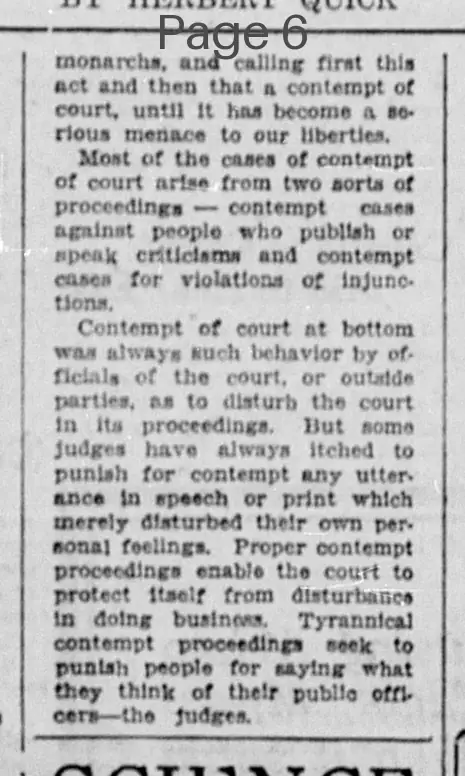
Most of the cases of contempt of court arise from two sorts of proceedings—contempt cases against people who publish or speak criticisms and cases for violations of injunctions.
Contempt of court at bottom was always such behavior by officials of the court, or outside parties, as to disturb the court in its proceedings. But some judges have always itched to punish for contempt any utterance in speech or print which merely disturbed their own personal feelings. Proper contempt proceedings enable the court to protect itself from disturbance in doing business.
Tyrannical contempt proceedings seek to punish people for saying what they think of their public officers—the judges.
The publishing of criticisms of a court does not interfere with its functions. It may make the judge angry, or it may humiliate him, but his court can go on just the same.
And in a democratic government, a court being a part of the government, it is necessary that people's mouths be not shut up as to the inefficiency, the unwisdom or the corruption of the courts. It is not only the right, but it may easily be the duty of any writer or speaker who believes that the courts are corrupt or inefficient, to say so.
Since 1914 the laws of the United States have forbidden contempt proceedings against the publishing of comments on cases pending. But the judges themselves construe these laws, and they have almost construed them away. It is time congress should act again.
Contempt of court at bottom was always such behavior by officials of the court, or outside parties, as to disturb the court in its proceedings. But some judges have always itched to punish for contempt any utterance in speech or print which merely disturbed their own personal feelings. Proper contempt proceedings enable the court to protect itself from disturbance in doing business.
Tyrannical contempt proceedings seek to punish people for saying what they think of their public officers—the judges.
The publishing of criticisms of a court does not interfere with its functions. It may make the judge angry, or it may humiliate him, but his court can go on just the same.
And in a democratic government, a court being a part of the government, it is necessary that people's mouths be not shut up as to the inefficiency, the unwisdom or the corruption of the courts. It is not only the right, but it may easily be the duty of any writer or speaker who believes that the courts are corrupt or inefficient, to say so.
Since 1914 the laws of the United States have forbidden contempt proceedings against the publishing of comments on cases pending. But the judges themselves construe these laws, and they have almost construed them away. It is time congress should act again.
What sub-type of article is it?
Press Freedom
Legal Reform
What keywords are associated?
Contempt Of Court
Judicial Criticism
Free Speech
Press Freedom
Legal Reform
Democratic Oversight
What entities or persons were involved?
Judges
Courts
Congress
Editorial Details
Primary Topic
Defense Of Free Speech Against Contempt Proceedings For Criticizing Courts
Stance / Tone
Critical Of Tyrannical Judicial Use Of Contempt, Advocating For Unrestricted Public Criticism Of Courts
Key Figures
Judges
Courts
Congress
Key Arguments
Contempt Of Court Originally Meant To Protect Proceedings From Disturbance, Not Punish Personal Offense
Publishing Criticisms Of Courts Does Not Interfere With Judicial Functions
In A Democracy, Public Must Be Free To Criticize Court Inefficiency, Unwisdom, Or Corruption
Federal Laws Since 1914 Prohibit Contempt For Publishing On Pending Cases, But Judges Undermine Them
Congress Should Enact Further Measures To Prevent Judicial Overreach