Thank you for visiting SNEWPapers!
Sign up free
Gazette Of The United States & Evening Advertiser
Philadelphia, Philadelphia County, Pennsylvania
What is this article about?
In the U.S. House of Representatives on April 29, members debated the contested election of Francis Preston from Virginia, alleging soldier interference by his brother Captain Preston intimidated Trigg's voters, leading to a narrow Preston victory. Defenders argued it was typical for southern elections and no laws broken.
Clipping
OCR Quality
Full Text
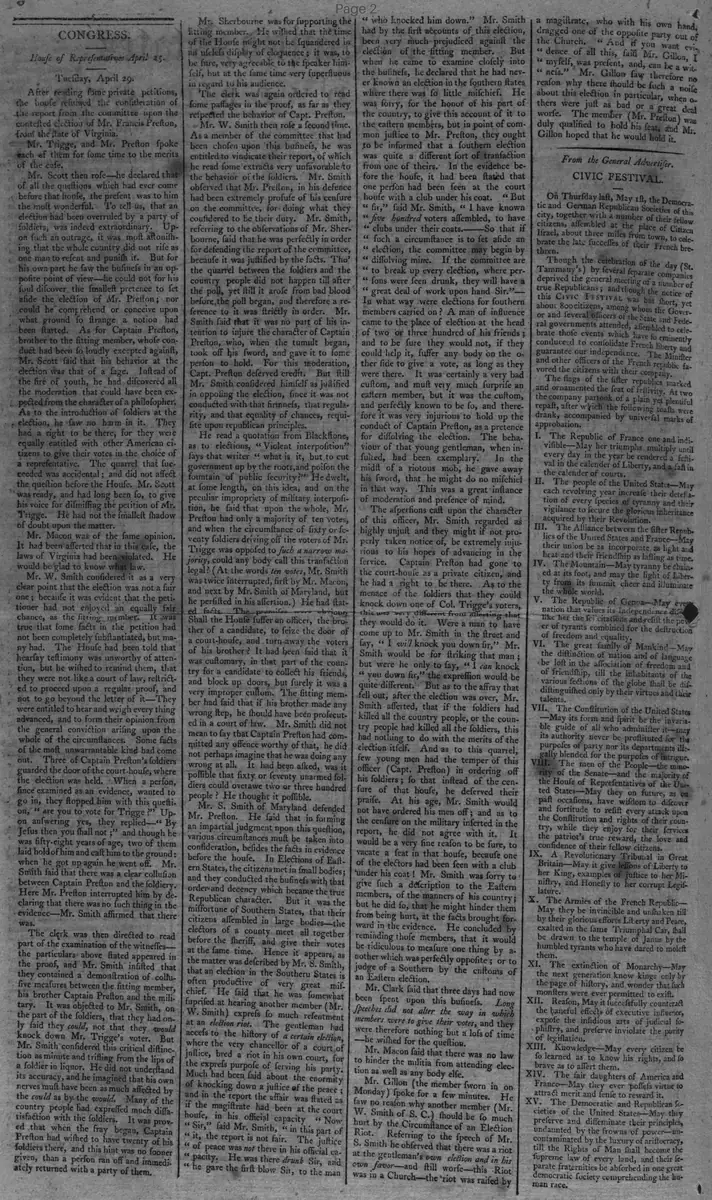
House of Representatives, April
Tuesday, April 29.
After reading some private petitions, the house resumed the consideration of the report from the committee upon the contested election of Mr. Francis Preston, from the state of Virginia.
Mr. Trigg, and Mr. Preston spoke each of them for some time to the merits of the case.
Mr. Scott then rose; he declared that of all the questions which had ever come before that house, the present was to him the most wonderful. To tell us, that an election had been overruled by a party of soldiers, was indeed extraordinary. Upon such an outrage, it was most astonishing that the whole country did not rise as one man to resent and punish it. But for his own part he saw the business in an opposite point of view—he could not for his soul discover the smallest pretence to set aside the election of Mr. Preston; nor could he comprehend or conceive upon what ground so strange a notion had been started. As for Captain Preston, brother to the sitting member, whose conduct had been so loudly excepted against, Mr. Scott said that his behavior at the election was that of a sage. Instead of the fire of youth, he had discovered all the moderation that could have been expected from the character of a philosopher. As to the introduction of soldiers at the election, he saw no harm in it. They had a right to be there, for they were equally entitled with other American citizens to give their votes in the choice of a representative. The quarrel that succeeded was accidental; and did not affect the question before the House. Mr. Scott was ready, and had long been so, to give his voice for dismissing the petition of Mr. Trigg. He had not the smallest shadow of doubt upon the matter.
Mr. Macon was of the same opinion. It had been asserted that in this case, the laws of Virginia had been violated. He would be glad to know what law.
Mr. W. Smith considered it as a very clear point that the election was not a fair one; because it was evident that the petitioner had not enjoyed an equally fair chance, as the sitting member. It was true that some facts in the petition had not been completely substantiated, but many had. The House had been told that hearsay testimony was unworthy of attention, but he wished to remind them, that they were not like a court of law, restricted to proceed upon a regular proof, and not to go beyond the letter of it—They were entitled to hear and weigh every thing advanced, and to form their opinion from the general conviction arising upon the whole of the circumstances. Some facts of the most unwarrantable kind had come out. Three of Captain Preston's soldiers guarded the door of the court-house, where the election was held. When a person, since examined as an evidence, wanted to go in, they stopped him with this question, "are you to vote for Trigg?" Upon answering yes, they replied—“By Jesus then you shall not;” and though he was fifty-eight years of age, two of them laid hold of him and cast him to the ground: when he got up again he went off. Mr. Smith said that there was a clear collusion between Captain Preston and the soldiery. Here Mr. Preston interrupted him by declaring that there was no such thing in the evidence—Mr. Smith affirmed that there was.
The clerk was then directed to read part of the examination of the witnesses—the particulars above stated appeared in the proof, and Mr. Smith insisted that they contained a demonstration of collusive measures between the sitting member, his brother Captain Preston and the military. It was objected to Mr. Smith, on the part of the soldiers, that they had only said they could, not that they would knock down Mr. Trigg's voter. But Mr. Smith considered this critical distinction as minute and trifling from the lips of a soldier in liquor. He did not understand its accuracy, and he imagined that his own nerves must have been as much affected by the could as by the would. Many of the country people had expressed much dissatisfaction with the soldiers. It was proved that when the fray began, Captain Preston had wished to have twenty of his soldiers there, and this hint was no sooner given, than a person ran off and immediately returned with a party of them.
Mr. Sherbourne was for supporting the sitting member. He wished that the time of the House might not be squandered in useless display of eloquence; it was, to be sure, very agreeable to the speaker himself, but at the same time very superfluous in regard to his audience.
The clerk was again ordered to read some passages in the proof, as far as they respected the behavior of Capt. Preston.—Mr. W. Smith then rose a second time. As a member of the committee that had been chosen upon this business, he was entitled to vindicate their report, of which he read some extracts very unfavorable to the behavior of the soldiers. Mr. Smith observed that Mr. Preston, in his defence had been extremely profuse of his censure on the committee, for doing what they considered to be their duty. Mr. Smith, referring to the observations of Mr. Sherbourne, said that he was perfectly in order for defending the report of the committee, because it was justified by the facts. Tho' the quarrel between the soldiers and the country people did not happen till after the poll, yet still it arose from bad blood before, the poll began, and therefore a reference to it was strictly in order. Mr. Smith said that it was no part of his intention to injure the character of Captain Preston, who, when the tumult began, took off his sword, and gave it to some person to hold. For this moderation, Capt. Preston deserved credit. But still Mr. Smith considered himself as justified in opposing the election, since it was not conducted with that firmness, that regularity, and that equality of chances, requisite upon republican principles.
He read a quotation from Blackstone, as to elections, "Violent interposition" says that writer "what is it, but to cut government up by the roots, and poison the fountain of public security?" He dwelt, at some length, on this idea, and on the peculiar impropriety of military interposition, he said that upon the whole, Mr. Preston had only a majority of ten votes, and when the circumstance of sixty or seventy soldiers driving off the voters of Mr. Trigg was opposed to such a narrow majority, could any body call this transaction legal? (At the words ten votes, Mr. Smith was twice interrupted, first by Mr. Macon, and next by Mr. Smith of Maryland, but he persisted in his assertion.) He had stated facts. The premises more obvious Shall the House suffer an officer, the brother of a candidate, to seize the door of a court-house, and turn away the voters of his brother? It had been said that it was customary, in that part of the country for a candidate to collect his friends, and block up doors, but surely it was a very improper custom. The sitting member had said that if his brother made any wrong step, he should have been prosecuted in a court of law. Mr. Smith did not mean to say that Captain Preston had committed any offence worthy of that, he did not perhaps imagine that he was doing any wrong at all. It had been asked, was it possible that sixty or seventy unarmed soldiers could overawe two or three hundred people? He thought it possible.
Mr. S. Smith of Maryland defended Mr. Preston. He said that in forming an impartial judgment upon this question, various circumstances must be taken into consideration, besides the facts in evidence before the house. In Elections of Eastern States, the citizens met in small bodies; and they conducted the business with that order and decency which became the true Republican character. But it was the misfortune of Southern States, that their citizens assembled in large bodies—the electors of a county meet all together before the sheriff, and give their votes at the same time. Hence it appears, as the matter was described by Mr. S. Smith, that an election in the Southern States is often productive of very great mischief. He said that he was somewhat surprised at hearing another member (Mr. W. Smith) express so much resentment at an election riot. The gentleman had access to the history of a certain election, where the very chancellor of a court of justice, bred a riot in his own court, for the express purpose of serving his party. Much had been said about the enormity of knocking down a justice of the peace; and in the report the affair was stated as if the magistrate had been at the court house, in his official capacity "Now Sir," said Mr. Smith, "in this part of it, the report is not fair. The justice of peace was not there in his official capacity. He was there drunk Sir, and he gave the first blow Sir, to the man who knocked him down."
Mr. Smith had by the first accounts of this election, been very much prejudiced against the election of the sitting member. But when he came to examine closely into the business, he declared that he had never known an election in the southern states where there was so little mischief. He was sorry, for the honor of his part of the country, to give this account of it to the eastern members, but in point of common justice to Mr. Preston, they ought to be informed that a southern election was quite a different sort of transaction from one of theirs. In the evidence before the house, it had been stated that one person had been seen at the court house with a club under his coat. "But Sir," said Mr. Smith, "I have known five hundred voters assembled, to have clubs under their coats.—So that if such a circumstance is to set aside an election, the committee may begin by dissolving mirre. If the committee are to break up every election, where persons were seen drunk, they will have a great deal of work upon hand Sir."
In what way were elections for southern members carried on? A man of influence came to the place of election at the head of two or three hundred of his friends; and to be sure they would not, if they could help it, suffer any body on the other side to give a vote, as long as they were there. It was certainly a very bad custom, and must very much surprise an eastern member, but it was the custom, and perfectly known to be so, and therefore it was very injurious to hold up the conduct of Captain Preston, as a pretence for dissolving the election. The behaviour of that young gentleman, when insulted, had been exemplary. In the midst of a riotous mob, he gave away his sword, that he might do no mischief in that way. This was a great instance of moderation and presence of mind.
The aspersions cast upon the character of this officer, Mr. Smith regarded as highly unjust and they might if not properly taken notice of, be extremely injurious to his hopes of advancing in the service. Captain Preston had gone to the court-house as a private citizen, and he had a right to be there. As to the menace of the soldiers that they could knock down one of Col. Trigg's voters, this was very different from asserting that they would do it. Were a man to have come up to Mr. Smith in the street and say, "I will knock you down Sir,". Mr. Smith would be for striking that man; but were he only to say, "I can knock you down Sir," the expression would be quite different. But as to the affray that fell out, after the election was over, Mr. Smith asserted, that if the soldiers had killed all the country people, or the country people had killed all the soldiers, this had nothing to do with the merits of the election itself. And as to this quarrel, few young men had the temper of this officer (Capt. Preston) in ordering off his soldiers; so that instead of the censure of that house, he deserved their praise. At his age, Mr. Smith would not have ordered his men off; and as to the censure on the military inserted in the report, he did not agree with it. It would be a very fine reason to be sure, to vacate a seat in that house, because one of the electors had been seen with a club under his coat! Mr. Smith was sorry to give such a description to the Eastern members, of the manners of his country; but he did so, that he might hinder them from being hurt, at the facts brought forward in the evidence. He concluded by reminding those members, that it would be ridiculous to measure one thing by another which was perfectly opposite; or to judge of a Southern by the customs of an Eastern election.
Mr. Clark said that three days had now been spent upon this business. Long speeches did not alter the way in which members were to give their votes, and they were therefore nothing but a loss of time—he wished for the question.
Mr. Macon said that there was no law to hinder the militia from attending election as well as any body else.
Mr. Gillon (the member sworn in on Monday) spoke for a few minutes. He saw no reason why another member (Mr. W. Smith of S. C.) should be so much hurt by the circumstance of an Election Riot. Referring to the speech of Mr. S. Smith he observed that there was a riot at the gentleman's own election and in his own favor—and still worse—this Riot was in a Church—the riot was raised by a magistrate, who with his own hand dragged one of the opposite party out of the Church. "And if you want evidence of all this," said Mr. Gillon, "I myself, was present, and, can be a witness." Mr. Gillon saw therefore no reason why there should be such a noise about this election in particular, when others were just as bad or a great deal worse. The member (Mr. Preston) was duly qualified to hold his seat, and Mr. Gillon hoped that he would hold it.
What sub-type of article is it?
What themes does it cover?
What keywords are associated?
What entities or persons were involved?
Where did it happen?
Story Details
Key Persons
Location
Virginia
Event Date
Tuesday, April 29
Story Details
Debate in the House of Representatives on the contested election of Francis Preston from Virginia, where allegations of military interference by his brother Captain Preston's soldiers intimidated Trigg's voters, resulting in a narrow victory for Preston. Speakers debated fairness, southern election customs, and whether laws were violated.