Thank you for visiting SNEWPapers!
Sign up free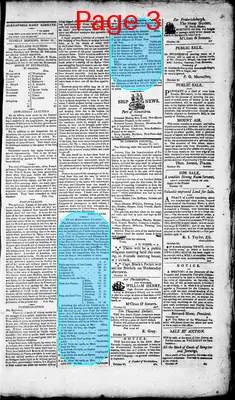
Alexandria Daily Gazette, Commercial & Political
Alexandria, Virginia
What is this article about?
Astronomical observations and calculations of a comet's position, distances from sun, planets, and stars, tail length estimates, and travel distance since September 8, 1811, dated October 19, 1811, using Rawling's tables.
Merged-components note: The comet data table and subsequent text on observations and calculations form a single coherent story on the comet's usefulness and distance.
Clipping
OCR Quality
Full Text
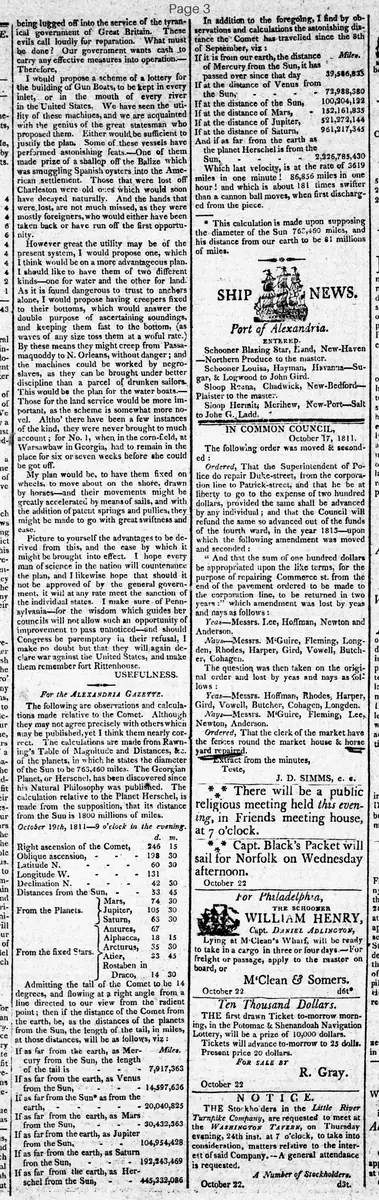
| Right ascension of the Comet, | 246 | 15 |
| Oblique ascension, | 198 | 30 |
| Latitude N. | 60 | 30 |
| Longitude W. | 131 | |
| Declination N. | 42 | 30 |
| Distances from the Sun, | 53 | 45 |
| From the Planets. | Mars, | 74 |
| Jupiter, | 105 | |
| Saturn, | 63 | |
| Antures, | 67 | |
| Alphacca, | 18 | |
| From the fixed Stars. | Arcturus, | 35 |
| Atier, | 33 | |
| Rostaben in | ||
| Draco, | 14 |
USEFULNESS.
For the ALEXANDRIA GAZETTE.
The following are observations and calculations made relative to the Comet. Although they may not agree precisely with others which may be published, yet I think them nearly correct. The calculations are made from Rawling's Table of Magnitude and Distances, &c. of the planets, in which he states the diameter of the Sun to be 763,460 miles. The Georgian Planet, or Herschel, has been discovered since his Natural Philosophy was published. The calculation relative to the Planet Herschel, is made from the supposition, that its distance from the Sun is 1800 millions of miles.
October 19th, 1811—9 o'clock in the evening
Admitting the tail of the Comet to be 14 degrees, and flowing at a right angle from a line directed to our view from the radiant point; then if the distance of the Comet from the earth, be, as the distances of the planets from the Sun, the length of the tail, in miles, at those distances, will be as follows, viz:
If as far from the earth, as Mercury from the Sun, the length of the tail is 7,917,363 Miles.
If as far from the earth, as Venus from the Sun, 14,597,636
If as far from the Sun as from the earth, 20,040,825
If as far from the earth, as Mars from the Sun, 30,432,363.
If as far from the earth, as Jupiter from the Sun, 104,954,428:
If as far from the earth, as Saturn from the Sun, 192,243,469
If as far from the earth, as Herschel from the Sun, 445,332,086
In addition to the foregoing, I find by observations and calculations the astonishing distance the Comet has travelled since the 8th of September, viz:
If it is from our earth, the distance of Mercury from the Sun, it has passed over since that day 39,586,835 Miles.
If at the distance of Venus from the Sun, 72,988,380
If at the distance of the Sun 100,204,122
If at the distance of Mars, 152,161,835
If at the distance of Jupiter, 521,272,144
If at the distance of Saturn, 961,217,345
And if as far from the earth as the planet Herschel is from the Sun, 2,226,785,430
Which last velocity, is at the rate of 3619 miles in one minute! 86,856 miles in one hour! and which is about 181 times swifter than a cannon ball moves, when first discharged from the piece.
* This calculation is made upon supposing the diameter of the Sun 760,450 miles, and his distance from our earth to be 81 millions of miles.
What sub-type of article is it?
What themes does it cover?
What keywords are associated?
Story Details
Event Date
October 19th, 1811
Story Details
Observations and calculations of the comet's right ascension, declination, distances from sun, planets, and stars; estimates of tail length and distance traveled since September 8, 1811, at various planetary distances, highlighting its immense speed.