Thank you for visiting SNEWPapers!
Sign up free
West Virginia Argus
Kingwood, Preston County, West Virginia
What is this article about?
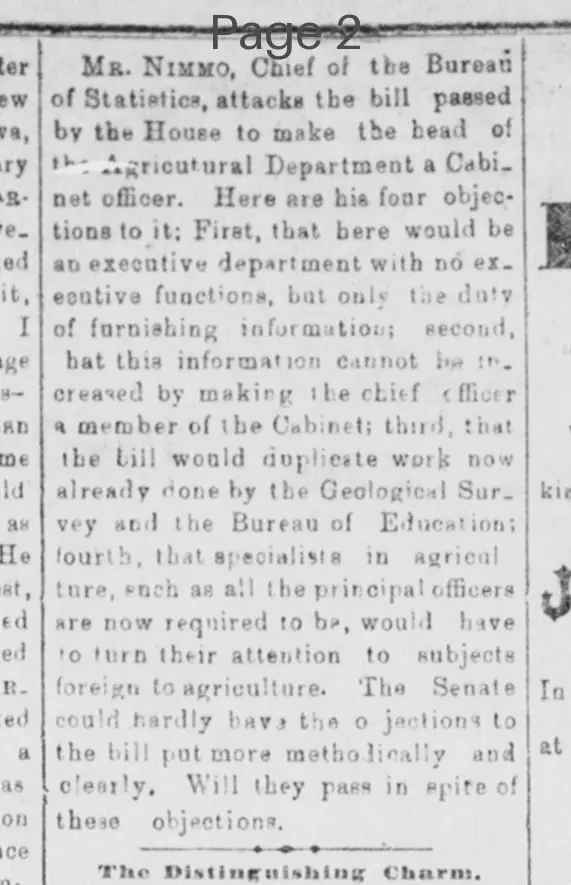
Mr. Nimmo, Chief of the Bureau of Statistics, raises four objections to a House-passed bill elevating the head of the agricultural Department to Cabinet status, arguing it lacks executive functions, won't improve information, duplicates existing work, and diverts agricultural specialists. The Senate may still pass it.
Clipping
OCR Quality
Full Text
What sub-type of article is it?
What keywords are associated?
What entities or persons were involved?
Domestic News Details
Key Persons
Outcome
the senate could hardly have put the objections to the bill more methodically and clearly. will they pass it in spite of these objections.
Event Details
Mr. Nimmo, Chief of the Bureau of Statistics, attacks the bill passed by the House to make the head of the agricultural Department a Cabinet officer. Here are his four objections to it: First, that there would be an executive department with no executive functions, but only the duty of furnishing information; second, that this information cannot be increased by making the Chief officer a member of the Cabinet; third, that the bill would duplicate work now already done by the Geological Survey and the Bureau of Education; fourth, that specialists in agriculture, such as all the principal officers are now required to be, would have to turn their attention to subjects foreign to agriculture.