Thank you for visiting SNEWPapers!
Sign up free
Literary
May 4, 1786
Fowle's New Hampshire Gazette And General Advertiser
Portsmouth, Rockingham County, New Hampshire
What is this article about?
Joseph Greenleaf's 1785 letter to John Clarke details an experiment successfully raising Indian corn on poor, sandy land using an innovative light plough, minimal labor (one horse, two boys), and no manure. Over three years, yields increased, outperforming a neighboring well-manured field, challenging beliefs about exhausted soil.
Clipping
OCR Quality
95%
Excellent
Full Text
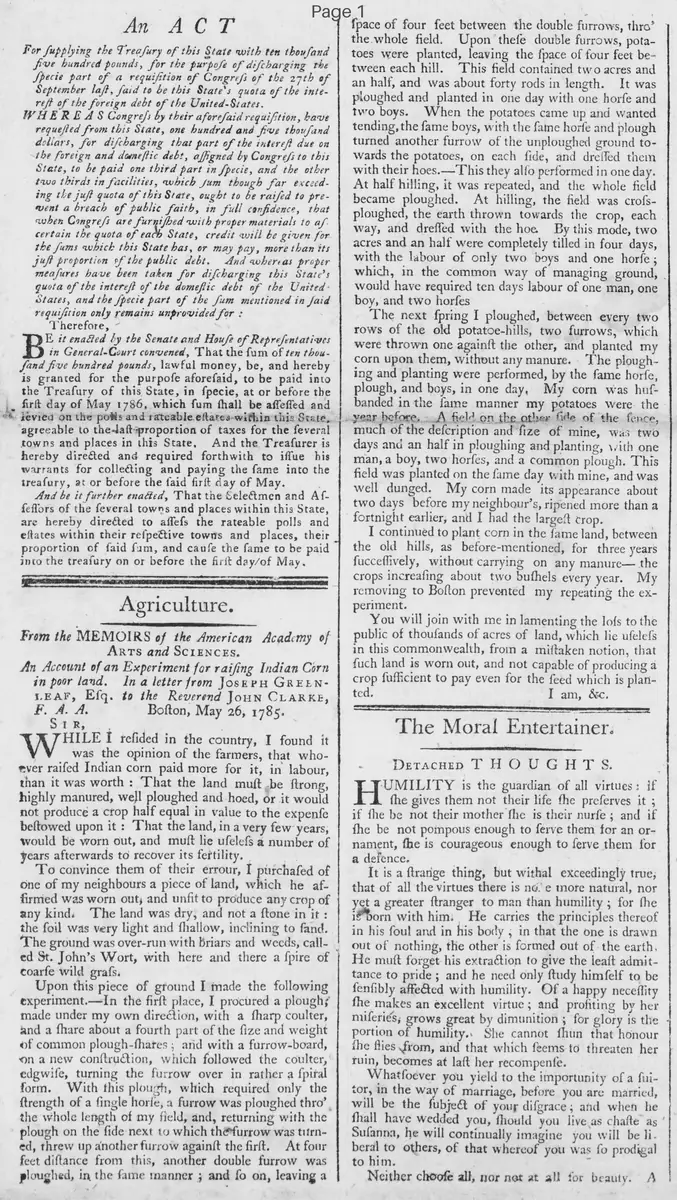
Agriculture.
From the MEMOIRS of the American Academy of Arts and Sciences.
An Account of an Experiment for raising Indian Corn in poor land. In a letter from JOSEPH GREENLEAF, Esq. to the Reverend JOHN CLARKE, F. A. A.
Boston, May 26, 1785.
SIR,
WHILE I resided in the country, I found it was the opinion of the farmers, that whoever raised Indian corn paid more for it, in labour, than it was worth: That the land must be strong, highly manured, well ploughed and hoed, or it would not produce a crop half equal in value to the expense bestowed upon it: That the land, in a very few years, would be worn out, and must lie useless a number of years afterwards to recover its fertility.
To convince them of their error, I purchased of one of my neighbours a piece of land, which he affirmed was worn out, and unfit to produce any crop of any kind. The land was dry, and not a stone in it: the soil was very light and shallow, inclining to sand. The ground was over-run with briars and weeds, called St. John's Wort, with here and there a sprig of coarse wild grass.
Upon this piece of ground I made the following experiment. In the first place, I procured a plough, made under my own direction, with a sharp coulter, and a share about a fourth part of the size and weight of common plough-shares; and with a furrow-board, on a new construction, which followed the coulter, edgewise, turning the furrow over in rather a spiral form. With this plough, which required only the strength of a single horse, a furrow was ploughed thro' the whole length of my field, and, returning with the plough on the side next to which the furrow was turned, threw up another furrow against the first. At four feet distance from this, another double furrow was ploughed, in the same manner; and so on, leaving a space of four feet between the double furrows thro' the whole field. Upon these double furrows, potatoes were planted, leaving the space of four feet between each hill. This field contained two acres and an half, and was about forty rods in length. It was ploughed and planted in one day with one horse and two boys. When the potatoes came up and wanted tending, the same boys, with the same horse and plough turned another furrow of the unploughed ground towards the potatoes, on each side, and dressed them with their hoes. This they also performed in one day. At half hilling, it was repeated, and the whole field became ploughed. At hilling, the field was cross-ploughed, the earth thrown towards the crop, each way, and dressed with the hoe. By this mode, two acres and an half were completely tilled in four days, with the labour of only two boys and one horse; which, in the common way of managing ground, would have required ten days labour of one man, one boy, and two horses.
The next spring I ploughed, between every two rows of the old potatoe-hills, two furrows, which were thrown one against the other, and planted my corn upon them, without any manure. The ploughing and planting were performed, by the same horse, plough, and boys, in one day. My corn was husbanded in the same manner my potatoes were the year before. A field on the other side of the fence, much of the description and size of mine, was two days and an half in ploughing and planting, with one man, a boy, two horses, and a common plough. This field was planted on the same day with mine, and was well dunged. My corn made its appearance about two days before my neighbour's, ripened more than a fortnight earlier, and I had the largest crop.
I continued to plant corn in the same land, between the old hills, as before-mentioned, for three years successively, without carrying on any manure-- the crops increasing about two bushels every year. My removing to Boston prevented my repeating the experiment.
You will join with me in lamenting the loss to the public of thousands of acres of land, which lie useless in this commonwealth, from a mistaken notion, that such land is worn out, and not capable of producing a crop sufficient to pay even for the seed which is planted.
I am, &c.
From the MEMOIRS of the American Academy of Arts and Sciences.
An Account of an Experiment for raising Indian Corn in poor land. In a letter from JOSEPH GREENLEAF, Esq. to the Reverend JOHN CLARKE, F. A. A.
Boston, May 26, 1785.
SIR,
WHILE I resided in the country, I found it was the opinion of the farmers, that whoever raised Indian corn paid more for it, in labour, than it was worth: That the land must be strong, highly manured, well ploughed and hoed, or it would not produce a crop half equal in value to the expense bestowed upon it: That the land, in a very few years, would be worn out, and must lie useless a number of years afterwards to recover its fertility.
To convince them of their error, I purchased of one of my neighbours a piece of land, which he affirmed was worn out, and unfit to produce any crop of any kind. The land was dry, and not a stone in it: the soil was very light and shallow, inclining to sand. The ground was over-run with briars and weeds, called St. John's Wort, with here and there a sprig of coarse wild grass.
Upon this piece of ground I made the following experiment. In the first place, I procured a plough, made under my own direction, with a sharp coulter, and a share about a fourth part of the size and weight of common plough-shares; and with a furrow-board, on a new construction, which followed the coulter, edgewise, turning the furrow over in rather a spiral form. With this plough, which required only the strength of a single horse, a furrow was ploughed thro' the whole length of my field, and, returning with the plough on the side next to which the furrow was turned, threw up another furrow against the first. At four feet distance from this, another double furrow was ploughed, in the same manner; and so on, leaving a space of four feet between the double furrows thro' the whole field. Upon these double furrows, potatoes were planted, leaving the space of four feet between each hill. This field contained two acres and an half, and was about forty rods in length. It was ploughed and planted in one day with one horse and two boys. When the potatoes came up and wanted tending, the same boys, with the same horse and plough turned another furrow of the unploughed ground towards the potatoes, on each side, and dressed them with their hoes. This they also performed in one day. At half hilling, it was repeated, and the whole field became ploughed. At hilling, the field was cross-ploughed, the earth thrown towards the crop, each way, and dressed with the hoe. By this mode, two acres and an half were completely tilled in four days, with the labour of only two boys and one horse; which, in the common way of managing ground, would have required ten days labour of one man, one boy, and two horses.
The next spring I ploughed, between every two rows of the old potatoe-hills, two furrows, which were thrown one against the other, and planted my corn upon them, without any manure. The ploughing and planting were performed, by the same horse, plough, and boys, in one day. My corn was husbanded in the same manner my potatoes were the year before. A field on the other side of the fence, much of the description and size of mine, was two days and an half in ploughing and planting, with one man, a boy, two horses, and a common plough. This field was planted on the same day with mine, and was well dunged. My corn made its appearance about two days before my neighbour's, ripened more than a fortnight earlier, and I had the largest crop.
I continued to plant corn in the same land, between the old hills, as before-mentioned, for three years successively, without carrying on any manure-- the crops increasing about two bushels every year. My removing to Boston prevented my repeating the experiment.
You will join with me in lamenting the loss to the public of thousands of acres of land, which lie useless in this commonwealth, from a mistaken notion, that such land is worn out, and not capable of producing a crop sufficient to pay even for the seed which is planted.
I am, &c.
What sub-type of article is it?
Epistolary
Essay
What themes does it cover?
Agriculture Rural
What keywords are associated?
Indian Corn
Poor Land
Agricultural Experiment
Efficient Ploughing
Soil Fertility
Labor Saving
Crop Yield
What entities or persons were involved?
Joseph Greenleaf, Esq.
Literary Details
Title
An Account Of An Experiment For Raising Indian Corn In Poor Land
Author
Joseph Greenleaf, Esq.
Subject
Experiment For Raising Indian Corn In Poor Land
Key Lines
To Convince Them Of Their Error, I Purchased Of One Of My Neighbours A Piece Of Land, Which He Affirmed Was Worn Out, And Unfit To Produce Any Crop Of Any Kind.
By This Mode, Two Acres And An Half Were Completely Tilled In Four Days, With The Labour Of Only Two Boys And One Horse; Which, In The Common Way Of Managing Ground, Would Have Required Ten Days Labour Of One Man, One Boy, And Two Horses.
My Corn Made Its Appearance About Two Days Before My Neighbour's, Ripened More Than A Fortnight Earlier, And I Had The Largest Crop.
I Continued To Plant Corn In The Same Land... For Three Years Successively, Without Carrying On Any Manure The Crops Increasing About Two Bushels Every Year.
You Will Join With Me In Lamenting The Loss To The Public Of Thousands Of Acres Of Land, Which Lie Useless In This Commonwealth, From A Mistaken Notion...