Thank you for visiting SNEWPapers!
Sign up free
The National Republican And Ohio Political Register
Cincinnati, Hamilton County, Ohio
What is this article about?
A letter from Thomas M. Randolph to the Virginia Advocate editors details Thomas Jefferson's 1825 expressed preference for General Andrew Jackson as a future leader to counter constitutional overreach, praising Jackson's character and principles, while noting Jefferson's views on Adams, Clay, and Crawford during the 1824 election.
Clipping
OCR Quality
Full Text
Mr. Jefferson's opinion of General Jackson.
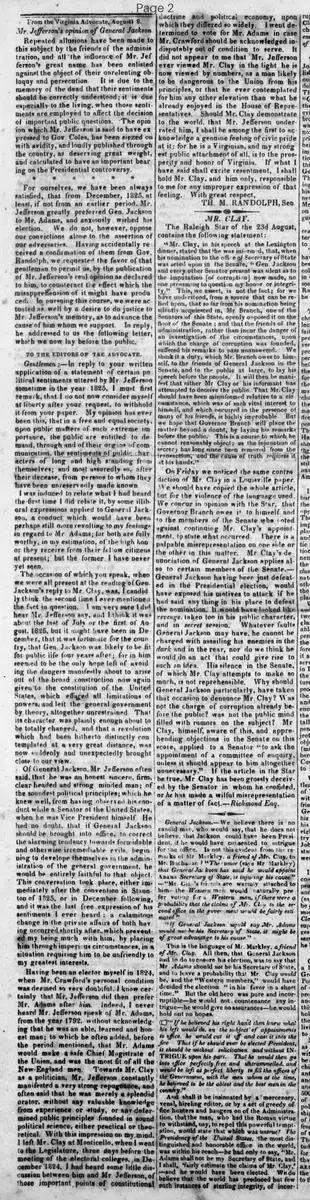
Repeated allusions have been made to this subject by the friends of the administration, and all the influence of Mr. Jefferson's great name has been enlisted against the object of their unrelenting obloquy and persecution. It is due to the memory of the dead that their sentiments should be correctly understood; it is due especially to the living, when those sentiments are employed to affect the decision of important public questions. The opinion which Mr. Jefferson is said to have expressed to Gov. Coles, has been seized on with avidity, and loudly published through the country, as deserving great weight, and calculated to have an important bearing on the Presidential controversy.
For ourselves, we have been always satisfied, that from December, 1825, at least, if not from an earlier period, Mr. Jefferson greatly preferred Gen. Jackson to Mr. Adams, and anxiously wished his election. We do not, however, oppose our convictions alone to the assertion of our adversaries. Having accidentally received a confirmation of them from Gov. Randolph, we requested the favor of that gentleman to permit us, by the publication of Mr. Jefferson's real opinion as declared to him, to counteract the effect which the misapprehension of it might have produced. In pursuing this course, we were actuated as well by a desire to do justice to Mr. Jefferson's memory, as to advance the cause of him whom we support. In reply, he addressed to us the following letter, which we now lay before the public.
TO THE EDITORS OF THE ADVOCATE.
Gentlemen: In reply to your written application of a statement of certain political sentiments uttered by Mr. Jefferson sometime in the year 1825, I must first remark, that I do not now consider myself at liberty after your request, to withhold it from your paper. My opinion has ever been this, that in a free and equal society upon public matters of such extreme importance, the public are entitled to demand, through and of their organs of communication, the sentiments of public characters of long and high standing from themselves; and most assuredly so, after their decease, from persons to whom they have been unreservedly made known.
I was induced to relate what I had heard the first time I did relate it, by some illiberal expressions applied to General Jackson, a conduct which would have been perhaps still more revolting to my feelings in regard to Mr. Adams; for both are fully worthy, in my estimation, of the high honor they receive from their fellow citizens at present; but the former I have never yet seen.
The occasion of which you speak, when we were all present at the reading of Gen. Jackson's reply to Mr. Clay, was, I candidly think, the second time I ever mentioned the fact in question. I am very sure I did hear Mr. Jefferson say, and I think it was about the last of July or the first of August, 1825, but it was might have been in December, that it was fortunate for the country, that Gen. Jackson was likely to be fit for public life four years after: for in him seemed to be the only hope left of avoiding the dangers manifestly about to arise out of the broad construction now again given to the constitution of the United States, which effaced all limitations of powers, and left the general government by theory, altogether unrestrained. That its character was plainly enough about to be totally changed, and that a revolution which had been hitherto distinctly contemplated at a very great distance, was now suddenly and unexpectedly brought close to our view.
Of General Jackson, Mr. Jefferson often said, that he was an honest, sincere, firm, clear headed and strong minded man; of the soundest political principles; which he knew well, from having observed his conduct while a Senator of the United States, when he was Vice President himself. He had no doubt, that if General Jackson should be brought into office, to correct the alarming tendency towards formidable and otherwise irremediable evils, beginning to develope themselves in the administration of the general government, he would be entirely faithful to that object.
This conversation took place, either immediately after the convention in Staunton of 1825, or in December following, and it was the last free expression of his sentiments I ever heard: a calamitous change in the private affairs of both having occurred shortly after, which prevented my being much with him, by placing him through imperious circumstances, in a situation requiring him to be unfriendly to my greatest interests.
Having been an elector myself in 1824, when Mr. Crawford's personal condition was deemed so very doubtful, I know certainly that Mr. Jefferson did then prefer Mr. Adams after him. Indeed, I never heard Mr. Jefferson speak of Mr. Adams, from the year 1792, without acknowledging that he was an able, learned and honest man; to which he often added, before the period mentioned, that Mr. Adams would make a safe Chief Magistrate of the Union, and was the most fit of all the New-England men. Towards Mr. Clay as a politician, Mr. Jefferson constantly manifested a very strong repugnance, and often said that he was merely a splendid orator, without any valuable knowledge from experience or study, or any determined public principles sounded in sound political science, either practical or theoretical. With this impression on my mind, I left Mr. Clay at Monticello, when I went to the Legislature, three days before the meeting of the electoral colleges, in December 1824. I had heard some little discussion between him and Mr. Jefferson, of those important points of constitutional doctrine and political economy, upon which they differed so widely. I went determined to vote for Mr. Adams in case Mr. Crawford should be acknowledged indisputably out of condition to serve. It did not appear to me that Mr. Jefferson ever viewed Mr. Clay in the light he is now viewed by numbers, as a man likely to be dangerous to the Union from his principles, or that he ever contemplated for him any other elevation than what he already enjoyed in the House of Representatives. Should Mr. Clay demonstrate to the world that Mr. Jefferson underrated him, I shall be among the first to acknowledge a genuine feeling of civic pride at it: for he is a Virginian, and my strongest public attachment of all, is to the prosperity and honor of Virginia. If what I have said shall excite resentment, I shall hold Mr. Clay, and him only, responsible to me for any improper expression of that feeling.
With great respect,
TH. M. RANDOLPH, Sen.
What sub-type of article is it?
What themes does it cover?
What keywords are associated?
What entities or persons were involved?
Where did it happen?
Story Details
Key Persons
Location
Monticello, Virginia; Staunton
Event Date
1825; December 1824
Story Details
Thomas M. Randolph recounts Thomas Jefferson's 1825 conversations praising Andrew Jackson's character and suitability to counter constitutional overreach, preferring him over Adams by late 1825, while detailing Jefferson's 1824 preferences for Adams over Crawford and his disdain for Clay.