Thank you for visiting SNEWPapers!
Sign up free
Editorial
January 20, 1758
The New Hampshire Gazette
Portsmouth, Rockingham County, New Hampshire
What is this article about?
An anonymous editorial from London critiques national corruption, luxury, and moral decay as precursors to ruin, urging reformation through taxing vices to fund the ongoing war, ministerial unity, legal reform, and shorter parliamentary terms to preserve the constitution and empire.
Clipping
OCR Quality
98%
Excellent
Full Text
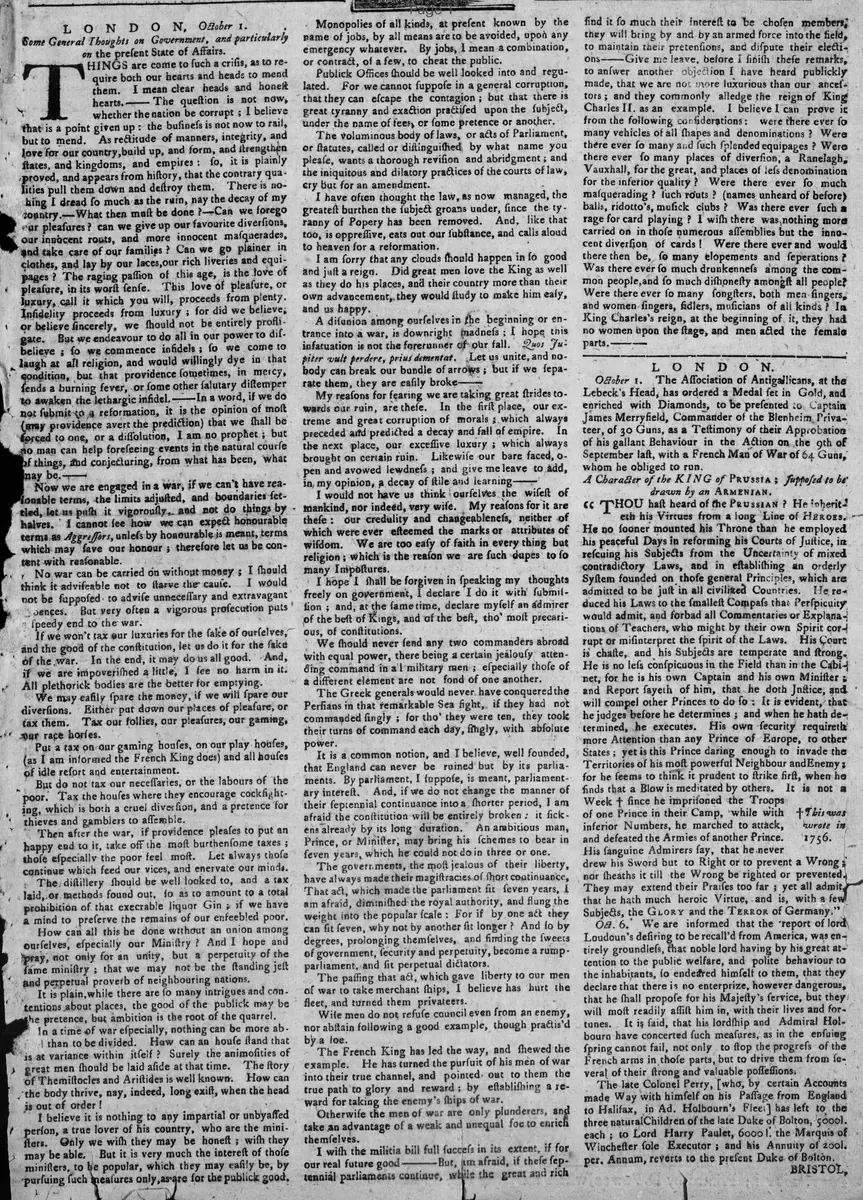
LONDON, October 1.
Some General Thoughts on Government, and particularly on the present State of Affairs.
Things are come to such a crisis, as to require both our hearts and heads to mend them. I mean clear heads and honest hearts. The question is not now, whether the nation be corrupt; I believe that is a point given up: the business is not now to rail, but to mend. As rectitude of manners, integrity, and love for our country, build up, and form, and strengthen states, and kingdoms, and empires: so, it is plainly proved, and appears from history, that the contrary qualities pull them down and destroy them. There is nothing I dread so much as the ruin, nay the decay of my country.--What then must be done?--Can we forego our pleasures? can we give up our favourite diversions, our innocent routs, and more innocent masquerades, and take care of our families? Can we go plainer in clothes, and lay by our laces, our rich liveries and equipages? The raging passion of this age, is the love of pleasure, in its worst sense. This love of pleasure, or luxury, call it which you will, proceeds from plenty. Infidelity proceeds from luxury; for did we believe, or believe sincerely, we should not be entirely profligate. But we endeavour to do all in our power to disbelieve; so we commence infidels; so we come to laugh at all religion, and would willingly die in that condition, but that providence sometimes, in mercy, ends a burning fever, or some other salutary distemper to awaken the lethargic infidel.----In a word, if we do not submit to a reformation, it is the opinion of most (may providence avert the prediction) that we shall be forced to one, or a dissolution, I am no prophet; but no man can help foreseeing events in the natural course of things, and conjecturing, from what has been, what may be...
Now we are engaged in a war, if we can't have reasonable terms, the limits adjusted, and boundaries settled, let us push it vigorously, and not do things by halves. I cannot see how we can expect honourable terms as Aggressors, unless by honourable is meant, terms which may save our honour; therefore let us be content with reasonable.
No war can be carried on without money; I should think it advisable not to starve the cause. I would not be supposed to advise unnecessary and extravagant expenses. But very often a vigorous prosecution puts a speedy end to the war.
If we won't tax our luxuries for the sake of ourselves, and the good of the constitution, let us do it for the sake of the war. In the end, it may do us all good. - And, if we are impoverished a little, I see no harm in it. All plethoric bodies are the better for emptying.
We may easily pare the money, if we will pare our diversions. Either put down our places of pleasure, or tax them. Tax our follies, our pleasures, our gaming, our race horses.
Put a tax on our gaming houses, on our play-houses (as I am informed the French King does) and all houses of idle resort and entertainment.
But do not tax our necessaries, or the labours of the poor. Tax the houses where they encourage cock-fighting, which is both a cruel diversion, and a pretence for thieves and gamblers to assemble.
Then after the war, if providence pleases to put an happy end to it, take off the most burdensome taxes; those especially the poor feel most. Let always those continue which feed our vices, and enervate our minds.
The distillery should be well looked to, and a tax laid, or methods found out, so as to amount to a total prohibition of that execrable liquor Gin; if we have a mind to preserve the remains of our enfeebled poor.
How can all this be done without an union among ourselves, especially our Ministry? And I hope and pray, not only for an unity, but a perpetuity of the same ministry: that we may not be the standing jest and perpetual proverb of neighbouring nations.
It is plain, while there are so many intrigues and contentions about places, the good of the publick may be the pretence, but ambition is the root of the quarrel.
In a time of war especially, nothing can be more absurd than to be divided. How can a house stand that is at variance within itself? Surely the animosities of great men should be laid aside at that time. The story of Themistocles and Aristides is well known. How can the body thrive, nay, indeed, long exist, when the head is out of order!
I believe it is nothing to any impartial or unbiased person, a true lover of his country, who are the ministers. Only we wish they may be honest; wish they may be able. But it is very much the interest of those ministers, to be popular, which they may easily be, by pursuing such measures only, as are for the publick good.
Monopolies of all kinds, at present known by the name of jobs, by all means are to be avoided, upon any emergency whatever. By jobs, I mean a combination, or contract, of a few, to cheat the public.
Publick Offices should be well looked into and regulated. For we cannot suppose in a general corruption, that they can escape the contagion; but that there is great tyranny and exaction practised upon the subject, under the name of fees, or some pretence or another.
The voluminous body of laws, or acts of Parliament, or statutes, called or distinguished by what name you please, wants a thorough revision and abridgment; and the iniquitous and dilatory practices of the courts of law, cry but for an amendment.
I have often thought the law, as now managed, the greatest burthen the subject groans under, since the tyranny of Popery has been removed. And, like that too, is oppressive, eats out our substance, and calls aloud to heaven for a reformation.
- I am sorry that any clouds should happen in so good and just a reign. Did great men love the King as well as they do his places, and their country more than their own advancement, they would study to make him easy, and us happy.
A disunion among ourselves in the beginning or entrance into a war, is downright madness; I hope this infatuation is not the forerunner of our fall. Quos Jupiter vult perdere, prius dementat. Let us unite, and nobody can break our bundle of arrows; but if we separate them, they are easily broke.
My reasons for fearing we are taking great strides towards our ruin, are these. In the first place, our extreme and great corruption of morals; which always preceded and predicted a decay and fall of empire. In the next place, our excessive luxury; which always brought on certain ruin. Likewise our bare faced, open and avowed lewdness; and give me leave to add, in my opinion, a decay of taste and learning.
I would not have us think ourselves the wisest of mankind, nor indeed, very wise. My reasons for it are these: our credulity and changeableness, neither of which were ever esteemed the marks or attributes of wisdom. We are too easy of faith in every thing but religion; which is the reason we are such dupes to so many Impostures.
I hope I shall be forgiven in speaking my thoughts freely on government, I declare I do it with submission: and, at the same time, declare myself an admirer of the best of Kings, and of the best, tho' most precarious, of constitutions.
We should never send any two commanders abroad with equal power, there being a certain jealousy attending command in all military men; especially those of a different element are not fond of one another.
The Greek generals would never have conquered the Persians in that remarkable Sea fight, if they had not commanded singly; for tho' they were ten, they took their turns of command each day, singly, with absolute power.
It is a common notion, and I believe, well founded, that England can never be ruined but by its parliaments. By parliament, I suppose, is meant, parliamentary interest. And, if we do not change the manner of their septennial continuance into a shorter period, I am afraid the constitution will be entirely broken: it sickens already by its long duration. An ambitious man, Prince, or Minister, may bring his schemes to bear in seven years, which he could not do in three or one.
The governments, the most jealous of their liberty, have always made their magistracies of short continuance.
That act, which made the parliament sit seven years, I am afraid, diminished the royal authority, and flung the weight into the popular scale: For if by one act they can sit seven, why not by another sit longer? And so by degrees, prolonging themselves, and finding the sweets of government, security and perpetuity, become a rump-parliament, and sit perpetual dictators.
The passing that act, which gave liberty to our men of war to take merchant ships, I believe has hurt the fleet, and turned them privateers.
Wise men do not refuse counsel even from an enemy, nor abstain following a good example, though practis'd by a foe.
The French King has led the way, and shewed the example. He has turned the pursuit of his men of war into their true channel, and pointed out to them the true path to glory and reward; by establishing a reward for taking the enemy's ships of war.
Otherwise the men of war are only plunderers, and take an advantage of a weak and unequal foe to enrich themselves.
I wish the militia bill full success in its extent, if for our real future good.
-But, I am afraid, if these septennial parliaments continue, while the great and rich find it so much their interest to be chosen members they will bring by and by an armed force into the field, to maintain their pretensions, and dispute their elections--Give me leave, before I finish these remarks, to answer another objection I have heard publickly made, that we are not more luxurious than our ancestors; and they commonly alledge the reign of King Charles II. as an example. I believe I can prove it from the following considerations: were there ever so many vehicles of all shapes and denominations? Were there ever so many and such splendid equipages? Were there ever so many places of diversion, as Ranelagh, Vauxhall, for the great, and places of less denomination for the inferior quality? Were there ever so much masquerading? such routs? (names unheard of before) balls, ridottos, musick clubs? Was there ever such a rage for card playing? I wish there was nothing more carried on in those numerous assemblies but the innocent diversion of cards! Were there ever and would there then be, so many elopements and separations? Was there ever so much drunkenness among the common people, and so much dishonesty amongst all people? Were there ever so many singers, both men singers and women-singers, fiddlers, musicians of all kinds? In King Charles's reign, at the beginning of it, they had no women upon the stage, and men acted the female parts. I.
Some General Thoughts on Government, and particularly on the present State of Affairs.
Things are come to such a crisis, as to require both our hearts and heads to mend them. I mean clear heads and honest hearts. The question is not now, whether the nation be corrupt; I believe that is a point given up: the business is not now to rail, but to mend. As rectitude of manners, integrity, and love for our country, build up, and form, and strengthen states, and kingdoms, and empires: so, it is plainly proved, and appears from history, that the contrary qualities pull them down and destroy them. There is nothing I dread so much as the ruin, nay the decay of my country.--What then must be done?--Can we forego our pleasures? can we give up our favourite diversions, our innocent routs, and more innocent masquerades, and take care of our families? Can we go plainer in clothes, and lay by our laces, our rich liveries and equipages? The raging passion of this age, is the love of pleasure, in its worst sense. This love of pleasure, or luxury, call it which you will, proceeds from plenty. Infidelity proceeds from luxury; for did we believe, or believe sincerely, we should not be entirely profligate. But we endeavour to do all in our power to disbelieve; so we commence infidels; so we come to laugh at all religion, and would willingly die in that condition, but that providence sometimes, in mercy, ends a burning fever, or some other salutary distemper to awaken the lethargic infidel.----In a word, if we do not submit to a reformation, it is the opinion of most (may providence avert the prediction) that we shall be forced to one, or a dissolution, I am no prophet; but no man can help foreseeing events in the natural course of things, and conjecturing, from what has been, what may be...
Now we are engaged in a war, if we can't have reasonable terms, the limits adjusted, and boundaries settled, let us push it vigorously, and not do things by halves. I cannot see how we can expect honourable terms as Aggressors, unless by honourable is meant, terms which may save our honour; therefore let us be content with reasonable.
No war can be carried on without money; I should think it advisable not to starve the cause. I would not be supposed to advise unnecessary and extravagant expenses. But very often a vigorous prosecution puts a speedy end to the war.
If we won't tax our luxuries for the sake of ourselves, and the good of the constitution, let us do it for the sake of the war. In the end, it may do us all good. - And, if we are impoverished a little, I see no harm in it. All plethoric bodies are the better for emptying.
We may easily pare the money, if we will pare our diversions. Either put down our places of pleasure, or tax them. Tax our follies, our pleasures, our gaming, our race horses.
Put a tax on our gaming houses, on our play-houses (as I am informed the French King does) and all houses of idle resort and entertainment.
But do not tax our necessaries, or the labours of the poor. Tax the houses where they encourage cock-fighting, which is both a cruel diversion, and a pretence for thieves and gamblers to assemble.
Then after the war, if providence pleases to put an happy end to it, take off the most burdensome taxes; those especially the poor feel most. Let always those continue which feed our vices, and enervate our minds.
The distillery should be well looked to, and a tax laid, or methods found out, so as to amount to a total prohibition of that execrable liquor Gin; if we have a mind to preserve the remains of our enfeebled poor.
How can all this be done without an union among ourselves, especially our Ministry? And I hope and pray, not only for an unity, but a perpetuity of the same ministry: that we may not be the standing jest and perpetual proverb of neighbouring nations.
It is plain, while there are so many intrigues and contentions about places, the good of the publick may be the pretence, but ambition is the root of the quarrel.
In a time of war especially, nothing can be more absurd than to be divided. How can a house stand that is at variance within itself? Surely the animosities of great men should be laid aside at that time. The story of Themistocles and Aristides is well known. How can the body thrive, nay, indeed, long exist, when the head is out of order!
I believe it is nothing to any impartial or unbiased person, a true lover of his country, who are the ministers. Only we wish they may be honest; wish they may be able. But it is very much the interest of those ministers, to be popular, which they may easily be, by pursuing such measures only, as are for the publick good.
Monopolies of all kinds, at present known by the name of jobs, by all means are to be avoided, upon any emergency whatever. By jobs, I mean a combination, or contract, of a few, to cheat the public.
Publick Offices should be well looked into and regulated. For we cannot suppose in a general corruption, that they can escape the contagion; but that there is great tyranny and exaction practised upon the subject, under the name of fees, or some pretence or another.
The voluminous body of laws, or acts of Parliament, or statutes, called or distinguished by what name you please, wants a thorough revision and abridgment; and the iniquitous and dilatory practices of the courts of law, cry but for an amendment.
I have often thought the law, as now managed, the greatest burthen the subject groans under, since the tyranny of Popery has been removed. And, like that too, is oppressive, eats out our substance, and calls aloud to heaven for a reformation.
- I am sorry that any clouds should happen in so good and just a reign. Did great men love the King as well as they do his places, and their country more than their own advancement, they would study to make him easy, and us happy.
A disunion among ourselves in the beginning or entrance into a war, is downright madness; I hope this infatuation is not the forerunner of our fall. Quos Jupiter vult perdere, prius dementat. Let us unite, and nobody can break our bundle of arrows; but if we separate them, they are easily broke.
My reasons for fearing we are taking great strides towards our ruin, are these. In the first place, our extreme and great corruption of morals; which always preceded and predicted a decay and fall of empire. In the next place, our excessive luxury; which always brought on certain ruin. Likewise our bare faced, open and avowed lewdness; and give me leave to add, in my opinion, a decay of taste and learning.
I would not have us think ourselves the wisest of mankind, nor indeed, very wise. My reasons for it are these: our credulity and changeableness, neither of which were ever esteemed the marks or attributes of wisdom. We are too easy of faith in every thing but religion; which is the reason we are such dupes to so many Impostures.
I hope I shall be forgiven in speaking my thoughts freely on government, I declare I do it with submission: and, at the same time, declare myself an admirer of the best of Kings, and of the best, tho' most precarious, of constitutions.
We should never send any two commanders abroad with equal power, there being a certain jealousy attending command in all military men; especially those of a different element are not fond of one another.
The Greek generals would never have conquered the Persians in that remarkable Sea fight, if they had not commanded singly; for tho' they were ten, they took their turns of command each day, singly, with absolute power.
It is a common notion, and I believe, well founded, that England can never be ruined but by its parliaments. By parliament, I suppose, is meant, parliamentary interest. And, if we do not change the manner of their septennial continuance into a shorter period, I am afraid the constitution will be entirely broken: it sickens already by its long duration. An ambitious man, Prince, or Minister, may bring his schemes to bear in seven years, which he could not do in three or one.
The governments, the most jealous of their liberty, have always made their magistracies of short continuance.
That act, which made the parliament sit seven years, I am afraid, diminished the royal authority, and flung the weight into the popular scale: For if by one act they can sit seven, why not by another sit longer? And so by degrees, prolonging themselves, and finding the sweets of government, security and perpetuity, become a rump-parliament, and sit perpetual dictators.
The passing that act, which gave liberty to our men of war to take merchant ships, I believe has hurt the fleet, and turned them privateers.
Wise men do not refuse counsel even from an enemy, nor abstain following a good example, though practis'd by a foe.
The French King has led the way, and shewed the example. He has turned the pursuit of his men of war into their true channel, and pointed out to them the true path to glory and reward; by establishing a reward for taking the enemy's ships of war.
Otherwise the men of war are only plunderers, and take an advantage of a weak and unequal foe to enrich themselves.
I wish the militia bill full success in its extent, if for our real future good.
-But, I am afraid, if these septennial parliaments continue, while the great and rich find it so much their interest to be chosen members they will bring by and by an armed force into the field, to maintain their pretensions, and dispute their elections--Give me leave, before I finish these remarks, to answer another objection I have heard publickly made, that we are not more luxurious than our ancestors; and they commonly alledge the reign of King Charles II. as an example. I believe I can prove it from the following considerations: were there ever so many vehicles of all shapes and denominations? Were there ever so many and such splendid equipages? Were there ever so many places of diversion, as Ranelagh, Vauxhall, for the great, and places of less denomination for the inferior quality? Were there ever so much masquerading? such routs? (names unheard of before) balls, ridottos, musick clubs? Was there ever such a rage for card playing? I wish there was nothing more carried on in those numerous assemblies but the innocent diversion of cards! Were there ever and would there then be, so many elopements and separations? Was there ever so much drunkenness among the common people, and so much dishonesty amongst all people? Were there ever so many singers, both men singers and women-singers, fiddlers, musicians of all kinds? In King Charles's reign, at the beginning of it, they had no women upon the stage, and men acted the female parts. I.
What sub-type of article is it?
Moral Or Religious
Economic Policy
War Or Peace
What keywords are associated?
National Corruption
Moral Decay
Luxury Taxation
War Funding
Ministerial Unity
Parliamentary Reform
Gin Prohibition
What entities or persons were involved?
Ministry
King
Parliament
French King
Editorial Details
Primary Topic
Reformation Of Morals, Luxury Taxation, And War Prosecution To Avert National Ruin
Stance / Tone
Concerned Advisory Urging Unity And Reform
Key Figures
Ministry
King
Parliament
French King
Key Arguments
- corruption and luxury lead to empire's decay; reformation needed through moral integrity.
- tax luxuries, gaming, and vices to fund war without burdening the poor.
- pursue war vigorously for reasonable terms; avoid half-measures.
- achieve ministerial unity to prevent division in wartime.
- revise laws, abridge statutes, reform courts to reduce burdens.
- shorten parliamentary terms to prevent abuse and preserve constitution.
- prohibit gin to protect the poor; learn from french naval rewards.