Thank you for visiting SNEWPapers!
Sign up free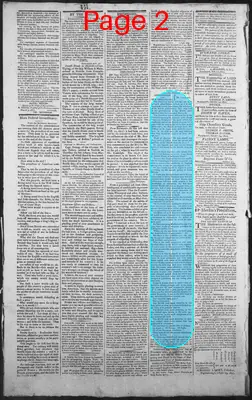
Editorial
October 27, 1807
The New Hampshire Gazette
Portsmouth, Rockingham County, New Hampshire
What is this article about?
An editorial from the Aurora warns Americans of British aggressive intentions, drawing parallels to the invasion of Denmark and seizure of its navy. It criticizes lack of U.S. military preparations and urges readiness against potential invasion, referencing historical British rivalries.
Clipping

OCR Quality
95%
Excellent
Full Text
From the AURORA of Oct. 11.
COPENHAGEN
AND
No
NEUTRALS.
THE CHESAPEAKE.
The American reader will see, not with so much astonishment indeed, as if it had happened twenty years since, the principles of the British government—fully displayed in the proclamation of the British commanders who have invaded Denmark.
The American reader will now see in the "amicably demand of the Deposit of the Danish navy in a British port," the motive which has constantly excited the British clamour for a navy—had we now 24 sail of the line, as the Danes have, we should perhaps have Mr. Erskine or Sir James Craig with his 15,000 men. in the most amicable way soliciting that they should be deposited in some British port.
People of America! Do you expect any thing more of justice from the amicable dispositions of the British than the Danes?
Do you suppose that you are less formidable or less feared by the British than the Danes?
Do you think that those who invade Zealand, would hesitate to invade Long Island, or Rhode Island. or Sullivan's Island?
You see that England has had her emissaries in Copenhagen disguised as peasants and even as women—the emissaries of England among you, do not use any disguise at all.
Do you vainly expect to repose in peace—relying on the amicable policy of Great Britain.
It seems you do—you seem not to be conscious that, if thirty thousand men well disciplined were landed on your shores, that before your best men could acquire a due knowledge of discipline, the first three months would cost you ten thousand lives, of the very best of your materials for an army—and the very best of your materials for officers: for it is the very best that would go first—to battle and to death.
How are you preparing for the inevitable state of things that must arise in less than seven months—if not before.
The drafts for your contingents of 100,000 men are not yet made out, and yet it is six months since you were called upon to make this preparation—it is not made.
The states act as if they were not interested in self-defence, because there is a general government to concentrate the power of the whole, and to unite its action for common good.
No state excepting Massachusetts and Virginia, have made an adequate provision for arming its public force.
Where are the founderies for brass guns, the manufactories of gun-powder? &c.
But there is this comfort—you can rely on the amicable disposition and justice of British ministers and generals.
Why is the most sanguinary and cold-blooded officer in the British army appointed commander in chief in Canada?—Wholly from an amicable disposition towards the United States.
But it is in vain to preach to you—until you begin to feel; like all the people of the earth, in your prosperity you raise your hands against each other at the excitement of your deadly enemies—and instead of preventing the evils that flow from such conduct, you create more afflictions, when afflictions comes upon you—and after being the prey of your own credulity—you become enraged against those by whom you have been deceived, when you ought to be enraged at yourselves for not seeing your own folly.
Congress is now about to meet—they assemble on Monday sen'night, and in the mean time you will see new manoeuvres played off, to lull you into a false security—to persuade you that Britain's amicable disposition towards Denmark, is not of the same kind as her amicable disposition toward you.
You calculate upon peace
You miscalculate.
The British look upon America in the same point of view, as Alexander looked upon Tyre, with jealousy and ire.
The British look upon America, as Venice looked upon Genoa, in the early ages of commerce, as the most dangerous of all her commercial rivals.
The British look upon America, as they have looked upon every nation that has prospered in commerce.
She has been the amicable ally of Holland. Of Flanders. Of Tuscany. Of Russia. Of all the European continent.
They have all felt the amicable dispositions of Great Britain.
We have experienced that amicable disposition also in a degree—but the cup is not yet full—and if we are taken by surprise as the Danes were, after their experience of 1801—Whose fault will it be.
COPENHAGEN
AND
No
NEUTRALS.
THE CHESAPEAKE.
The American reader will see, not with so much astonishment indeed, as if it had happened twenty years since, the principles of the British government—fully displayed in the proclamation of the British commanders who have invaded Denmark.
The American reader will now see in the "amicably demand of the Deposit of the Danish navy in a British port," the motive which has constantly excited the British clamour for a navy—had we now 24 sail of the line, as the Danes have, we should perhaps have Mr. Erskine or Sir James Craig with his 15,000 men. in the most amicable way soliciting that they should be deposited in some British port.
People of America! Do you expect any thing more of justice from the amicable dispositions of the British than the Danes?
Do you suppose that you are less formidable or less feared by the British than the Danes?
Do you think that those who invade Zealand, would hesitate to invade Long Island, or Rhode Island. or Sullivan's Island?
You see that England has had her emissaries in Copenhagen disguised as peasants and even as women—the emissaries of England among you, do not use any disguise at all.
Do you vainly expect to repose in peace—relying on the amicable policy of Great Britain.
It seems you do—you seem not to be conscious that, if thirty thousand men well disciplined were landed on your shores, that before your best men could acquire a due knowledge of discipline, the first three months would cost you ten thousand lives, of the very best of your materials for an army—and the very best of your materials for officers: for it is the very best that would go first—to battle and to death.
How are you preparing for the inevitable state of things that must arise in less than seven months—if not before.
The drafts for your contingents of 100,000 men are not yet made out, and yet it is six months since you were called upon to make this preparation—it is not made.
The states act as if they were not interested in self-defence, because there is a general government to concentrate the power of the whole, and to unite its action for common good.
No state excepting Massachusetts and Virginia, have made an adequate provision for arming its public force.
Where are the founderies for brass guns, the manufactories of gun-powder? &c.
But there is this comfort—you can rely on the amicable disposition and justice of British ministers and generals.
Why is the most sanguinary and cold-blooded officer in the British army appointed commander in chief in Canada?—Wholly from an amicable disposition towards the United States.
But it is in vain to preach to you—until you begin to feel; like all the people of the earth, in your prosperity you raise your hands against each other at the excitement of your deadly enemies—and instead of preventing the evils that flow from such conduct, you create more afflictions, when afflictions comes upon you—and after being the prey of your own credulity—you become enraged against those by whom you have been deceived, when you ought to be enraged at yourselves for not seeing your own folly.
Congress is now about to meet—they assemble on Monday sen'night, and in the mean time you will see new manoeuvres played off, to lull you into a false security—to persuade you that Britain's amicable disposition towards Denmark, is not of the same kind as her amicable disposition toward you.
You calculate upon peace
You miscalculate.
The British look upon America in the same point of view, as Alexander looked upon Tyre, with jealousy and ire.
The British look upon America, as Venice looked upon Genoa, in the early ages of commerce, as the most dangerous of all her commercial rivals.
The British look upon America, as they have looked upon every nation that has prospered in commerce.
She has been the amicable ally of Holland. Of Flanders. Of Tuscany. Of Russia. Of all the European continent.
They have all felt the amicable dispositions of Great Britain.
We have experienced that amicable disposition also in a degree—but the cup is not yet full—and if we are taken by surprise as the Danes were, after their experience of 1801—Whose fault will it be.
What sub-type of article is it?
Foreign Affairs
War Or Peace
Military Affairs
What keywords are associated?
British Aggression
Danish Invasion
Military Preparation
Copenhagen
Chesapeake
Neutral Rights
American Defense
What entities or persons were involved?
British Government
Danes
Congress
Massachusetts
Virginia
Mr. Erskine
Sir James Craig
Editorial Details
Primary Topic
British Aggression Towards America Akin To Denmark Invasion
Stance / Tone
Alarmist Warning Against British Intentions
Key Figures
British Government
Danes
Congress
Massachusetts
Virginia
Mr. Erskine
Sir James Craig
Key Arguments
British Principles Shown In Invasion Of Denmark Apply To America
Demand For Danish Navy Reveals Motive For British Clamor Against U.S. Navy
Americans Should Not Expect Justice From British Amicable Dispositions
Lack Of Preparation For Invasion Could Cost Many Lives
States Failing To Arm Forces Despite Calls For 100,000 Men
British View America As Dangerous Commercial Rival Like Historical Enemies
Urgent Need For Military Readiness Before Congress Meets