Thank you for visiting SNEWPapers!
Sign up free
Domestic News
December 5, 1820
The Portland Gazette
Portland, Cumberland County, Maine
What is this article about?
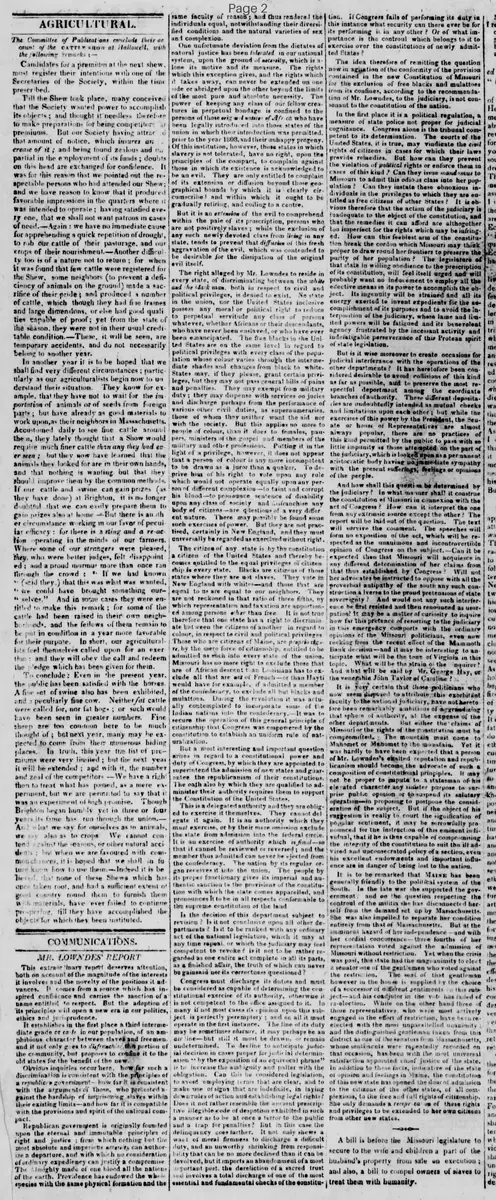
Editorial critique of Mr. Lowndes' report on Missouri's admission, arguing against excluding free blacks and mulattoes, emphasizing constitutional rights, republican principles, and Congress's duty to ensure republican constitutions in new states.
Clipping
OCR Quality
95%
Excellent
Full Text
COMMUNICATIONS.
MR. LOWNDES' REPORT
This extraordinary report deserves attention, both on account of the magnitude of the interests it involves and the novelty of the positions it advances. It comes from a source which has inspired confidence and carries the sanction of a name entitled to respect. But the adoption of its principles will open a new era in our politics, ethics and jurisprudence.
It establishes in the first place a third intermediate grade or cast in our population, of an amphibious character between slaves and freemen. and it not only goes to disfranchise this portion of the community, but proposes to confine it to the old states for the benefit of the new.
Obvious inquiries occur here, how far such a discrimination is consistent with the principles of a republic government-how far it is consistent with the arguments of those. who protested against the hardship of imprisoning slaves within their existing limits-and how far it is compatible with the provisions and spirit of the national compact.
Republican government is originally founded upon the eternal and immutable principles of right and justice ; from which nothing but the most absolute and imperious necessity can authorize a departure, and with which no consideration of ordinary expediency can justify a compromise The Almighty made of one blood all the nations of the earth. Providence has endowed the whole species with the same physical formation and the same faculty of reason; and thus rendered the individuals equal, notwithstanding their diversified conditions and the natural varieties of sex and complexion.
One unfortunate deviation from the dictates of natural justice has been tolerated in our national system, upon the ground of necessity, which is alone its motive and its measure. The rights which this exception gives, and the rights which it takes away, can never be extended on one side or abridged upon the other beyond the limits of the most pure and absolute necessity. The power of keeping any class of our fellow creatures in perpetual bondage is confined to the persons of those original natives of Africa who have been legally introduced into those states of the union in which their introduction was permitted. prior to the year 1808, and their unhappy progeny.
Of this institution, however, those states in which slavery is not tolerated, have no right, upon the principles of the compact. to complain against those in which its existence is acknowledged to be an evil. They are only entitled to complain of its extension or diffusion beyond those geographical bounds by which it is clearly circumscribed and within which it ought to be gradually retiring, and coiling to a centre.
But it is an extension of the evil to comprehend within the pale of its proscription, persons who are not positively slaves; while the exclusion of any such newly devoted class from living in any state, tends to prevent that diffusion of this fresh aggravation of the evil.which was contended to be desirable for the dissipation of the original evil itself.
The right alleged by Mr. Lowndes to reside in every state, of discriminating between the white and the black man. both in respect to civil and political privileges, is denied to exist. No state in the union, nor the United States inclusive possess any moral or political right to reduce to perpetual servitude any class of persons whatever, whether Africans or their descendants, who have never been enslaved, or who have ever been emancipated. The free blacks in the United States are on the same level in regard to political privileges with every class of the population whose colour varies through the intermediate shades and changes from black to white.
States may, if they please, grant certain privileges, but they may not pass general bills of pains and penalties. They may exempt from military duty: they may dispense with services on juries and discharge perhaps from the performance of various other civil duties, as supernumeraries, those of whom they neither want the aid nor wish the society. But this applies no more to people of colour, than it does to females, paupers. ministers of the gospel and members of the military and other professions. Putting it in the light of a privilege,however, it does not appear that a person of colour is any more incompetent to be drawn as a juror than a quaker. To deprive him of his right to vote upon any rule which would not operate equally upon any person of different complexion-to taint and corrupt his blood-to pronounce sentence of disability upon any class of society and disfranchise any body of citizens-are questions of a very different nature. There may possibly be found some such exercises of power. But they are not practised, certainly in New England, and they must universally be regarded as exercised without right.
The citizen of any state is by the constitution a citizen of the United States and thereby becomes entitled to the equal privileges of citizenship in every state. Blacks are citizens of those states where they are not slaves. They vote in New England with whites--and those that are equal to us are equal to our neighbors. They are not reckoned in that ratio of three fifths, by which representation and taxation are apportioned among persons other than free. It is not true therefore that one state has a right to discriminate between the citizens of another in regard to colour, in respect to civil and political privileges Those who are citizens of Maine, are proprio vigore, by the mere force of citizenship. entitled to be admitted as such into every state of the union.
Missouri has no more right to exclude those that are of African descent than Louisiana has to exclude all that are not of French-or than Hayti would have for example, if admitted a member of the confederacy. to exclude all but blacks and mulattoes. During the revolution it was actually contemplated to incorporate some of the Indian nations into the confederacy.-It was to secure the operation of this general principle of citizenship that Congress was empowered by the constitution to establish an uniform rule of naturalization.
But a most interesting and important question arises in regard to a constitutional power and duty of Congress, by which they are appointed to superintend the admission of new states and guarantee the republicanism of their constitutions. The oath also by which they are qualified to administer their authority requires them to support the Constitution of the United States.
This is a delegated authority and they are obliged to exercise it themselves. They cannot delegate it again. It is an authority which they must exercise, or by their mere omission exclude the state from admission into the federal circle. It is an exercise of authority which is final-so that it cannot be reviewed or reversed; and the member thus admitted can never be ejected from the confederacy. The nation by its regular organ receives it into the union. The people by its proper functionary gives its imperial and authentic sanction to the provisions of the constitution with which the state comes apparelled, and pronounces It to be in all respects conformable to the supreme constitution of the land
Is the decision of this department subject to revision ? Is it not conclusive upon all other departments ? Is it to be ranked with any ordinary act of the national legislature, which it may at any time repeal, or which the judiciary may feel competent to revoke? is it not to be rather regarded as one entire act complete in all its parts, as a finished affair, the truth of which can never be gainsaid nor its correctness questioned?
Congress must discharge its duties and must be considered as capable of determining the constitutional exercise of its authority, otherwise it is not competent to the office assigned to it. In many if not most cases its opinion upon this subject is perfectly peremptory ; and on all it must operate in the first instance. The line of its duty may be sometimes obscure, it may perhaps be an angular line-but still it must be drawn, or remain undetermined. To decline to anticipate judicial decision in cases proper for judicial determination by the exposition of an equivocal phrase is to increase the ambiguity and palter with the obligation. Can this be considered legislation, to avoid employing terms that are clear, and to make use of signs that are indefinite, in laying down rules of action and establishing legal rights? Does it not rather resemble the ancient prescriptive illegible code of despotism exhibited in such a manner as to be at once a terror to the public and a trap for penalties? But in this case the delinquency goes further. It not only shews a want of moral firmness to discharge a difficult duty, and an unworthy shrinking from responsibility that can be no more declined than it can be devolved, but it imports an abandonment of a most important post. the dereliction of a sacred trust and involves a total discharge of one of the most essential and fundamental checks of the constitution. if Congress fails of performing its duty in this instance what security can there ever be for its performing it in any other ? Or of what importance is the controul which belongs to it to exercise over the constitutions of newly admitted States ?
The idea therefore of remitting the question now in agitation of the conformity of the provision contained in the new Constitution of Missouri for the exclusion of free blacks and mulattoes from its confines, according to the recommendation of Mr. Lowndes, to the judiciary, is not consonant to the constitution of the nation.
In the first place it is a political regulation, a measure of state police not proper for judicial cognizance. Congress alone is the tribunal competent to its determination. The courts of the United States, it is true, may vindicate the civil rights of citizens in cases for which their laws provide remedies. But how can they prevent the violation of political rights or enforce them in cases of this kind ? Can they issue mandamus to Missouri to admit this odious class into her population? Can they instate these obnoxious individuals in the privileges to which they are entitled as free citizens of other States? It is obvious therefore that the action of the judiciary is inadequate to the object of the constitution, and that the remedies it can afford are altogether too imperfect for the rights which may be infringed. How can this feeblest arm of the constitution break the cordon which Missouri may think proper to draw round her frontiers to preserve the purity of her population? The legislature of that state in willing obedience to the prescription of its constitution, will feel itself urged and will probably want no inducement to employ all the effective means in its power to accomplish the object. Its ingenuity will be strained and all its energy exerted to invent expedients for the accomplishment of its purposes and to avoid the interposition of the judiciary, whose lame and limited powers will be fatigued and its benevolent agency frustrated by the incessant activity and indefatigable perseverance of this Protean spirit of state legislation.
But is it wise moreover to create occasions for judicial interference with the operations of the other departments? It has heretofore been considered desirable to avoid collisions of this kind as far as possible, and to preserve the most respectful deportment among the coordinate branches of authority. These different depositories are undoubtedly intended as mutual checks and limitations upon each other; but while the exercises of this power by the President, the Senate or house of Representatives are almost always popular, there are no practices of this kind permitted by the public to pass with so little impunity as those attempted on the part of the judiciary, which is looked upon as a permanent aristocratic body having no immediate sympathy with the present sufferings, feelings or opinions of the people.
And how shall this question be determined by the judiciary? In what manner shall it construe the constitution of Missouri in connection with the act of Congress? How can it interpret the one from any extrinsic source except the other? The report will be laid out of the question. The text will survive the comment. The speeches will form no exposition of the act, which will be respected as the unanimous and incontrovertible opinion of Congress on the subject.-Can it be expected then that Missouri will acquiesce in any different determination of her claims from that thus established by Congress? Will not her advocates be instructed to oppose with all the proverbial antipathy of the south any such construction adverse to the proud pretensions of state sovereignty ? And would not any such interference be first resisted and then renounced as usurpation? it may be a matter of curiosity to inquire how far this pretence of resorting to the judiciary in this emergency comports with the ordinary opinions of the Missouri politicians, even now reeking from the recent effect of the Mammoth Bank decision--and it may be interesting to anticipate what will be the tone of Virginia in this topic. What will be the strain of the inquirer? And what will be said by Mr. George Hay, or the venerable John Taylor of Caroline ?
It is very certain that those politicians who now seem disposed to attribute this exorbitant faculty to the national judiciary, have not heretofore been remarkably ambitious of aggrandizing that sphere of authority, at the expense of the other departments.
But either the claims of Missouri or the rights of the constitution must be compromised. : The mountain must come to Mahomet or Mahomet to the mountain. Yet it was hardly to be expected that a person of Mr. Lowndes's exalted reputation and republicanism should become the advocate of such a composition of constitutional principles. It may not be proper to impute to a statesman of his elevated character any sinister purpose to surprise public opinion or to suspend its salutary operation-in proposing to postpone the consideration of the subject, But if the object of his suggestion is really to court the signification of popular sentiment, it may be sorrowfully pronounced for the instruction of this eminent individual, that if he is thus capable of compromising the integrity of the constitution to suit the ill advised and unconsecrated policy of a section, even his excellent endowments and important influence are in danger of being lost to the nation.
It is to be remarked that Maine has been generally friendly to the political system of the South. In the late war she supported the government; and on the question respecting the control of the militia she has disconnected herself from the demand set up by Massachusetts. She was also impelled to separate her condition entirely from that of Massachusetts. But at the imminent hazard of her independence -and with her cordial concurrence-three fourths of her representation voted against the admission of Missouri without restriction. Yet when the crisis was past, this state had the magnanimity to elect a senator one of the gentlemen who voted against the restriction. The seat of that gentleman however in the house is supplied by the choice of a successor of different sentiments on thus subject-and his coadjutor in the vote has failed of re-election. While on the other hand three of those representatives. who were most actively engaged in the effort of restriction, have been re-elected with the most unparalleled unanimity : and the distinguished gentleman taken from this district as one of the senators from Massachusetts, whose sentiments were repeatedly recorded on that occasion, has been with the most universal satisfaction appointed chief justice of the state.
In addition to these facts, indicative of the state of opinion and feelings in Maine, the constitution of this new state has opened the door of admission to the citizens of the other states, of all complexions, to the free and full rights of citizenship. She only demands a reciprocal on of these rights and privileges to be extended to her own citizens from other new states.
A bill is before the Missouri legislature to secure to the wife and children a part of the husband's property from sale on execution and also, a bill to compel owners of slaves to treat them with humanity
MR. LOWNDES' REPORT
This extraordinary report deserves attention, both on account of the magnitude of the interests it involves and the novelty of the positions it advances. It comes from a source which has inspired confidence and carries the sanction of a name entitled to respect. But the adoption of its principles will open a new era in our politics, ethics and jurisprudence.
It establishes in the first place a third intermediate grade or cast in our population, of an amphibious character between slaves and freemen. and it not only goes to disfranchise this portion of the community, but proposes to confine it to the old states for the benefit of the new.
Obvious inquiries occur here, how far such a discrimination is consistent with the principles of a republic government-how far it is consistent with the arguments of those. who protested against the hardship of imprisoning slaves within their existing limits-and how far it is compatible with the provisions and spirit of the national compact.
Republican government is originally founded upon the eternal and immutable principles of right and justice ; from which nothing but the most absolute and imperious necessity can authorize a departure, and with which no consideration of ordinary expediency can justify a compromise The Almighty made of one blood all the nations of the earth. Providence has endowed the whole species with the same physical formation and the same faculty of reason; and thus rendered the individuals equal, notwithstanding their diversified conditions and the natural varieties of sex and complexion.
One unfortunate deviation from the dictates of natural justice has been tolerated in our national system, upon the ground of necessity, which is alone its motive and its measure. The rights which this exception gives, and the rights which it takes away, can never be extended on one side or abridged upon the other beyond the limits of the most pure and absolute necessity. The power of keeping any class of our fellow creatures in perpetual bondage is confined to the persons of those original natives of Africa who have been legally introduced into those states of the union in which their introduction was permitted. prior to the year 1808, and their unhappy progeny.
Of this institution, however, those states in which slavery is not tolerated, have no right, upon the principles of the compact. to complain against those in which its existence is acknowledged to be an evil. They are only entitled to complain of its extension or diffusion beyond those geographical bounds by which it is clearly circumscribed and within which it ought to be gradually retiring, and coiling to a centre.
But it is an extension of the evil to comprehend within the pale of its proscription, persons who are not positively slaves; while the exclusion of any such newly devoted class from living in any state, tends to prevent that diffusion of this fresh aggravation of the evil.which was contended to be desirable for the dissipation of the original evil itself.
The right alleged by Mr. Lowndes to reside in every state, of discriminating between the white and the black man. both in respect to civil and political privileges, is denied to exist. No state in the union, nor the United States inclusive possess any moral or political right to reduce to perpetual servitude any class of persons whatever, whether Africans or their descendants, who have never been enslaved, or who have ever been emancipated. The free blacks in the United States are on the same level in regard to political privileges with every class of the population whose colour varies through the intermediate shades and changes from black to white.
States may, if they please, grant certain privileges, but they may not pass general bills of pains and penalties. They may exempt from military duty: they may dispense with services on juries and discharge perhaps from the performance of various other civil duties, as supernumeraries, those of whom they neither want the aid nor wish the society. But this applies no more to people of colour, than it does to females, paupers. ministers of the gospel and members of the military and other professions. Putting it in the light of a privilege,however, it does not appear that a person of colour is any more incompetent to be drawn as a juror than a quaker. To deprive him of his right to vote upon any rule which would not operate equally upon any person of different complexion-to taint and corrupt his blood-to pronounce sentence of disability upon any class of society and disfranchise any body of citizens-are questions of a very different nature. There may possibly be found some such exercises of power. But they are not practised, certainly in New England, and they must universally be regarded as exercised without right.
The citizen of any state is by the constitution a citizen of the United States and thereby becomes entitled to the equal privileges of citizenship in every state. Blacks are citizens of those states where they are not slaves. They vote in New England with whites--and those that are equal to us are equal to our neighbors. They are not reckoned in that ratio of three fifths, by which representation and taxation are apportioned among persons other than free. It is not true therefore that one state has a right to discriminate between the citizens of another in regard to colour, in respect to civil and political privileges Those who are citizens of Maine, are proprio vigore, by the mere force of citizenship. entitled to be admitted as such into every state of the union.
Missouri has no more right to exclude those that are of African descent than Louisiana has to exclude all that are not of French-or than Hayti would have for example, if admitted a member of the confederacy. to exclude all but blacks and mulattoes. During the revolution it was actually contemplated to incorporate some of the Indian nations into the confederacy.-It was to secure the operation of this general principle of citizenship that Congress was empowered by the constitution to establish an uniform rule of naturalization.
But a most interesting and important question arises in regard to a constitutional power and duty of Congress, by which they are appointed to superintend the admission of new states and guarantee the republicanism of their constitutions. The oath also by which they are qualified to administer their authority requires them to support the Constitution of the United States.
This is a delegated authority and they are obliged to exercise it themselves. They cannot delegate it again. It is an authority which they must exercise, or by their mere omission exclude the state from admission into the federal circle. It is an exercise of authority which is final-so that it cannot be reviewed or reversed; and the member thus admitted can never be ejected from the confederacy. The nation by its regular organ receives it into the union. The people by its proper functionary gives its imperial and authentic sanction to the provisions of the constitution with which the state comes apparelled, and pronounces It to be in all respects conformable to the supreme constitution of the land
Is the decision of this department subject to revision ? Is it not conclusive upon all other departments ? Is it to be ranked with any ordinary act of the national legislature, which it may at any time repeal, or which the judiciary may feel competent to revoke? is it not to be rather regarded as one entire act complete in all its parts, as a finished affair, the truth of which can never be gainsaid nor its correctness questioned?
Congress must discharge its duties and must be considered as capable of determining the constitutional exercise of its authority, otherwise it is not competent to the office assigned to it. In many if not most cases its opinion upon this subject is perfectly peremptory ; and on all it must operate in the first instance. The line of its duty may be sometimes obscure, it may perhaps be an angular line-but still it must be drawn, or remain undetermined. To decline to anticipate judicial decision in cases proper for judicial determination by the exposition of an equivocal phrase is to increase the ambiguity and palter with the obligation. Can this be considered legislation, to avoid employing terms that are clear, and to make use of signs that are indefinite, in laying down rules of action and establishing legal rights? Does it not rather resemble the ancient prescriptive illegible code of despotism exhibited in such a manner as to be at once a terror to the public and a trap for penalties? But in this case the delinquency goes further. It not only shews a want of moral firmness to discharge a difficult duty, and an unworthy shrinking from responsibility that can be no more declined than it can be devolved, but it imports an abandonment of a most important post. the dereliction of a sacred trust and involves a total discharge of one of the most essential and fundamental checks of the constitution. if Congress fails of performing its duty in this instance what security can there ever be for its performing it in any other ? Or of what importance is the controul which belongs to it to exercise over the constitutions of newly admitted States ?
The idea therefore of remitting the question now in agitation of the conformity of the provision contained in the new Constitution of Missouri for the exclusion of free blacks and mulattoes from its confines, according to the recommendation of Mr. Lowndes, to the judiciary, is not consonant to the constitution of the nation.
In the first place it is a political regulation, a measure of state police not proper for judicial cognizance. Congress alone is the tribunal competent to its determination. The courts of the United States, it is true, may vindicate the civil rights of citizens in cases for which their laws provide remedies. But how can they prevent the violation of political rights or enforce them in cases of this kind ? Can they issue mandamus to Missouri to admit this odious class into her population? Can they instate these obnoxious individuals in the privileges to which they are entitled as free citizens of other States? It is obvious therefore that the action of the judiciary is inadequate to the object of the constitution, and that the remedies it can afford are altogether too imperfect for the rights which may be infringed. How can this feeblest arm of the constitution break the cordon which Missouri may think proper to draw round her frontiers to preserve the purity of her population? The legislature of that state in willing obedience to the prescription of its constitution, will feel itself urged and will probably want no inducement to employ all the effective means in its power to accomplish the object. Its ingenuity will be strained and all its energy exerted to invent expedients for the accomplishment of its purposes and to avoid the interposition of the judiciary, whose lame and limited powers will be fatigued and its benevolent agency frustrated by the incessant activity and indefatigable perseverance of this Protean spirit of state legislation.
But is it wise moreover to create occasions for judicial interference with the operations of the other departments? It has heretofore been considered desirable to avoid collisions of this kind as far as possible, and to preserve the most respectful deportment among the coordinate branches of authority. These different depositories are undoubtedly intended as mutual checks and limitations upon each other; but while the exercises of this power by the President, the Senate or house of Representatives are almost always popular, there are no practices of this kind permitted by the public to pass with so little impunity as those attempted on the part of the judiciary, which is looked upon as a permanent aristocratic body having no immediate sympathy with the present sufferings, feelings or opinions of the people.
And how shall this question be determined by the judiciary? In what manner shall it construe the constitution of Missouri in connection with the act of Congress? How can it interpret the one from any extrinsic source except the other? The report will be laid out of the question. The text will survive the comment. The speeches will form no exposition of the act, which will be respected as the unanimous and incontrovertible opinion of Congress on the subject.-Can it be expected then that Missouri will acquiesce in any different determination of her claims from that thus established by Congress? Will not her advocates be instructed to oppose with all the proverbial antipathy of the south any such construction adverse to the proud pretensions of state sovereignty ? And would not any such interference be first resisted and then renounced as usurpation? it may be a matter of curiosity to inquire how far this pretence of resorting to the judiciary in this emergency comports with the ordinary opinions of the Missouri politicians, even now reeking from the recent effect of the Mammoth Bank decision--and it may be interesting to anticipate what will be the tone of Virginia in this topic. What will be the strain of the inquirer? And what will be said by Mr. George Hay, or the venerable John Taylor of Caroline ?
It is very certain that those politicians who now seem disposed to attribute this exorbitant faculty to the national judiciary, have not heretofore been remarkably ambitious of aggrandizing that sphere of authority, at the expense of the other departments.
But either the claims of Missouri or the rights of the constitution must be compromised. : The mountain must come to Mahomet or Mahomet to the mountain. Yet it was hardly to be expected that a person of Mr. Lowndes's exalted reputation and republicanism should become the advocate of such a composition of constitutional principles. It may not be proper to impute to a statesman of his elevated character any sinister purpose to surprise public opinion or to suspend its salutary operation-in proposing to postpone the consideration of the subject, But if the object of his suggestion is really to court the signification of popular sentiment, it may be sorrowfully pronounced for the instruction of this eminent individual, that if he is thus capable of compromising the integrity of the constitution to suit the ill advised and unconsecrated policy of a section, even his excellent endowments and important influence are in danger of being lost to the nation.
It is to be remarked that Maine has been generally friendly to the political system of the South. In the late war she supported the government; and on the question respecting the control of the militia she has disconnected herself from the demand set up by Massachusetts. She was also impelled to separate her condition entirely from that of Massachusetts. But at the imminent hazard of her independence -and with her cordial concurrence-three fourths of her representation voted against the admission of Missouri without restriction. Yet when the crisis was past, this state had the magnanimity to elect a senator one of the gentlemen who voted against the restriction. The seat of that gentleman however in the house is supplied by the choice of a successor of different sentiments on thus subject-and his coadjutor in the vote has failed of re-election. While on the other hand three of those representatives. who were most actively engaged in the effort of restriction, have been re-elected with the most unparalleled unanimity : and the distinguished gentleman taken from this district as one of the senators from Massachusetts, whose sentiments were repeatedly recorded on that occasion, has been with the most universal satisfaction appointed chief justice of the state.
In addition to these facts, indicative of the state of opinion and feelings in Maine, the constitution of this new state has opened the door of admission to the citizens of the other states, of all complexions, to the free and full rights of citizenship. She only demands a reciprocal on of these rights and privileges to be extended to her own citizens from other new states.
A bill is before the Missouri legislature to secure to the wife and children a part of the husband's property from sale on execution and also, a bill to compel owners of slaves to treat them with humanity
What sub-type of article is it?
Politics
Slave Related
Legal Or Court
What keywords are associated?
Missouri Admission
Free Blacks Exclusion
Constitutional Rights
Slavery Extension
Congress Duty
What entities or persons were involved?
Mr. Lowndes
John Taylor Of Caroline
George Hay
Where did it happen?
Missouri
Domestic News Details
Primary Location
Missouri
Key Persons
Mr. Lowndes
John Taylor Of Caroline
George Hay
Event Details
Critique of Mr. Lowndes' report proposing exclusion of free blacks and mulattoes from Missouri, arguing it violates constitutional principles of citizenship and republican government; discusses Congress's duty to review new state constitutions and rejects deferring to judiciary.