Thank you for visiting SNEWPapers!
Sign up free
Letter to Editor
May 12, 1794
Gazette Of The United States & Evening Advertiser
Philadelphia, Philadelphia County, Pennsylvania
What is this article about?
Abstract of a letter by 'Homo' proposing that state legislatures ban wooden buildings in cities with 10,000+ inhabitants to prevent fires, requiring demolition of existing structures with public compensation and mandating future brick or stone construction covered in slate or tile.
Clipping
OCR Quality
98%
Excellent
Full Text
For the GAZETTE of the United STATES.
ABSTRACT.
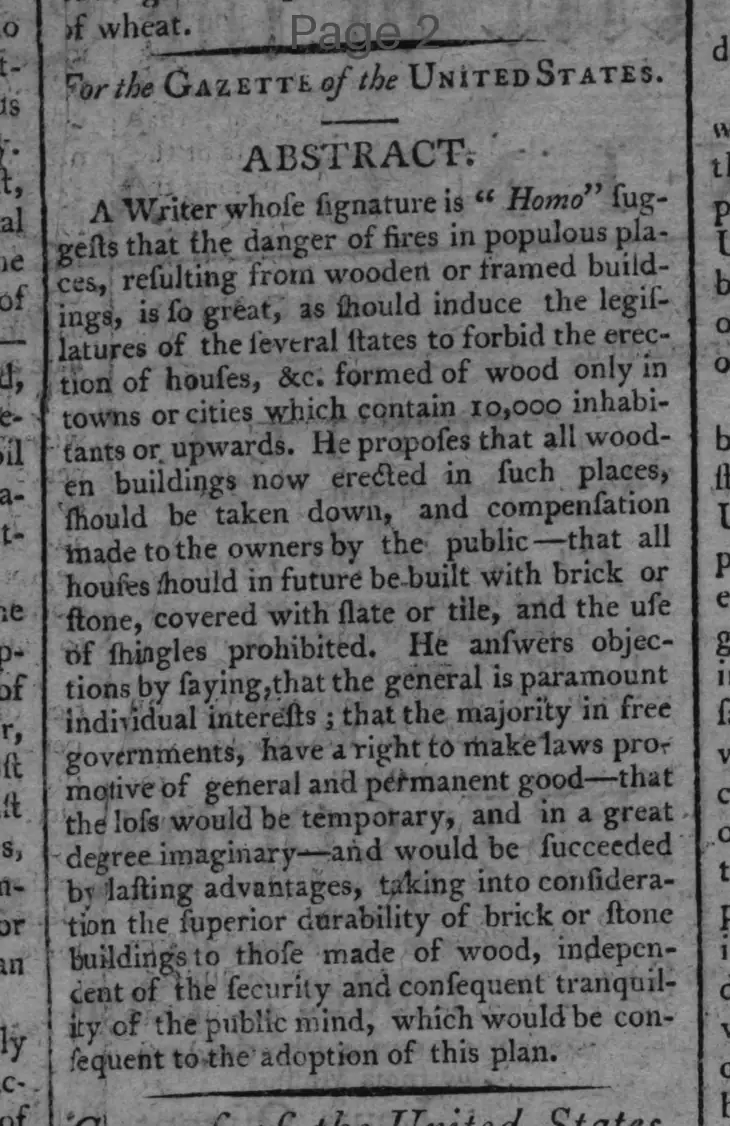
A Writer whose signature is "Homo" suggests that the danger of fires in populous places, resulting from wooden or framed buildings, is so great, as should induce the legislatures of the several states to forbid the erection of houses, &c. formed of wood only in towns or cities which contain 10,000 inhabitants or upwards. He proposes that all wooden buildings now erected in such places, should be taken down, and compensation made to the owners by the public-that all houses should in future be built with brick or stone, covered with slate or tile, and the use of shingles prohibited. He answers objections by saying, that the general is paramount to individual interests; that the majority in free governments, have a right to make laws promotive of general and permanent good-that the loss would be temporary, and in a great degree imaginary--and would be succeeded by lasting advantages, taking into consideration the superior durability of brick or stone buildings to those made of wood, independent of the security and consequent tranquility of the public mind, which would be consequent to the adoption of this plan.
ABSTRACT.
A Writer whose signature is "Homo" suggests that the danger of fires in populous places, resulting from wooden or framed buildings, is so great, as should induce the legislatures of the several states to forbid the erection of houses, &c. formed of wood only in towns or cities which contain 10,000 inhabitants or upwards. He proposes that all wooden buildings now erected in such places, should be taken down, and compensation made to the owners by the public-that all houses should in future be built with brick or stone, covered with slate or tile, and the use of shingles prohibited. He answers objections by saying, that the general is paramount to individual interests; that the majority in free governments, have a right to make laws promotive of general and permanent good-that the loss would be temporary, and in a great degree imaginary--and would be succeeded by lasting advantages, taking into consideration the superior durability of brick or stone buildings to those made of wood, independent of the security and consequent tranquility of the public mind, which would be consequent to the adoption of this plan.
What sub-type of article is it?
Persuasive
Informative
What themes does it cover?
Infrastructure
Social Issues
What keywords are associated?
Fire Prevention
Wooden Buildings
Urban Legislation
Brick Stone Construction
Public Compensation
State Legislatures
What entities or persons were involved?
Homo
Gazette Of The United States
Letter to Editor Details
Author
Homo
Recipient
Gazette Of The United States
Main Argument
state legislatures should forbid wooden buildings in cities of 10,000+ inhabitants to mitigate fire dangers, demolish existing ones with public compensation, and require future brick or stone construction to promote general safety and durability over individual interests.
Notable Details
General Interest Paramount To Individual
Majority Right To Laws For Permanent Good
Temporary Loss Succeeded By Lasting Advantages Including Durability And Public Tranquility