Thank you for visiting SNEWPapers!
Sign up free
Gazette Of The United States And Daily Evening Advertiser
Philadelphia, Philadelphia County, Pennsylvania
What is this article about?
On February 14, the U.S. House of Representatives passed a bill continuing the military establishment. They referred a public credit bill to committee and debated a debt recovery bill, with members like Boudinot and Wadsworth criticizing its clauses as tyrannical due to past Treasury mismanagement and hardships faced by debtors.
Clipping
OCR Quality
Full Text
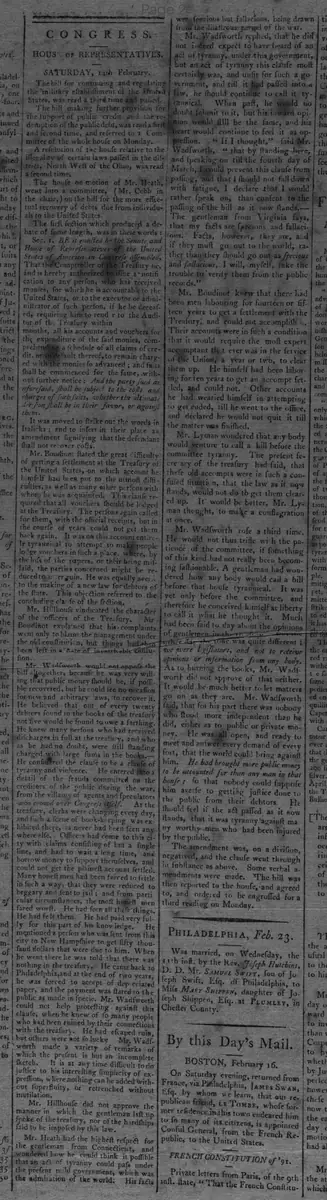
HOUSE OF REPRESENTATIVES.
SATURDAY, 14th February,
The bill for continuing and regulating the military establishment of the United States, was read a third time and passed.
The bill making further provision for the support of public credit and the redemption of the public debt, was read a first and second time, and referred to a Committee of the whole house on Monday.
A resolution of the house relative to the illegality of certain laws passed in the district, North West of the Ohio, was read a second time.
The house on motion of Mr. Heath, went into a committee, (Mr. Cobb in the chair) on the bill for the more effectual recovery of debts due from individuals to the United States.
The first section which produced a debate of some length, was in these words:
Sec. I. Be it enacted by the Senate and House of Representatives of the United States of America in Congress assembled, That the Comptroller of the Treasury be, and is hereby authorized to issue a notification to any person, who has received monies, or which he is accountable to the United States, or to the executor or administrator of such person, if he be deceased, requiring him to render to the Auditor of the Treasury within three months, all his accounts and vouchers for the expenditure of the said monies, comprehending a schedule of all claims of credit, or in default thereof, to remain charged with the monies so advanced; and suits shall be commenced for the same, without further notice: And the party sued as aforesaid, shall be subject to the costs and charges of such suits, whether the ultimate decision shall be in their favor, or against them.
It was moved to strike out the words in Italics; and to insert in their place an amendment signifying that the defendant shall not recover costs.
Mr. Boudinot stated the great difficulty of getting a settlement at the Treasury of the United States, on which account he himself had been put to the utmost difficulties, as well as many other persons with whom he was acquainted. This clause required that all vouchers should be lodged at the Treasury. The persons again called for them, with the official receipts, but in the course of years could not get them back again. It was on this account entirely tyrannical to attempt to make people lodge vouchers in such a place, where, by the loss of the papers, or their being mislaid, the parties concerned might be reduced to utter ruin. He was equally averse to the making of a new law for debtors of the state. This objection referred to the concluding clause of the section.
Mr. Hillhouse vindicated the character of the officers of the Treasury.
Mr. Boudinot explained that his complaints went only to blame the management under the old constitution, but things had been left in a state of inextricable confusion.
Mr. Wadsworth would not oppose the bill altogether, because he was very willing that public money should be, if possible recovered, but he could see no occasion for new and arbitrary laws, to recover it. He believed that out of every twenty debtors found in the books of the treasury not five would be found to owe a farthing. He knew many persons who had received discharges in full at the treasury, and who as he had no doubt, were still standing charged with large sums in the books. He considered the clause to be a clause of tyranny and violence. He entered into a detail of the frauds committed on the creditors of the public during the war, from the villainy of agents and speculators who crowded over Congress itself. At the treasury, clerks were changing every day, and such a scene of book-keeping was exhibited there, as never had been seen anywhere else. Officers had come to this city with claims consisting of but a single line, and had to wait a long time, and borrow money to support themselves, and could not get the plainest account settled. Many honest men had been forced to settle in such a way, that they were reduced to beggary and sent to jail; and from particular circumstances, the most honest men fared worst. He had seen all these things. He had felt them. He had paid very fully for this part of his knowledge. He mentioned a person who was sent from this city to New Hampshire to get fifty thousand dollars that were due to him. When he went there he was told that there was nothing in the treasury. He came back to Philadelphia, and at the end of two years, he was forced to accept of depreciated paper, and the payment was stated to the public as made in specie. Mr. Wadsworth could not help protesting against this clause, when he knew of so many people who had been ruined by their connections with the treasury. He had escaped ruin, but others were not so lucky. Mr. Wadsworth made a variety of remarks of which the present is but an incomplete sketch. It is at any time difficult to do justice to his interesting simplicity of expression, where nothing can be added without superfluity, or retrenched without mutilation.
Mr. Hillhouse did not approve the manner in which the gentleman last spoke of the treasury, nor of the hardships said to be imposed by this law.
Mr. Heath had the highest respect for the gentleman from Connecticut, and wondered how he could think it possible that an act of tyranny could pass under the present mild government, which was the admiration of the world: His facts were specious but fallacious, being drawn from the disastrous period of the war.
Mr. Wadsworth replied, that he did not indeed expect to have heard of an act of tyranny, under this government, but an act of tyranny this clause most certainly was, and unfit for such a government, and till it had passed into a law, he should continue to call it tyrannical. When past, he would no doubt submit to it, but his inward opinion would still be the same, and his heart would continue to feel it as oppression. "If I thought," said Mr. Wadsworth, "that by standing here, and speaking on till the fourth day of March, I could prevent this clause from passing, and that I should not fall down with fatigue, I declare that I would rather speak on, than consent to the passing of the bill as it now stands. The gentleman from Virginia says, that my facts are specious and fallacious. Facts, however, they are, and if they must go out to the world, rather than they should go out as specious and fallacious, I will, myself, take the trouble to verify them from the public records."
Mr. Boudinot knew that there had been men labouring for fourteen or sixteen years to get a settlement with the Treasury, and could not accomplish it. Their accounts were in such a condition that it would require the most expert accountant that ever was in the service of the Union, a year or two, to clear them up. He himself had been laboring for ten years to get an account settled, and could not. Other accounts he had wearied himself in attempting to get ended, till he went to the office, and declared he would not quit it till the matter was finished.
Mr. Lyman wondered that any body would venture to call a bill before the committee tyranny. The present secretary of the treasury had said, that these old accounts were in such a confused situation, that the law as it now stands, would not do to get them cleared up. It would be better, Mr. Lyman thought, to make a conflagration at once.
Mr. Wadsworth rose a third time. He would not thus trifle with the patience of the committee, if something of this kind had not really been becoming fashionable. A gentleman had wondered how any body would call a bill before that house tyrannical. It was yet only before the committee, and therefore he conceived himself at liberty to call it what he thought it. Much had been said to day about the opinions of gentlemen in the nation; but their day the tone was quite different: they were legislators, and not to receive opinions or information from any body. As to burning the books, Mr. Wadsworth did not approve of that neither. It would be much better to let matters go on as they are. Mr. Wadsworth said, that for his part there was nobody who stood more independent than he did, either as to public or private money. He was all open, and ready to meet and answer every demand of every sort, that the world could bring against him. He had brought more public money to be accounted for than any man in that house; so that nobody could suppose him averse to getting justice done to the public from their debtors. He should feel if the act passed as it now stands, that it was tyranny against many worthy men who had been injured by the public.
The amendment was, on a division, negatived, and the clause went through in substance as above. Some verbal amendments were made. The bill was then reported to the house, and agreed to, and ordered to be engrossed for a third reading on Monday.
What sub-type of article is it?
What themes does it cover?
What keywords are associated?
What entities or persons were involved?
Where did it happen?
Story Details
Key Persons
Location
House Of Representatives, United States
Event Date
Saturday, 14th February
Story Details
The House passed a military establishment bill and referred a public credit bill to committee. In committee, they debated a debt recovery bill's first section, which authorized the Comptroller to demand accounts and vouchers, with suits and costs if defaulted. An amendment to prevent cost recovery by defendants was proposed but negatived after debate on Treasury mismanagement, past hardships, and tyranny concerns raised by Boudinot and Wadsworth.