Thank you for visiting SNEWPapers!
Sign up free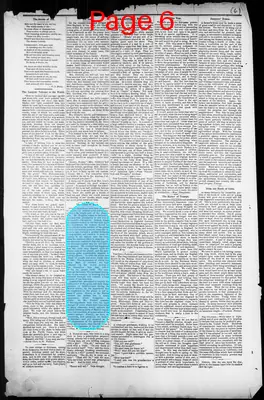
Story
November 18, 1877
The Daily Astorian
Astoria, Clatsop County, Oregon
What is this article about?
Article discusses hypotheses for Mars' reddish color: not due to atmosphere (Huggins, Arago), possibly clouds (Lockyer, supported by 1862-1864 observations), red vegetation (Lambert), or soil character (Herschel). By Chas. W. Raymond in the Galaxy.
Clipping
OCR Quality
98%
Excellent
Full Text
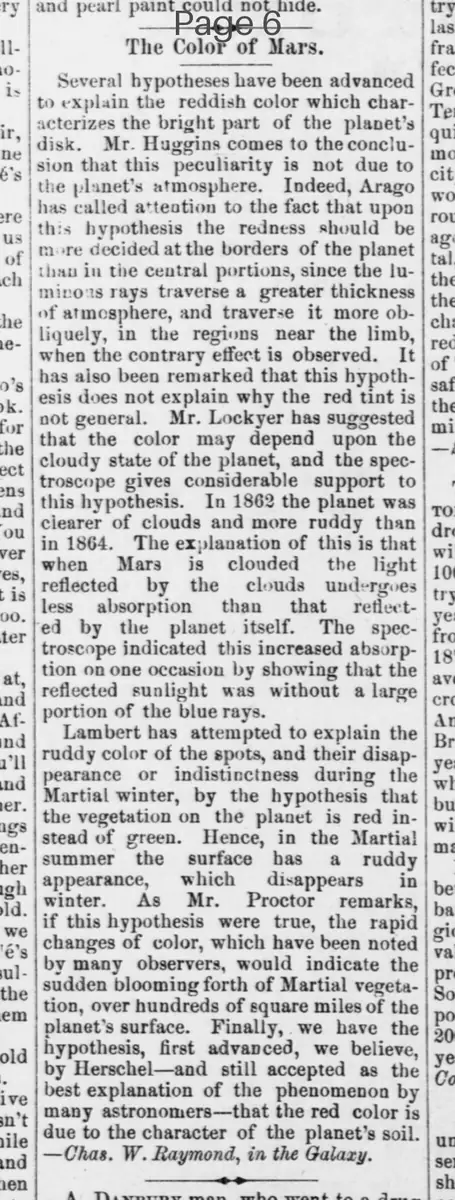
The Color of Mars.
Several hypotheses have been advanced to explain the reddish color which characterizes the bright part of the planet's disk. Mr. Huggins comes to the conclusion that this peculiarity is not due to the planet's atmosphere. Indeed, Arago has called attention to the fact that upon this hypothesis the redness should be more decided at the borders of the planet than in the central portions, since the luminous rays traverse a greater thickness of atmosphere, and traverse it more obliquely, in the regions near the limb, when the contrary effect is observed. It has also been remarked that this hypothesis does not explain why the red tint is not general. Mr. Lockyer has suggested that the color may depend upon the cloudy state of the planet, and the spectroscope gives considerable support to this hypothesis. In 1862 the planet was clearer of clouds and more ruddy than in 1864. The explanation of this is that when Mars is clouded the light reflected by the clouds undergoes less absorption than that reflected by the planet itself. The spectroscope indicated this increased absorption on one occasion by showing that the reflected sunlight was without a large portion of the blue rays.
Lambert has attempted to explain the ruddy color of the spots, and their disappearance or indistinctness during the Martial winter, by the hypothesis that the vegetation on the planet is red instead of green. Hence, in the Martial summer the surface has a ruddy appearance, which disappears in winter. As Mr. Proctor remarks, if this hypothesis were true, the rapid changes of color, which have been noted by many observers, would indicate the sudden blooming forth of Martial vegetation, over hundreds of square miles of the planet's surface. Finally, we have the hypothesis, first advanced, we believe, by Herschel—and still accepted as the best explanation of the phenomenon by many astronomers—that the red color is due to the character of the planet's soil.
—Chas. W. Raymond, in the Galaxy.
Several hypotheses have been advanced to explain the reddish color which characterizes the bright part of the planet's disk. Mr. Huggins comes to the conclusion that this peculiarity is not due to the planet's atmosphere. Indeed, Arago has called attention to the fact that upon this hypothesis the redness should be more decided at the borders of the planet than in the central portions, since the luminous rays traverse a greater thickness of atmosphere, and traverse it more obliquely, in the regions near the limb, when the contrary effect is observed. It has also been remarked that this hypothesis does not explain why the red tint is not general. Mr. Lockyer has suggested that the color may depend upon the cloudy state of the planet, and the spectroscope gives considerable support to this hypothesis. In 1862 the planet was clearer of clouds and more ruddy than in 1864. The explanation of this is that when Mars is clouded the light reflected by the clouds undergoes less absorption than that reflected by the planet itself. The spectroscope indicated this increased absorption on one occasion by showing that the reflected sunlight was without a large portion of the blue rays.
Lambert has attempted to explain the ruddy color of the spots, and their disappearance or indistinctness during the Martial winter, by the hypothesis that the vegetation on the planet is red instead of green. Hence, in the Martial summer the surface has a ruddy appearance, which disappears in winter. As Mr. Proctor remarks, if this hypothesis were true, the rapid changes of color, which have been noted by many observers, would indicate the sudden blooming forth of Martial vegetation, over hundreds of square miles of the planet's surface. Finally, we have the hypothesis, first advanced, we believe, by Herschel—and still accepted as the best explanation of the phenomenon by many astronomers—that the red color is due to the character of the planet's soil.
—Chas. W. Raymond, in the Galaxy.
What sub-type of article is it?
Curiosity
What themes does it cover?
Nature
Exploration
What keywords are associated?
Mars Color
Astronomical Hypotheses
Planetary Atmosphere
Cloud Reflection
Red Vegetation
Soil Composition
What entities or persons were involved?
Mr. Huggins
Arago
Mr. Lockyer
Lambert
Mr. Proctor
Herschel
Chas. W. Raymond
Where did it happen?
Mars
Story Details
Key Persons
Mr. Huggins
Arago
Mr. Lockyer
Lambert
Mr. Proctor
Herschel
Chas. W. Raymond
Location
Mars
Event Date
1862 And 1864
Story Details
Hypotheses explain Mars' reddish color: not atmosphere per Huggins and Arago; clouds per Lockyer with spectroscope evidence from 1862-1864; red vegetation per Lambert causing seasonal changes; soil character per Herschel as leading explanation.